Households face another substantial increase in energy costs as winter reaches its coldest months. The latest forecast puts January’s annualised price-cap benchmark at approximately £2,166, up from £1,723 now: an increase of about £443, or 26%.
For people already worried over rising energy prices, the concern is immediate. How much more will it cost to keep the living room comfortable? Will a direct debit cover the winter’s consumption? How far will the promised £100 Household Energy Payment go?
Throughout 2026, we have explored these questions from several angles: preparing before winter, understanding changing fuel prices, avoiding wasteful heating habits and choosing equipment that suits the home. January’s outlook brings those issues together.
The priority is to understand likely changes, protect essential warmth, and make careful decisions about the energy we use. A higher price cap makes efficiency more valuable, but it also makes practical advice more important.
What is expected to change in January 2027?
The current cap covers 1 October to 31 December 2026. January’s replacement will cover the following three months. For a typical dual-fuel household paying by Direct Debit, the confirmed autumn figures and January forecast compare as follows:
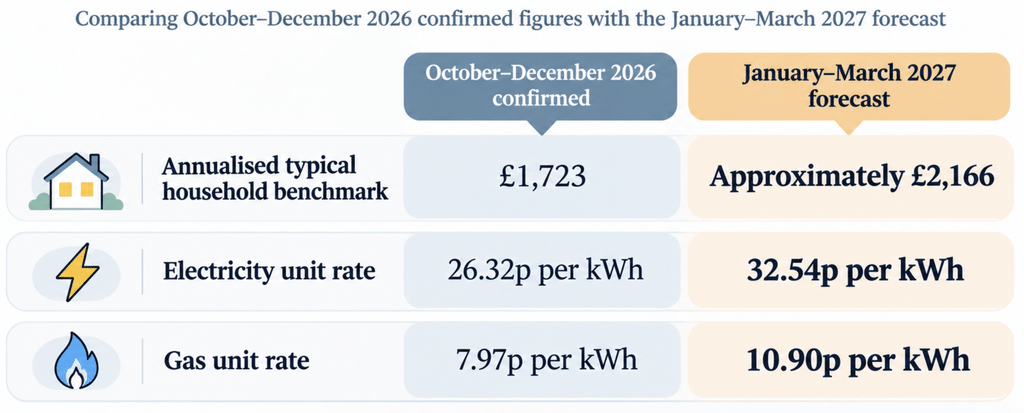
These are England, Scotland and Wales averages for Direct Debit customers. Actual rates depend on region, payment method and meter arrangements. The annual benchmark includes standing charges; the unit-rate rows show consumption costs only.
The difference between fuels is important. Calculating from these rates, electricity would rise by roughly 24% per unit and gas by roughly 37%. A household using a large amount of gas for heating could therefore experience a different increase from one relying mainly on electricity.
The £2,166 figure is an annualised comparison, not a bill for January to March, a guaranteed cost for all of 2027, or a maximum no household can exceed.
Why the price cap does not cap your total bill
Ofgem regulates the charges on eligible default tariffs. Your bill still depends on how much energy you use, alongside daily standing charges. Those charges remain payable even on days when you use no energy. The cap is reviewed every three months. An annualised benchmark makes different cap periods easier to compare.
Two neighbours can face very different costs under similar tariffs. One may live in a smaller, well-insulated property and spend much of the day elsewhere. The other may occupy a draughty home, work from home and need several rooms heated throughout the day.
For your budget, the most useful starting point is your consumption in kilowatt-hours, particularly during the previous winter, along with the rates your supplier actually charges.
The cap applies to eligible household gas and electricity tariffs in England, Scotland and Wales. Northern Ireland has different arrangements. A fixed tariff does not automatically change when the cap changes, although using more energy still increases the bill. Heating oil and heat networks are outside this cap, and it does not set the price of logs or bottled gas.
January now looks more expensive than it did in September
In our September article on rising energy costs and what UK homes faced that winter, we discussed an earlier January forecast of about £1,872. That estimate was a snapshot and not a confirmed rate.
The latest January projection is approximately £294 higher than the earlier estimate, using the same typical-consumption assumptions.
The worsening outlook is mainly due to wholesale-market pressures, including disruption linked to the Middle East conflict and pressure on gas supplies.
For households, this illustrates the difficulty of planning around a forecast several months ahead. It can provide a sensible warning, but it cannot offer certainty about a future tariff.
It also explains why efficiency advice must be realistic. Better controls and reduced heat loss can lower the energy needed for comfort. They cannot guarantee that a bill will fall when the price of each unit rises sharply. A household can make sensible improvements and still pay more.
A change in the headline calculation can make comparisons misleading
Our May guide to preparing for higher heating costs before October encouraged readers to look ahead, review consumption and address problems before the heating season. That approach remains useful, but the figures from that article need context when compared with today’s headlines.
From 1 July 2026, Ofgem changed the consumption assumptions used for its typical household benchmark. The standard electricity figure fell from 2,700 to 2,500 kWh a year, and gas from 11,500 to 9,500 kWh.
Using fewer units in a headline calculation produces a lower result even if the price of each unit stays unchanged.
This means you can’t always compare an older headline with a newer one directly. For a meaningful personal comparison, use the same amount of energy at both rate sets. Then consider whether anything has changed at home: occupancy, insulation, heating equipment or the number of rooms in use.
What could the increase mean during a winter month?
Dividing an annual headline increase by 12 can make it appear like a small, evenly spread monthly adjustment. But heating demand does not work that way.
The following examples hold consumption constant and apply the current and forecast unit rates. They are illustrations, not estimates of what every household will use.
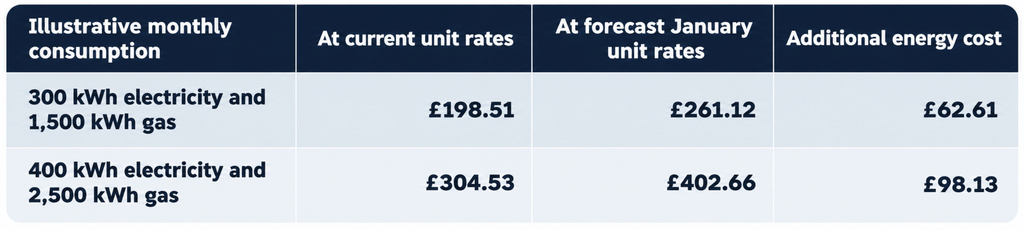
These calculations exclude standing charges, support payments and any account debt or credit. They use the rates in the first table and assume exactly the same consumption in each comparison.
For example, the first household’s electricity cost rises from £78.96 to £97.62, while its gas cost rises from £119.55 to £163.50. (£261.12). The combined increase is £62.61 before any change to the standing charge.
The exercise shows why the effect can feel particularly severe in winter: higher rates apply when the household may need more units. If a cold spell also increases consumption, the actual difference could be greater. If suitable improvements reduce consumption, the difference could be smaller.
Regular meter readings make this easier to understand. Compare kilowatt-hours as well as pounds, and consider the weather and time spent at home before deciding whether a change in the bill reflects a change in efficiency.
Who is likely to feel the greatest pressure?
The same cash increase has very different consequences depending on how much room there is in a household budget.
Someone with savings may absorb it by postponing another purchase. Someone already choosing carefully between food, travel and heating may have no equivalent flexibility. Advice to make further savings helps little when a household has already removed most avoidable excess costs.
People who need to keep their home warm for longer also have fewer opportunities to cut heating hours. That can include people working from home, families with young children, older residents and people whose circumstances require consistent warmth.
The building matters too. An inefficient home may require considerable energy to achieve a comfortable temperature. A tenant may be unable to change the insulation, heating system or windows without a landlord’s agreement. The people paying the bills do not always control the improvements that would make the greatest difference.
For someone using prepayment, the immediate question may be whether there is enough money for the next top-up. For a household paying by Direct Debit, it may be whether an apparently manageable monthly payment is keeping pace with actual costs.
Could winter weather make the increase harder to manage?
In August, we examined El Niño and what it could mean for UK winter weather and heating. A central point was that a strong El Niño does not provide a guaranteed forecast for a particular British winter.
There is now more recent evidence. NOAA’s 12 November update reported that El Niño was strengthening and that strong to very strong conditions were likely to persist into January-March 2027.
On 19 November, the Met Office outlined that its latest modelling favoured an increased likelihood of patterns associated with colder and drier UK winter conditions.
The change since August is a more developed seasonal outlook. A sensible household response is to be prepared for periods of higher demand while following shorter-range forecasts as they become available. That might mean ensuring existing heating works properly, checking fuel supplies where relevant and knowing where to seek help before a prolonged cold spell.
How much difference will the £100 Household Energy Payment make?
Our early November article on the January 2027 Household Energy Payment and staying warmer for less explained how the payment could support essential warmth and carefully chosen improvements.
The announced scheme provides £100 for eligible households responsible for Council Tax on their main home in bands A-D in England, with payments starting from January. Most Council Tax-exempt households are intended to be included, subject to the full criteria. A separate £100 million discretionary fund is intended to help councils support some households outside the main scheme.
There has been a useful clarification since our article. In a parliamentary answer on 18 November, the government said payments may be automatic for Council Tax Direct Debit payers. Others would be invited to provide bank details. Where payment has not been requested by the end of January, the stated arrangement is an automatic credit to the Council Tax account.
Check your own council’s published arrangements rather than assuming a particular cash-payment date. Scotland, Wales and Northern Ireland receive funding for support under arrangements determined by their respective governments; England’s eligibility rules should not be assumed to apply elsewhere.
The payment is separate from the price cap. It does not reduce your tariff’s unit rate.
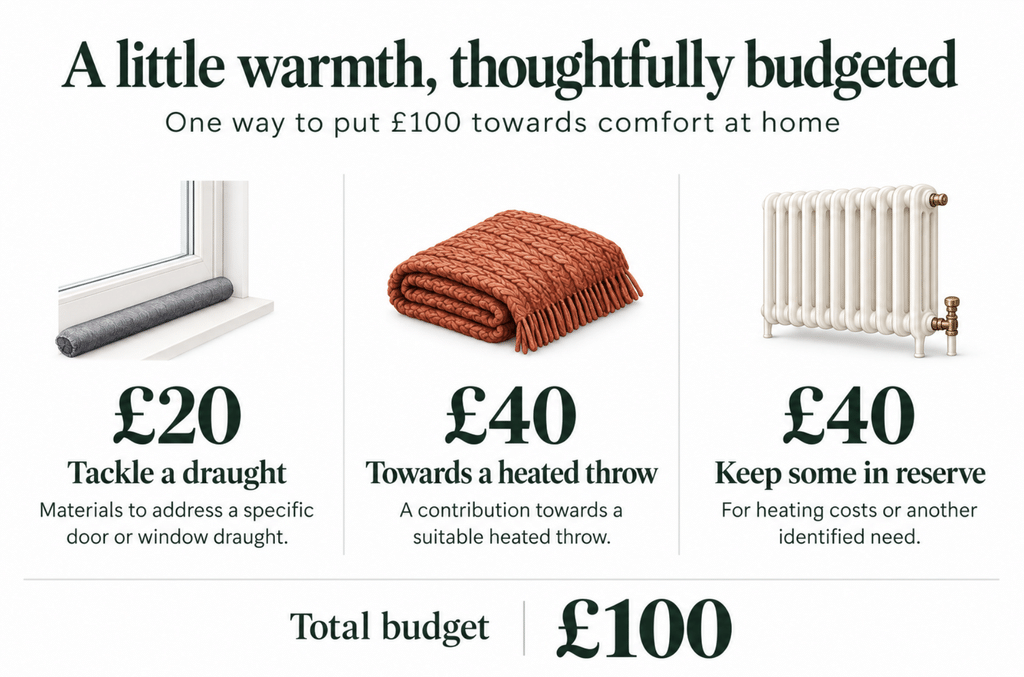
With this £100 payment, its best use depends on immediate need. If essential heating is unaffordable, helping with that cost may be more valuable than perhaps upgrading your fire. Where current warmth is secure, resolving a specific draught or arranging necessary maintenance may be worthwhile. The decision should begin with the problem the household actually faces.
Electricity VAT relief has been extended
There is another update to the position mentioned in September. The temporary zero rate of VAT on qualifying domestic electricity supplies in Great Britain has been extended from the original March end date through 30 June 2027. Gas retains its 5% rate, while qualifying domestic electricity in Northern Ireland remains subject to 5% VAT.
This offers continued relief, but it should be understood alongside the increase in underlying energy costs. The forecast electricity rate already incorporates the applicable VAT treatment. Deducting another 5% would overstate the saving.
What higher prices mean for the way we heat a room
For us, these changes reinforce the importance of matching heating to the home. An electric fire, gas fire or wood-burning stove can have a useful role, but its running cost depends on how it is used and how it interacts with the main heating system.
The relevant questions are practical. How much warmth does the room need? How much fuel does the appliance consume to provide it? Does its use replace other heating, or simply add another cost?
Electric fires and the meaning of efficiency
Direct electric room heating converts essentially all its electricity into heat at the point of use. That is a useful technical characteristic, but it does not establish that electricity is the cheapest way to provide a given amount of warmth.
For an appliance drawing 2 kW continuously for one hour, consumption is 2 kWh. At the forecast electricity rate of 32.54p per kWh, that would cost 65.08p, or approximately £1.30 for two hours at the same continuous input.
These are calculations, not a quoted running cost for every electric fire. A thermostat switching the heater on and off changes actual consumption, as do the selected setting and operating time. Check the input rating and instructions for the particular model.
If a model lets the flame effect run independently, that is a separate mode from running the heater. Use the manufacturer’s stated consumption for that mode rather than assuming the full heating rating applies whenever the flame effect is visible.
Below is our iRange i1800 Deep Electric Fire

Gas fires and useful heat
With a gas appliance, distinguish between the fuel it consumes and the useful heat it delivers. The input and output figures are different measures.
For illustration, an appliance operating at 80% efficiency would need 1.25 kWh of gas to deliver 1 kWh of useful heat. At the forecast gas rate of 10.90p per kWh, the fuel cost would be approximately 13.63p per kWh of useful heat.
That 80% is an assumption for the calculation, not a performance claim for every gas fire. Any comparison should use the specific appliance’s verified efficiency on a basis consistent with billed gas energy. It should also account for installation and servicing costs, and whether the appliance is correctly sized for the room. Mains-gas cap rates should not be applied to LPG running costs.
Good controls can help avoid overheating or unnecessary operating time. They cannot make an unsuitable appliance economical simply because it has a high maximum output.
Below is our Paragon P11 Conventional Flue Gas Fire

Wood-burning stoves and the cost of fuel quality
Logs are outside the Ofgem price cap. That doesn’t make wood automatically cheap, nor does it remove the need to compare delivery prices, quantity, storage, and the useful heat from each load.
Our June article on 11 heating choices that can make a home colder, costlier and less efficient highlighted how operating habits can undermine a heating system. With higher energy costs approaching, those details deserve renewed attention.
Defra advises using wood with a moisture content of 20% or less. Wet wood produces more smoke and deposits and delivers heat less efficiently. A low purchase price is poor value if the fuel performs badly or contributes to maintenance problems. Dry wood still produces emissions; responsible operation remains necessary.
Use the fuel specified for the stove and follow its air-control instructions. Restricting the air excessively to make a load last longer is not a sound substitute for efficient combustion. Choose an appropriate output rather than routinely running an oversized stove badly to avoid overheating the room.
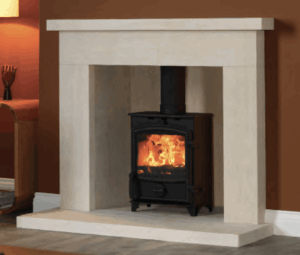
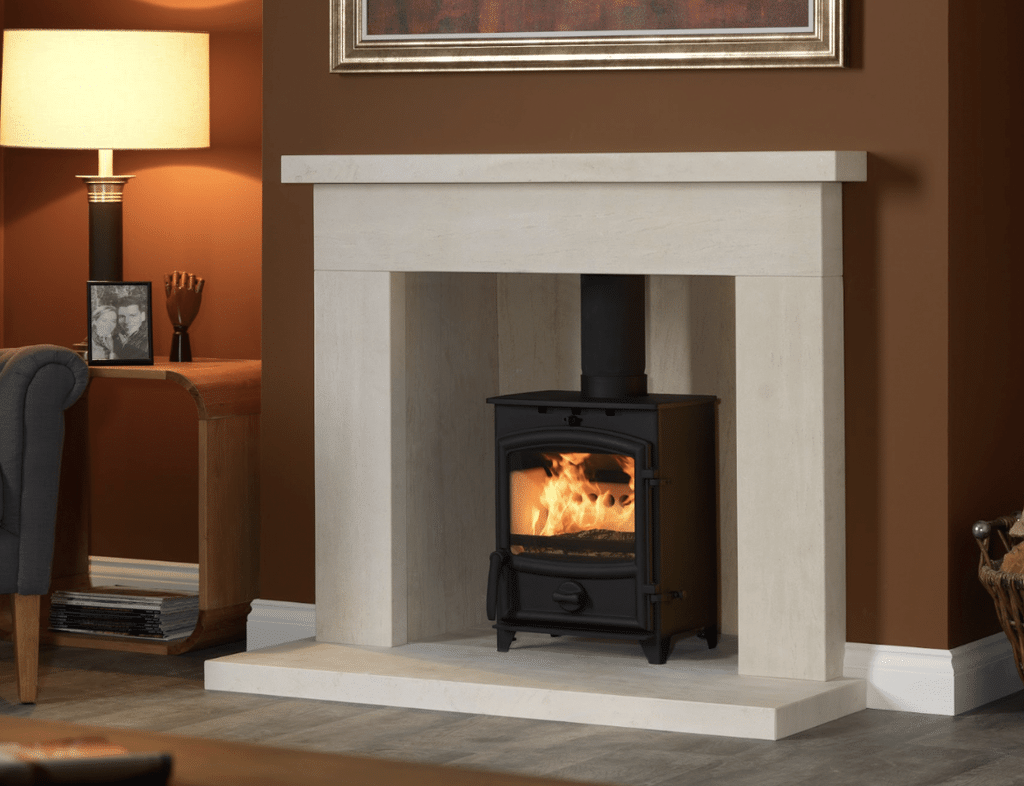
Below is our Fireline 5kW Wood-Burning Stove
When supplementary heating can help, and when it adds cost
Heating the room in use can make sense in some homes. The saving depends on what happens to the rest of the heating while that room is being warmed.
Consider two possible routines. In the first, someone uses a room heater for an evening while reducing heating elsewhere, keeping the other rooms at suitable conditions. In the second, the room heater runs while central heating continues on its usual settings throughout the house.
The first routine may reduce total costs, depending on the equipment and fuel prices. The second may simply add expenditure. The useful comparison is the total energy required for the household’s chosen comfort level.
This also depends on the main heating technology. A heat pump can deliver several units of heat for each unit of electricity because it transfers heat from its surroundings. An electric room heater and a heat pump therefore should not be treated as having identical running costs simply because both use electricity. Actual heat-pump performance varies with the system and conditions.
Practical steps to take before January
The most useful actions solve a known problem without creating another expense the household cannot afford.
Start with the bill and the controls
Check your current tariff, its end date if fixed, and the actual unit rates and standing charges. Once January’s rates are announced, use your own consumption to estimate the effect. A supplier’s annual cost estimate is more useful when it reflects the home’s recent circumstances.
Review heating schedules and room settings. A programme that suited last winter may no longer fit work patterns or family life. Check that controls are understood before replacing equipment: an existing timer or thermostat may already provide the adjustment required.
If considering a fixed tariff, compare its full cost at your own usage, including standing charges, the length of the deal and any exit fees. A decision made only against today’s headline cap ignores both personal consumption and the possibility of future rate changes.
Address avoidable heat loss carefully
Look for specific causes of discomfort: an unintended gap around an external door, furniture obstructing heat circulation or curtains trapping warmth behind them. Suitable small adjustments may improve comfort without requiring a higher thermostat setting.
Draught-proofing must preserve ventilation. Keep air bricks, trickle vents, extractors and any ventilation required by a combustion appliance clear. Where there is uncertainty about airflow around a fire or stove, ask a competent installer before making changes.
There is also a difference between keeping a home warm and letting unused areas become persistently cold or damp. Choose settings for the property and the people living in it, rather than applying a blanket instruction to heat only one room.
Keep essential maintenance on the list
HSE recommends that gas appliances are regularly maintained and serviced at least annually by an appropriately qualified Gas Safe registered engineer. Defra’s stove guidance recommends annual servicing and professional chimney sweeping at least once a year, with the required frequency also depending on use and appliance guidance.
If money is tight, explain the circumstances when seeking advice and prioritise a known safety or operating problem. A fault, obstructed flue or neglected appliance is not an acceptable way to save on winter costs.
For a future replacement, consider the room’s heat requirement, controls, installation needs, ongoing maintenance and expected fuel cost together. A purchase price alone cannot tell you what the appliance will cost to own or whether it is suitable.
Preparing for January means protecting useful warmth
The outlook has become more difficult since we discussed winter costs earlier in the year. The expected January increase is larger, the seasonal weather outlook has developed, and more information is available about government support. The advice must move with that evidence.
At Charlton & Jenrick, our starting point remains the home and the people living in it. For one household, the most valuable next step may be something as simple as understanding the controls on the fire. For another, it may be correcting heat loss, servicing an existing appliance or obtaining financial help. When each unit costs more, useful warmth becomes more valuable. Keeping that warmth where it is needed, choosing suitable equipment and operating it properly can all help households manage the months ahead.