September is the time to check your stove, protect your firewood and prepare for the colder months. After an exceptionally warm summer, and with a powerful El Niño shaping the seasonal outlook, there are a few additional considerations this year.
There is something special about the first wood-burning stove fire of autumn. Evenings are drawing in, the living room feels a little cooler, and the familiar glow of burning logs marks the start of another season. Before lighting that first fire, however, it is worth looking at things in closer detail.
Your stove, chimney, ventilation and fuel supply work together. A well-maintained appliance cannot compensate for damp logs, and perfectly seasoned firewood cannot make a blocked or defective chimney safe. Preparing the whole system helps deliver reliable warmth, better fuel use, and safer operation.
At Charlton & Jenrick, we encourage owners to make September their preparation month. This year, that means considering not only the usual servicing and sweeping, but also what the transition from summer heat to potentially wetter, windier weather could mean for your home and your log store.
Why autumn 2026 deserves a little extra planning
The Met Office provisionally recorded summer 2026 as the UK’s hottest on record. It was also drier than average, although the picture varied considerably by location. England received around 64% of its average summer rainfall, Wales 59%, Scotland 93% and Northern Ireland 91%. England and Wales also experienced their driest July on record. Calling it a super-dry summer, therefore, reflects conditions in some areas much more accurately than others.
For wood-burning stove owners, this raises two questions:
Has the dry weather helped this winter’s firewood season? And could the wetter weather suggested by the autumn from the Super El Niño outlook undo that benefit?
The answer to both is potentially yes, but don’t assume either outcome without checking your wood and its storage conditions.
What is Super El Niño and what could it actually mean for wood-burning stove owners?
El Niño is a sustained warming of the central and eastern equatorial Pacific Ocean that can influence weather patterns far beyond the tropics. Super El Niño is a term often used in headlines for particularly strong events; it is not an official category used by the Met Office.
Nevertheless, a significant event is developing. In August, the Met Office described the forecast signal as exceptionally strong and highlighted an increased likelihood of wetter, stormier conditions affecting north-west Europe, including the UK, during autumn and early winter.
The Met Office’s September 2026 seasonal update said the chances of a warm and wet autumn were about one-and-a-half to two times higher than normal, with a higher likelihood of windy conditions later in the season. Crucially, that describes a change in probability, not an expectation of twice the normal rainfall, nor a guarantee of severe storms. El Niño is only one influence on UK weather, and an event like this does not automatically translate into more severe UK impacts.
The sensible response is generally preparation, not alarm. Protect your fuel, check for chimney defects, and follow local forecasts and warnings as the season develops. Don’t base your whole winter heating plan on a headline about conditions thousands of miles away.
Start with the chimney, not the first bag of logs
Book a professional sweep before returning to regular use.
A chimney can accumulate soot and combustible deposits during use, but it can also develop obstructions while the stove is standing idle. A summer without fires does not necessarily mean the flue has remained clear. Nesting material, debris and deterioration all need consideration before the appliance is used again.
We recommend chimney sweeping at least twice a year or more when burning wood, with more frequent sweeping potentially needed for heavily used appliances. Ask your sweep to establish a schedule appropriate to your stove, fuel, previous deposits and pattern of use.
Tell the sweep about anything unusual you noticed last winter: smoke entering the room, difficulty establishing a fire, falling soot, persistent smells or a sudden change in performance. Those details can help identify an underlying problem instead of simply clearing away its symptoms.
Do not try to clear a suspected blockage or nest by lighting a fire beneath it. Arrange professional assessment, and keep your sweeping and servicing records with the appliance documentation.
Remember that sweeping and servicing are different jobs
Sweeping deals with the chimney and flue pathway. A stove service examines the appliance and its working components. Both are important.
Before the appointment, make sure the stove is completely cold and accessible. Remove decorative items or anything else placed inside it over summer, then check the visible condition of the firebox, door and controls. Firebricks, baffles, rope seals, glass, grates, hinges, and air controls are components that deserve attention.
Door seals and catches. A deteriorated rope seal can allow unwanted air into the stove, affecting how the fire responds to its controls. HETAS describes a simple cold-stove check: close the door on a strip of paper and gently try to pull it out, repeating around the seal. Little or no resistance can indicate a problem requiring attention. It is a useful screening check, not a substitute for a service. Example below:

Firebricks, baffles and glass. Look for displaced or crumbling linings, a damaged or incorrectly positioned baffle, and cracked glass. Don’t assume every mark requires replacement, but don’t assume a damaged component is harmless just because the stove still lights. Have its condition assessed against the manufacturer’s guidance.
Use the correct replacement components for the exact model. Our service and retailer network can help with maintenance, genuine spare parts and access to the relevant manual. Improvised repairs or vaguely similar parts are certainly not a good foundation for the winter ahead.
Check the room as carefully as the stove
Autumn preparations often involve draught-proofing, moving furniture and bringing out heavier curtains. Make sure those changes do not interfere with the stove’s safe operation. Keep the manufacturer’s required clearances around the appliance and flue. Move log baskets, furniture, curtains and drying laundry away from hot surfaces, and use a suitable protective guard where children or vulnerable people could come into contact with the stove. A hearth is not automatically a safe place to store combustible items simply because it is made from stone.
Never block the appliance’s ventilation. Air bricks and permanent vents are there for a reason, even when they feel draughty. An extractor fan or changes to the building’s airtightness can also affect pressure within the room and the chimney’s ability to draw. Mention new extraction equipment or significant alterations to your installer or service technician.
Test the carbon monoxide and smoke alarms
Install an appropriate carbon monoxide alarm in the room with the stove, positioned according to the manufacturer’s instructions. Test it, check its replacement date and ensure it has not been covered, moved or obstructed. Check your smoke alarms too, and continue testing throughout the season. Carbon monoxide cannot be seen or smelt. A room that does not smell smoky is not proof that everything is safe. Alarms provide important warnings, but they do not replace correct installation, ventilation, sweeping and servicing.
Has the hot, dry summer improved this winter’s firewood?
It may have helped wood that was already being seasoned. Warm weather and good airflow can help moisture leave properly prepared logs. Wood cut, split, and stacked before or early in the summer may have benefited from the prolonged dry conditions, particularly if the stack was raised off the ground and exposed to moving air.
The important point is that if they were properly prepared…
A tightly packed heap of large, unsplit logs does not receive the same benefit as smaller split logs in a ventilated storage area. Sun on the outside of a log is not proof that its centre has dried sufficiently. Species, starting moisture content, log dimensions, storage and time all affect the outcome.
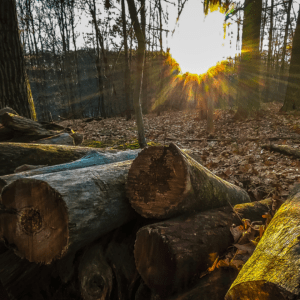
Also, a drought-affected tree is not ready-to-burn fuel, although some people mistakenly think it is. Brown leaves, dry bark or a sun-baked woodland floor do not tell you the moisture content inside a tree. Freshly cut timber can still contain substantial water, and larger sections can remain wet internally despite looking dry at the surface. A tree felled during the heatwave should not be treated as good fuel for this autumn. Depending on the wood and conditions, seasoning may take one to two years or longer. The only reliable decision is based on moisture testing.
Could the dry summer affect availability or prices?
Potentially, but the effects can work in different directions. Drought can reduce tree growth and cause dieback and mortality, and it can also increase risks from wildfire, pests, disease, and windthrow (trees uprooted by wind). These can affect woodland productivity and management beyond the summer in which the drought occurred.
For firewood buyers, possible consequences include local changes in supply as damaged trees are removed, or disruption where fire risk and woodland damage interfere with operations. However, newly available timber still requires processing and drying. More felled wood does not necessarily mean more suitable fuel available immediately.
These are possible local impacts, not a true forecast that UK firewood will become uniformly cheaper, more expensive or scarce this winter. Ask your supplier about current stock, moisture standards and delivery arrangements. Planning ahead is more useful than panic-buying unseasoned wood.
Check the fuel you have
For normal domestic wood-burning use, the key practical target is 20% moisture content or less, subject to your stove’s instructions. In England, wood fuel sold in quantities below two cubic metres must be certified as Ready to Burn, confirming that moisture standard. Larger deliveries do not have the same certification requirement but must include the prescribed drying and storage information. A large delivery should therefore not be assumed ready for immediate use simply because it came from a firewood supplier.
Ready to Burn certification is valuable, but storage is still important. Even correctly dried wood can become wet again if it is exposed to rain or poorly stored.
How to take a useful moisture reading
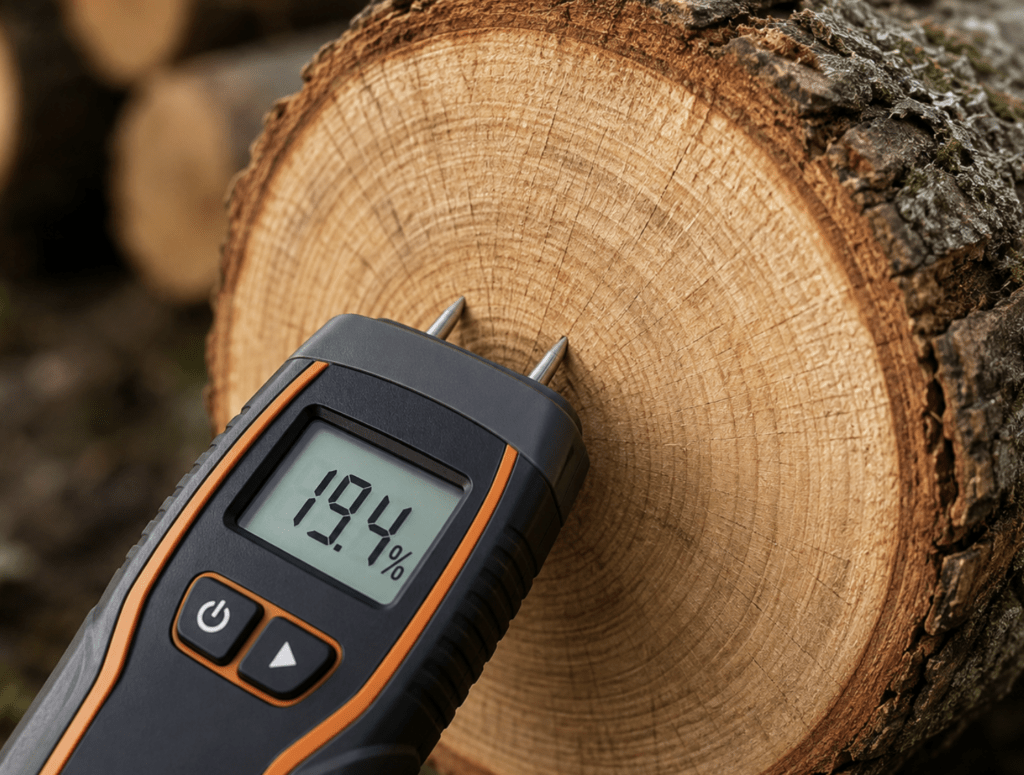
Choose several representative logs, including pieces from different parts of the stack. Split them and test the freshly exposed inner face, rather than relying on bark or the already-dried ends.
Use the meter’s appropriate wood setting and follow its calibration, temperature and species guidance where provided. Moisture readings can be expressed on different bases, so follow the meter’s firewood instructions rather than assuming every instrument displays directly comparable results.
A single satisfactory log does not prove that a mixed delivery is uniformly dry. Keep suspect batches separate and allow further drying before retesting. Appearance can help you decide what to investigate, but cracks, loose bark and a reassuring clack when two logs are knocked together are not replacements for checking moisture internally.
Protect your log store before the first prolonged wet spell
With wetter conditions more likely in the seasonal outlook, protecting existing dry fuel deserves plenty of attention.
Keep rain out without trapping moisture inside
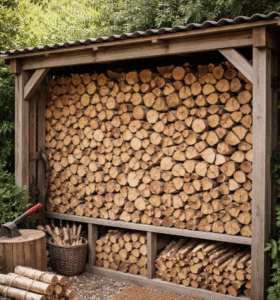
A useful log store has a sound roof, a raised base and enough ventilation for air to move through the stack. Keep logs away from direct ground contact and avoid packing them so tightly that air cannot circulate. Check the roof now. Look for damaged covering, loose fixings, inadequate overhangs and places where water runs towards the stack. A roof that copes with a summer shower may still leave the outer rows exposed during wind-driven rain. If you use a cover, protect the top while maintaining ventilation around the wood. Wrapping the entire stack tightly in non-breathable plastic can trap moisture instead of solving the problem.
Think about sideways rain and water from below
Heavy rain does not always fall vertically. Consider which side of the store is most exposed during autumn storms and whether a roof overhang or suitably ventilated weather screen would offer better protection.
Also inspect the ground. Logs can be affected by standing water, splashback and runoff even when the roof above them is intact. Keep the stack raised and choose a position that is not an obvious collection point for water. These are practical applications of the basic storage principles: prevent direct rewetting and preserve airflow.
A raised base protects against normal damp ground; it is not flood protection. Where flooding is a realistic risk, plan a safer storage location and follow the relevant local warning service. Never enter floodwater to rescue fuel.
Understand the difference between a shower and sustained soaking
A little surface moisture does not necessarily undo months of seasoning. However, prolonged heavy rain can cause problems and delay drying. Repeated wetting is a different situation from a brief shower followed by good ventilation. After a wet period, inspect the exposed rows and the bottom of the stack. Separate affected wood from your ready-to-use supply, improve its protection and airflow, and retest before burning. Do not assume a dry centre makes a visibly soaked log suitable for immediate use.
Keep a modest, accessible supply, not a drying pile beside the stove
A small supply of already-seasoned logs indoors can be convenient, but keep the logs safely away from the appliance and within the manufacturer’s clearance requirements. Never pile logs against the stove, lay them on top of it or use the hearth as a makeshift kiln. The same applies to wet gloves, coats and other items brought in during stormy weather!
A useful arrangement is to separate fuel into ready-to-burn stock, wood still drying and a small working supply. That makes it less likely that you’ll accidentally use damp logs.
Treat flood-contaminated wood differently
Floodwater may contain sewage, chemicals and other contaminants. Logs exposed to contaminated flooding should not be treated as ordinary rain-wet firewood and simply dried for use. Keep them separate and seek disposal advice from your local council’s environmental health service. Likewise, do not burn storm-damaged fence panels, painted timber, treated decking, furniture, MDF or other unsuitable waste wood. Free fuel is not a saving when its coatings, preservatives or adhesives make it inappropriate for the appliance.
Wetter and windier weather can affect the chimney too
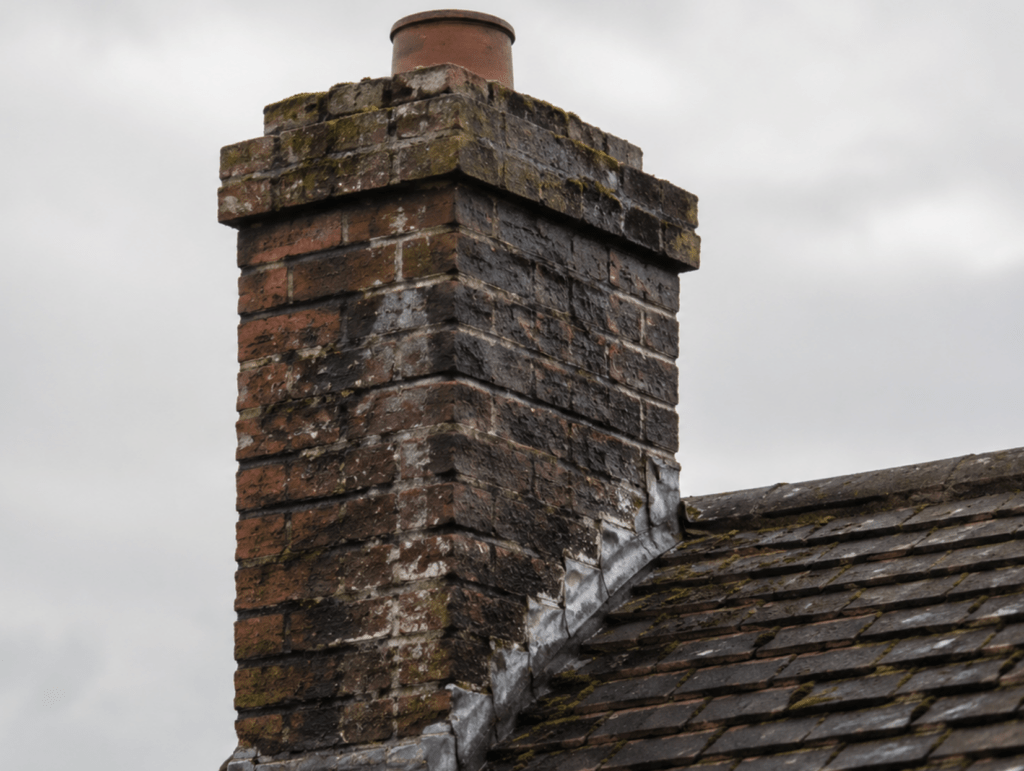
Look for water ingress before it becomes a problem. Rain-related issues are not confined to the log store. Chimney pots, terminals, flashing and exposed masonry all need attention.
Look from a safe position for obvious damage, and check indoors for new staining, persistent damp smells or water marks that become more noticeable after heavy rain. These are reasons to investigate, not simply redecorate. Water can enter the chimney system from several places, so identify the source before choosing repairs.
Arrange professional assessment where necessary. Do not climb onto a roof to inspect a cowl or chimney after a storm, and do not try to dry out a suspected chimney defect with an unusually large fire.
Strong winds can change how a flue draws
Wind around rooflines, nearby buildings and trees can create pressure changes at a chimney terminal. In some circumstances, this can disrupt the upward flow or produce downdraught. A problem may appear only when the wind comes from a particular direction.
Cold or mild, muggy conditions can also make the initial draught less dependable, especially after the stove has stood unused. Weather, building pressure and ventilation interact together; not every difficult start to a fire is caused by the logs.
Don’t dismiss smoke entering the room, repeated difficult lighting, or a marked change in stove behaviour isn’t just the weather. Stop using the appliance and arrange an assessment. A different cowl or flue alteration should follow a proper diagnosis. After a significant storm, check for visible damage or new warning signs before use. A pre-season sweep doesn’t remove the need to respond to changes later.
Make the first fire of the season controlled and deliberate
Once you’ve checked the stove, cleared the flue, and confirmed the fuel is suitable, choose a time when you can stay nearby and watch the first fire. Follow your model’s lighting instructions. We have previously explained the benefits of top-down lighting: an appropriately sized arrangement of logs below dry kindling and a suitable firelighter can help establish the fire while limiting smoke. The precise fuel quantity and air-control sequence should still come from your appliance manual.
Do not compensate for reluctant ignition by repeatedly adding more fuel. Never use petrol, paraffin or similar liquids to get things moving. Do not overload the firebox.
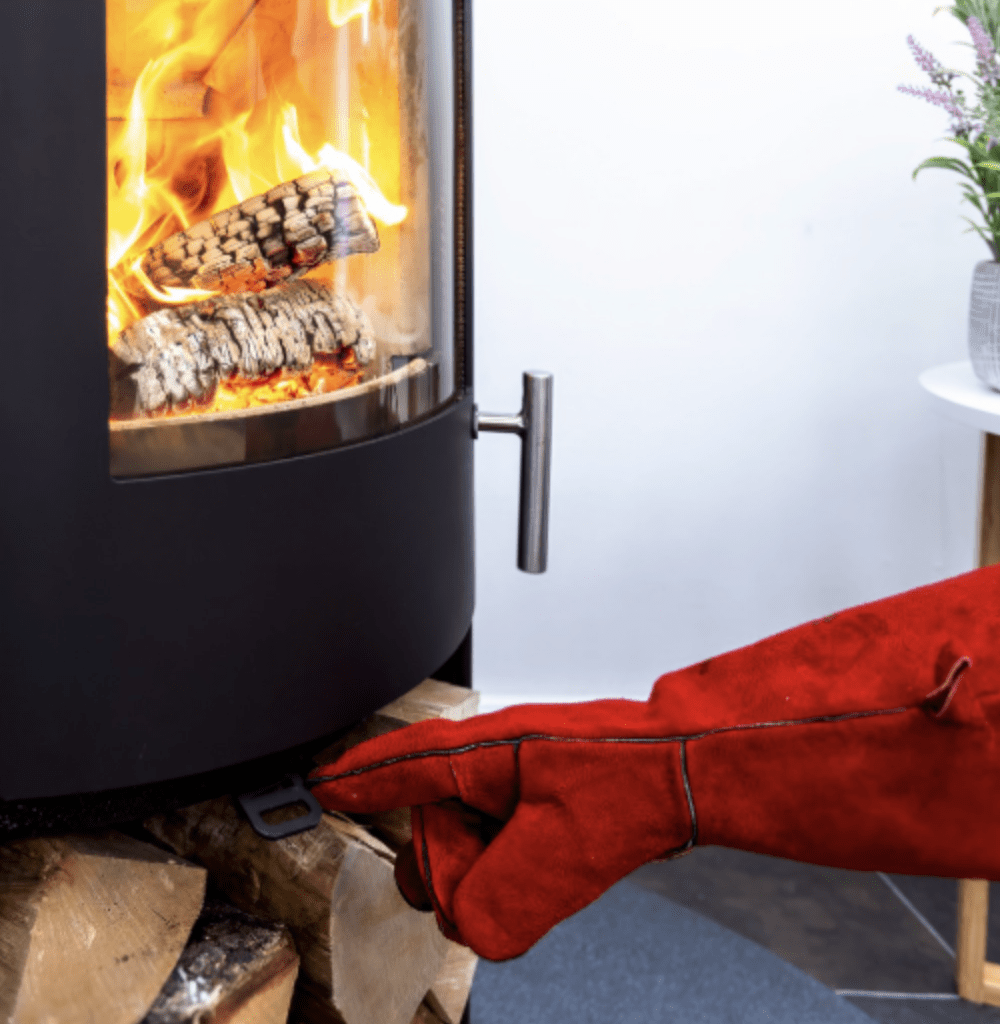
Do not confuse a gentle evening fire with prolonged smouldering. On a mild autumn evening, it can be tempting to fill the stove and then shut the air down heavily because the room becomes too warm. That is not an efficient way to match the fire to the room’s needs. Deliberately restricting air to keep wood smouldering can encourage incomplete combustion and deposits. Avoid overnight slumbering unless the appliance has specifically been tested and approved for that operation.
Follow the permitted fuel loads and operating guidance, and allow the fire to finish when further heat is unnecessary. Never try to burn accumulated chimney deposits away with an extra-hot fire.
Keep ash handling on the safety checklist
Ash can be easily overlooked once the flames have gone. Use a suitable metal container, preferably with a lid, and keep it outside on a non-combustible surface away from the building and other combustible materials. Do not put hot ash or embers into a wheelie bin, cardboard box or plastic container. Follow the stove manual when removing ash and maintaining any ash bed. Avoid treating every appliance the same: the right routine depends on its design.
After a dry summer, it is particularly sensible to think about where the ash container stands. Keep it away from your log store, dry vegetation and anything else that could ignite.
Plan for disruption without taking shortcuts
Storms can damage electricity networks and interrupt supplies. Keep torches, batteries and a charged phone accessible, rather than relying on candles while carrying logs or operating the stove in a dark room. In England, Scotland and Wales, 105 connects you to the local electricity network operator for power-cut reporting and information.
Before relying on a stove as backup heating, confirm how your particular installation operates. Boiler-linked appliances and systems with electrical components need specific advice; don’t assume every solid-fuel installation behaves like a simple room-heating stove.
Also remember that flood-protection measures can change the ventilation available to the appliance. Do not operate a stove while its required combustion-air vents are covered or obstructed. After flooding, have affected equipment assessed before returning them to service.
Make September the month you get ready
The most useful preparation is straightforward: arrange the sweep and service, check alarms and ventilation, test representative logs, weatherproof the store without sealing it, and deal with any chimney concerns before regular use begins.
This summer may have given well-managed firewood a useful head start. A wetter autumn could make protecting that investment particularly important. Neither the sunshine behind us nor the possible impact of a Super El Niño ahead can replace the importance of checking the condition of the fuel and appliance.
At Charlton & Jenrick, our retailers and service team can help with model-specific guidance, genuine parts and maintenance support. Keep your manual available, raise concerns early and give your stove the attention it needs before asking it to look after you through winter.
Prepare now, so the first fire of autumn is something to enjoy, not the moment you discover a problem.