A more energy-efficient home should hold on to useful heat. It should not hold on to harmful combustion gases.
That distinction is becoming increasingly important as homeowners add insulation, replace draughty windows, seal gaps and install more sophisticated ventilation systems. These improvements can make a property warmer, quieter and less expensive to heat, but they also change how air moves through the building.
In our previous article on the carbon monoxide risks associated with gas fires, we looked at the Gas Safe Register’s Let It Flow campaign. The central message was that gas appliances need an appropriate supply of air and that ventilation openings must not be covered or blocked. We also explained why regular servicing and an audible carbon monoxide alarm are so important.
Those recommendations still stand. However, the way many homes are constructed and renovated gives us another reason to revisit the subject.
Older properties often received a surprising amount of fresh air through gaps around windows, doors, floorboards, loft hatches and other parts of the building. Modern homes increasingly rely on purposeful ventilation instead. That is a positive development when the systems are correctly designed, installed and maintained, but it means homeowners need to understand that insulation, airtightness, ventilation, fires and flues cannot be considered separately.
A carbon monoxide alarm is a relatively small part of that system, but it provides an invaluable independent warning if something goes wrong.
What is carbon monoxide?
Carbon monoxide, usually shortened to CO, is a poisonous gas produced when fuels containing carbon do not burn completely.
Appliances and equipment that can produce it include:
1. gas fires, stoves, boilers and cookers;
2. wood-burning stoves and open fires;
3. oil-fired appliances;
4. coal fires;
5. paraffin heaters;
6. portable generators;
7. barbecues and camping stoves.
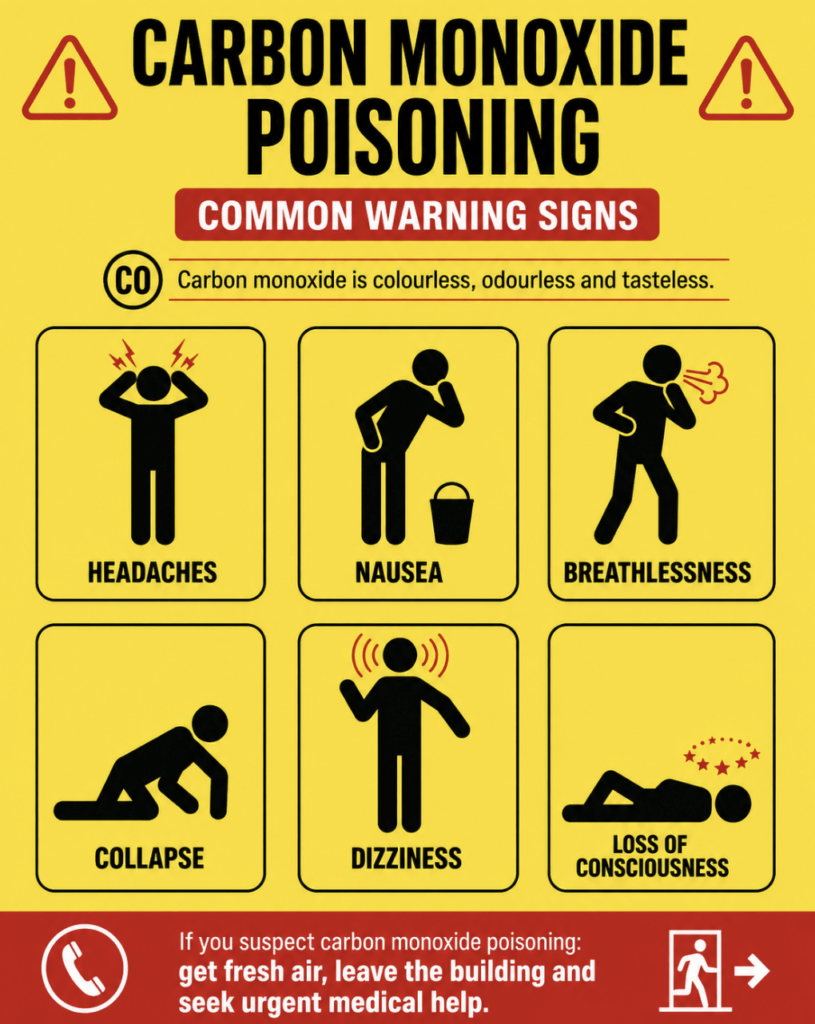
Carbon monoxide is colourless, tasteless and odourless. Unlike a natural gas leak, it does not have a distinctive smell added to warn occupants that something is wrong. You cannot rely on your senses to detect it. When inhaled, CO interferes with the blood’s ability to transport oxygen around the body. Significant exposure can cause serious illness, lasting injury or death. The HSE reports that around seven people die each year from carbon monoxide poisoning associated with gas appliances and flues that have been poorly installed, inadequately maintained or insufficiently ventilated.
This is why the word alarm is important. A domestic CO alarm does more than passively detect a change: it sounds an audible warning to alert the people in the property.
A colour-changing indicator or so-called black-spot card cannot wake someone who is asleep or immediately attract attention in another part of the room. Gas Safe Register recommends an audible alarm rather than relying on a visual indicator alone.
Carbon monoxide can be difficult to recognise without an alarm.
The early symptoms of carbon monoxide poisoning are often mistaken for more familiar illnesses. They can resemble flu, food poisoning, a virus, exhaustion or a hangover.
Possible symptoms include:
1. headache;
2. dizziness;
3. nausea or vomiting;
4. weakness and tiredness;
5. confusion;
6. chest or muscle pain;
7. shortness of breath;
8. visual problems;
9. loss of consciousness.
One particularly important warning sign is that symptoms become worse while someone is inside a particular room or building but improve when they go outside. Several people in the same household feeling unwell at a similar time should also be treated seriously.
A CO alarm obviously does not need to interpret those symptoms. It monitors the air continuously, including overnight, when the occupants may not notice physical warning signs or changes in an appliance’s operation.
You do not install an alarm because you expect your fire, stove or boiler to become unsafe. You install one because carbon monoxide cannot otherwise be reliably detected by the people in the room.
Does insulation create carbon monoxide?
No. Insulation does not produce carbon monoxide, and an airtight home is not automatically an unsafe home. Carbon monoxide is associated with incomplete combustion and problems such as an incorrectly installed or poorly maintained appliance, an inadequate air supply, a blocked or defective flue, or combustion gases spilling back into the property. What insulation and airtightness can change is the movement of air around the home.
In a traditional, draughtier property, some fresh air enters accidentally through gaps in the building. This uncontrolled leakage is sometimes described as infiltration or adventitious ventilation.
Sealing those gaps reduces heat loss, but it may also remove air movement that a homeowner did not realise was taking place.
Approved Document F acknowledges that many existing homes are ventilated partly through infiltration. It warns that energy-efficiency improvements can reduce that infiltration and cause a property to become under-ventilated unless the ventilation arrangements are assessed and, where necessary, improved.
Approved Document J makes a similar point specifically in relation to combustion. Its guidance for very airtight houses reflects the reduction in accidental ventilation compared with older, leakier buildings. The aim should never be to preserve random draughts simply because they existed before. It should be to replace uncontrolled leakage with a suitable ventilation strategy while making sure any combustion appliance receives the air it needs to operate safely.
Why energy-efficiency work can affect an existing fire
Home improvements are often completed gradually rather than as part of one coordinated retrofit. A homeowner might replace windows one year, insulate the loft the next and seal a suspended floor several years later. They may then install a powerful cooker hood, upgrade bathroom fans or add an extension. Each individual project may seem unrelated to the fireplace. Together, however, they can significantly alter how the house behaves.
Work that can affect airflow or the operation of a combustion appliance includes:
1. fitting double- or triple-glazed windows;
2. replacing external doors;
3. draught-proofing;
4. insulating and sealing suspended floors;
5. installing internal or external wall insulation;
6. increasing loft or roof insulation;
7. sealing a redundant chimney;
8. constructing an extension or conservatory;
9. installing a new kitchen extractor;
10. changing bathroom fans;
11. fitting whole-house mechanical ventilation;
12. altering, enclosing or obstructing a flue terminal;
13. covering an existing air vent during decorating or building work.
You should not cover air vents or flues during home improvements because these may be essential to the safe operation of an appliance. Also, using an appropriately qualified Gas Safe registered engineer whenever work involves or could affect gas equipment is essential.
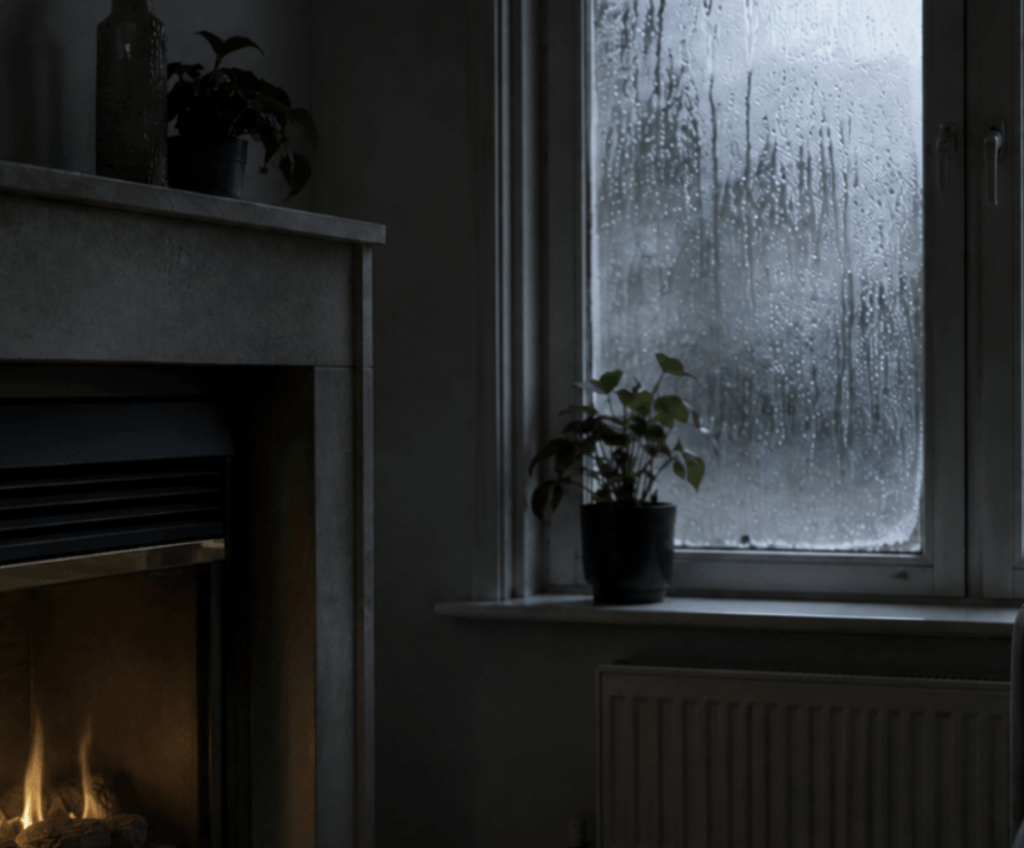
A lazy flame and condensation are key signs of a possible carbon monoxide risk:
The extractor-fan problem many homeowners do not consider
A fire may be in the living room while the most powerful extractor is in the kitchen. It is easy to assume that the two cannot affect one another. Air pressure does not necessarily respect room boundaries. When a cooker hood, bathroom fan, tumble dryer or whole-house extract system removes air from the property, it lowers the pressure inside. Replacement air must then enter from somewhere. With an open-flued appliance, sufficiently strong negative pressure can interfere with the natural movement of combustion gases up the chimney or flue. In certain circumstances, gases may spill back into the building rather than being safely discharged outside.
Approved Document J specifically warns that extract fans can cause combustion products to spill from open-flued appliances, even when the appliance and fan are in different rooms. It states that combustion appliances should operate safely both when fans are running and when they are switched off. This is one reason why a competent installer may test an appliance with doors and windows closed and relevant fans operating at their highest normal setting.
A homeowner should therefore arrange professional advice when:
1. fitting a more powerful cooker hood;
2. adding a new mechanical extract system;
3. installing or substantially altering MVHR;
4. moving internal doors or changing the room layout;
5. making the home significantly more airtight;
6. experiencing smoke or fumes entering the room;
7. noticing that a fire behaves differently when an extractor is switched on.
A carbon monoxide alarm provides an additional warning, but it should not be used to prove that an untested combination of appliance and ventilation system is safe. Open-flued and room-sealed appliances behave differently. Not every gas fire or stove takes its combustion air from the room.
An open-flued appliance generally draws the air needed for combustion from the space in which it is installed. Its safe operation can therefore be affected by the available air supply and pressure conditions within the property. A room-sealed appliance, including many balanced-flue products, takes combustion air from outside and discharges combustion gases outside through a sealed system. It is less dependent on air from the living space and less directly affected by normal room ventilation.
Approved Document J notes that room-sealed appliances or products with a directly connected external air supply can minimise ventilation-related heat loss and cold draughts.
That does not make servicing or a CO alarm unnecessary, however. Flues can be damaged, obstructed or incorrectly assembled, and seals and other components can deteriorate. It’s important to make sure concealed flues are accessible for inspection because an engineer needs to be able to examine the full system properly at any time.
Why a CO alarm is so useful in an efficient home
A modern home is designed to control energy and airflow more precisely. A CO alarm adds another form of control: independent monitoring. It does not depend on sight or smell. Soot, unusual staining, excessive condensation or a change in flame appearance can indicate a problem, but these signs may not always be obvious. Some decorative fuel-effect fires also naturally have yellow or orange flames, so flame colour alone cannot be used as a reliable test.
People are less likely to notice physical symptoms, a change in appliance sound or a developing problem while sleeping.
An audible alarm is designed to attract attention when the occupants cannot monitor the appliance themselves. It can warn of a problem that develops between services. Professional servicing reduces risk, but it cannot guarantee that nothing will change afterwards.
Some fireplaces are used only during the coldest weeks of winter. A fault may therefore remain unnoticed for much of the year.
Before using a seasonal appliance again, it should be checked and serviced at the appropriate interval. A working alarm provides protection when it returns to use.
Which rooms should have a CO alarm?
NHS guidance recommends having an audible carbon monoxide alarm in each room containing an appliance that burns gas, oil, coal or wood.
Examples include rooms containing:
1. a gas fire or gas stove;
2. a wood-burning or multifuel stove;
3. an open fire;
4. a gas or oil boiler;
5. an oil-fired room heater;
6. another fixed combustion appliance.
The safe indoor levels of CO2 are generally around 400 to 1,000 ppm.
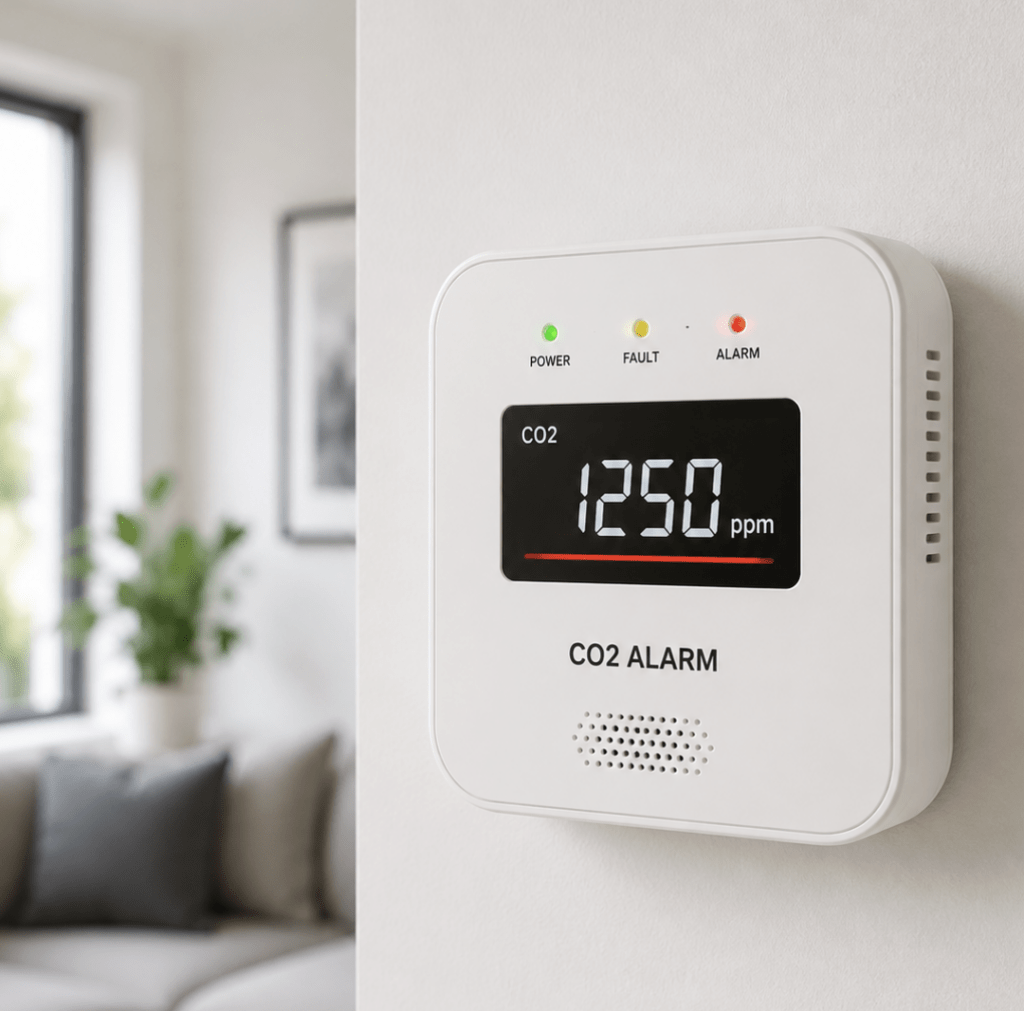
An electric fire does not burn fuel and therefore does not produce carbon monoxide. However, the same property may still contain a boiler, cooker, stove, fire or flue that warrants CO detection elsewhere.
In England, guidance supporting Part J states that a carbon monoxide alarm should be provided in the same room when a new or replacement fixed solid-fuel appliance, oil-burning appliance or gas-burning appliance is installed. Gas appliances used solely for cooking are excluded from that particular Approved Document J provision. That is a regulatory baseline for certain installations, and certainly not a reason to leave an older home unprotected. An existing appliance may pre-date the current guidance, but the risk presented by undetectable CO remains.
Requirements also differ according to where in the UK the property is located and whether it is owner-occupied or rented. Homeowners, landlords and installers should check the rules applying to the individual property rather than assuming one arrangement covers every nation and tenure.
Choosing an appropriate carbon monoxide alarm
A domestic CO alarm should be audible and suitable for use in a home. Current Approved Document J guidance in England specifies alarms complying with BS EN 50291-1:2018. It describes units powered by a battery designed to last for the alarm’s working life, with a warning when the end of that life is approaching. It also permits an appropriately specified fixed-wired mains alarm with a sensor-failure warning.
When choosing an alarm, look for:
1. clear evidence of conformity with the relevant standard;
2. a loud audible warning;
3. an end-of-life indication;
4. a test button;
5. clear installation instructions;
6. a visible replacement or expiry date;
7. an alarm suitable for the intended room and property.
A digital display can be useful, particularly for showing readings or recorded peak levels, but it does not make professional investigation unnecessary. For someone who is deaf, hard of hearing, older or otherwise unlikely to hear a standard alarm, specialist warning arrangements may be needed. Type A CO alarms can provide an output for ancillary devices such as remote sounders, visual warnings or other accessible alerting equipment.
It is also important to understand what the product detects. A standard carbon monoxide alarm does not necessarily detect a natural gas leak, smoke or heat. Combination products exist, but the specification should be checked carefully rather than assumed.
Where should a CO alarm be installed?
Follow the alarm manufacturer’s instructions and the advice of the competent appliance installer. For new and replacement fixed gas appliances in England, Approved Document J’s guidance places the alarm in the same room as the appliance and between one and three metres away horizontally.
It advises positioning it either:
1. on the ceiling, at least 300mm from any wall; or
2. high on a wall, above doors and windows but at least 150mm below the ceiling.
The alarm should not be installed immediately above the appliance.
Avoid placing it where airflow or obstructions could prevent it from working effectively, such as:
1. inside a cupboard;
2. behind a curtain;
3. behind large furniture;
4. next to a window or external door;
5. directly beside an air vent;
6. in a position where it can be covered, painted or damaged.
A CO alarm left on a shelf is only appropriate when the manufacturer specifically permits that position. Do not assume that a portable-looking product can be placed anywhere in the room. When redecorating or building a media wall around a fire, make sure the alarm remains visible, accessible and in a suitable detection position.
An alarm has a working life
A carbon monoxide alarm is not a permanent fixture that can be forgotten once it has been installed. The sensor has a defined service life. Once the end-of-life warning is activated or the manufacturer’s replacement date is reached, the whole alarm may need to be replaced even if the test button still produces a sound.
Homeowners should:
1. test the alarm at the intervals stated by the manufacturer;
2. keep its openings free from dust;
3. check for damage after decorating or building work;
4. never paint over it;
5. never remove or disable it because of intermittent warning sounds;
6. understand the difference between an alarm signal, low-battery warning, fault warning and end-of-life indication;
7. keep the product instructions somewhere accessible;
8. replace the unit when required.
The test button verifies the alarm functions specified by the manufacturer. Approved Document J explicitly states that installing an alarm should not be regarded as a substitute for correct installation and regular servicing of a combustion appliance.
A safer home combines several measures:
Correct appliance selection. The fire or stove must be suitable for the room, flue and ventilation arrangements.
Competent installation. Gas work must be completed by a suitably qualified Gas Safe registered engineer. Solid-fuel and oil installations require appropriately competent professionals.
Adequate combustion air. Air vents and other required openings must be correctly sized and kept clear.
A sound flue or chimney. Combustion products need a reliable route outside. Flues should be accessible where inspection is required, and chimneys should be maintained appropriately.
Regular servicing. Gas Safe Register recommends that gas appliances are serviced and safety-checked annually.
Working ventilation. Mechanical ventilation must be commissioned, maintained and used as designed. Filters and terminals should not be allowed to become obstructed.
A suitable CO alarm. The alarm provides warning if the other safeguards do not prevent CO from entering the living space.
A CO safety checklist before improving your home
Before replacing windows, insulating walls or undertaking substantial draught-proofing, identify every combustion appliance and flue in the property. Ask the designer, builder or retrofit installer:
1. Will this work reduce the air entering the home?
2. Does any fire, stove or boiler draw combustion air from the room?
3. Are any permanent air vents being covered, moved or reduced?
4. Could new insulation obstruct or overheat a flue?
5. Will an extension alter the position or clearance of an external flue terminal?
6. Could a new extractor fan affect an open-flued appliance?
7. Does the ventilation system need to be recommissioned?
8. Should the combustion appliance be tested again after the work?
9. Is there a compliant, correctly positioned CO alarm in every relevant room?
10. Have the alarm’s replacement date and testing instructions been recorded?
Approved Document F states that energy-efficiency work should not make a dwelling’s ventilation less satisfactory than it was before and that an assessment may be needed to determine whether additional ventilation should be provided. A whole-house approach is preferable to treating each measure as an isolated improvement.
What should you do if the alarm sounds?
Do not remove the battery, silence the alarm and continue using the fire. Leave the property and move into fresh air. Stop using the suspected appliance if this can be done quickly and safely, but do not delay leaving in order to investigate. Do not return to the affected building until you have received appropriate advice.
Contact NHS 111 if you believe you may have symptoms of carbon monoxide poisoning. Call 999 if anyone is having difficulty breathing, becomes suddenly confused, loses consciousness, feels severely weak or develops chest or muscle pain.
Where a gas appliance may be responsible, call the National Gas Emergency Service on 0800 111 999. The service operates 24 hours a day. The appliance must not be used again until it has been assessed and made safe by a suitably qualified Gas Safe registered engineer.
Efficient homes can also be exceptionally safe homes. Better insulation and improved airtightness are not reasons to be afraid of installing or using a combustion appliance. They are reasons to plan it properly.
Modern homes no longer need to rely on unpredictable draughts for their supply of fresh air. They can combine high levels of insulation with controlled ventilation, correctly selected appliances, properly designed flues and effective safety monitoring.
The important point is that these elements must work together.
A fireplace should not be selected without considering ventilation. A powerful extractor should not be added without considering an existing open-flued appliance. An air vent should not be covered because it feels cold. An insulation project should not obstruct a flue terminal. And a CO alarm should never be seen as an alternative to professional installation and maintenance.
Our earlier article focused on the need to let air flow around gas fires. The next step is to recognise that, as homes become tighter, that airflow is increasingly planned rather than accidental.
A properly selected and positioned audible carbon monoxide alarm provides the final independent warning. It is a small addition to an energy-efficient home, but one that can make an enormous difference when something unexpected happens.