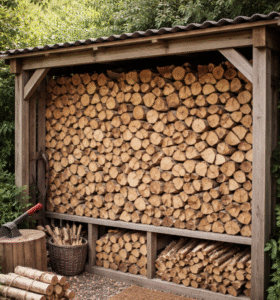
As we head into the winter of 2026, ongoing global uncertainty and escalating conflict in the Middle East, particularly involving Iran and disruption to vital oil and gas supply routes, are once again putting pressure on energy markets. With Ofgem’s energy price cap rising by 4% in October, UK households continue to face the challenge of rising heating bills and unpredictable energy costs. Against this backdrop, wood-burning stoves remain an attractive option for homeowners looking for greater control over their heating, reduced reliance on conventional energy supplies, and a more sustainable way to keep their homes warm.
With energy security, affordability and environmental responsibility high on the agenda, the importance of sustainably sourced firewood has never been clearer. When harvested responsibly from well-managed woodlands, firewood can provide a renewable source of heat while supporting healthy forests, encouraging biodiversity and maintaining woodland productivity for future generations.
Sustainable forestry plays a vital role in this process, ensuring that harvested trees are replaced through natural regeneration or replanting, helping to maintain woodland carbon stocks over time. Although burning wood produces carbon emissions, responsible woodland management, properly seasoned logs and efficient modern stoves can help significantly reduce its environmental impact.
Across the UK, several types of woodland contribute to sustainable firewood production, each offering different environmental and practical benefits. Three of the most important are coppiced woodlands, native mixed forests and managed plantations, including dedicated energy crops.

Coppiced Woodlands: A Traditional Approach to Sustainable Firewood
Coppicing is one of Britain’s oldest woodland management practices and remains an effective way of producing renewable firewood while supporting healthy woodland ecosystems.
The process involves cutting suitable trees close to ground level, leaving the stump, known as a stool, to produce new shoots. These shoots grow into multiple stems that can be harvested again after several years, allowing the same trees to provide wood for generations without repeatedly replanting. Historically, coppicing was widely practised across Britain to supply firewood, charcoal, fencing materials and timber for traditional crafts. Although its use declined during the 20th century, there has been renewed interest in restoring coppiced woodlands for sustainable timber production and wildlife conservation. When managed correctly, coppicing provides a renewable source of wood fuel while allowing the established root systems to remain intact and regenerate naturally.
Certain tree species are particularly well suited to coppicing. Hazel, sweet chestnut, hornbeam and oak are among the most commonly used, although each has different growth characteristics and harvesting requirements. Hazel is traditionally grown for flexible poles and smaller wood products, while sweet chestnut produces durable timber suitable for fencing and other uses. Hornbeam and oak can also provide valuable firewood because of their dense hardwood.
To maintain a sustainable supply, coppiced woodlands are divided into sections known as coupes, which are harvested in rotation. Depending on the species and intended use, harvesting cycles commonly range from around 7 to 20 years, although some hardwoods require longer. By cutting different sections at different times, woodland managers can maintain a regular supply of usable wood while allowing other areas to regenerate. Protecting young shoots from excessive deer browsing is also essential to ensure successful regrowth.
One of the greatest advantages of coppicing is its potential to support woodland biodiversity. Rotational harvesting creates a patchwork of habitats, with some areas recently cut and open to sunlight, while others develop dense vegetation and more mature tree cover. This variation can benefit woodland wildlife, including hazel dormice, nightingales and specialist butterflies such as the pearl-bordered fritillary, where suitable habitat conditions exist. Increased sunlight reaching the woodland floor can also encourage wildflowers, including primroses, violets and bluebells.
However, coppicing is not suitable for every woodland, and its ecological benefits depend on careful planning, appropriate harvesting cycles and the protection of existing habitats. With responsible management, the restoration of traditional coppice woodlands can offer a practical balance between renewable firewood production, woodland conservation and long-term forest health.
As interest in locally sourced firewood continues in 2026, coppicing demonstrates how centuries-old forestry techniques can still contribute to more sustainable woodland management today.
Native Mixed Forests: Multi-Functional Woodlands
The UK’s native mixed forests, typically dominated by broadleaf species (oak, birch, ash, beech, etc.), can also supply firewood as part of their management. These woodlands are usually managed for multiple benefits: wildlife habitat, recreation, timber, and fuelwood. Sustainable harvesting in mixed woodlands often involves selective felling or thinning. This means periodically removing certain trees (for example, weaker or crowded stems), which yields logs for firewood while giving the remaining trees more space and light to grow.
Thinning improves the overall health and resilience of the forest, and the removed wood can be used as domestic fuel instead of going to waste.
In well-managed native woodlands, firewood is essentially a useful by-product of good forestry. Dead or storm-fallen trees can be logged for fuel, and routine pruning or thinning provides off-cuts suitable for burning. Importantly, such harvesting is done at a rate that allows the forest to regenerate continuously. Management plans typically follow principles such as those in the UK Forestry Standard, which require that any large-scale felling be coupled with replanting or natural regeneration of trees.
Native woodlands managed under these guidelines can continue to provide a modest yield of firewood indefinitely. At the same time, they maintain their ecological integrity, especially if care is taken to preserve ancient trees, leave some deadwood for wildlife, protect soil and water quality, and maintain a mix of tree species. Many British broadleaf woodlands historically had a “coppice-with-standards” system: a mix of coppiced understorey and big standard trees. Reviving traditional management practices today can enhance biodiversity and produce home-grown fuelwood, reducing reliance on fossil fuels.

Plantations and Energy Crops: High-Yield Wood Fuel Sources
Plantations are more intentionally cultivated forests, often featuring faster-growing trees or even single species, designed to produce wood in high volumes. In the context of firewood production, plantations can take several forms. One common type in the UK is conifer plantations, such as those of Scots pine or Sitka spruce. These are typically grown for timber, but they also contribute to a sustainable fuel supply.
Thinning operations in conifer plantations remove select trees during the growth cycle, yielding substantial wood that may not be sawmill quality but can be cut into logs or wood chips for fuel. When the plantation is eventually clear-felled for timber, operators can recover smaller branches and off-cuts as biomass fuel. As long as the plantation is replanted after harvest (a standard practice), this forms a renewable cycle. Modern forestry aims to avoid the old monoculture approach; even plantations now often feature mixed-species or mosaic planting to reduce disease risk and support biodiversity. For example, UK guidelines limit single-species areas and encourage replanting with a mix of species, such as oak, ash, and beech, which can also be coppiced.
Another category is short-rotation energy crops, essentially fast-growing trees grown specifically for fuel. Short Rotation Coppice (SRC) typically involves species such as willow or poplar, which are planted densely and harvested every 2–5 years for biomass. Machines often cut these and turn them into wood chips or pellets rather than logs, but they remain a high-yield source of renewable wood fuel. On suitable sites, SRC willow or poplar can produce about 7–12 oven-dried tonnes of wood per hectare annually, far exceeding natural forests. The trade-off is that these are more like agricultural crops, requiring intensive planting, tending, and mechanised harvest, and they primarily supply larger-scale biomass boilers or power plants. However, smallholders can also manage smaller-scale plantations of fast-growing trees to produce logs for home use. Some farmers and landowners in the UK and Europe plant poplar, willow, or hybrid aspen in rotations to provide a local firewood supply within a decade or two.
In summary, plantations (whether traditional conifer forests or dedicated energy woodlots) can be part of the sustainable firewood picture. They yield large quantities of wood and, if managed to sustainability standards, support continuous replanting and minimal ecological disruption. Plantations work best as one component of a broader landscape approach, for instance, by taking pressure off natural woodlands and meeting a share of wood fuel demand, while native woods are managed more for biodiversity and lighter harvesting.
Woodland Management for Long-Term Firewood Yields
Regardless of the woodland type, sustainable forest management practices are crucial for producing firewood indefinitely without degrading the forest. Effective management strikes a balance between extraction and regrowth, promoting ecosystem health.
Key practices include:
Harvest at the forest’s growth rate: A fundamental rule is to never remove wood faster than the trees can regrow. In practical terms, foresters calculate an annual allowable cut or rotation cycle based on how quickly the woodland accumulates new growth (increment). For example, a small wood might sustainably yield a few cubic meters of firewood per year if that’s equal to its annual growth. By maintaining harvest levels within the forest’s natural productivity, the supply can continue indefinitely.
Use rotation and regenerative harvesting: Techniques like coppicing follow rotation cycles that give trees time to regenerate between cuts. In larger forests, managers often employ continuous cover forestry or selective felling, removing only some trees and allowing the canopy to continually regenerate. This avoids large clear-cuts except where necessary. If a section of woodland is felled more extensively, replanting or natural seeding is carried out afterwards to maintain forest cover. Essentially, every tree taken for firewood is replaced by new growth, either from stump sprouts or new seedlings.
Protect soil and water: Logging operations for firewood should minimise damage to the forest floor and waterways. Heavy machinery is kept on designated tracks; felling is timed to avoid very wet conditions that could churn up the soil. This prevents erosion and maintains the nutrient-rich soil that new trees need. By safeguarding the growing conditions, the forest can continue to renew itself after each harvest.
Maintain biodiversity and habitats: Sustainable management isn’t just about trees; it also considers wildlife and plant communities. Leaving some dead wood and older trees untouched provides habitat for birds, insects, and fungi. Creating a mix of light and shade conditions (for example, small gaps or coppice coupes) supports a variety of species. Even in a productive woodland, certain areas might be set aside or harvest rotations extended to allow old-growth features to develop. The UK Forestry Standard addresses such considerations, requiring attention to species diversity, the conservation of important habitats, and limits on practices such as large-scale clear-felling. In practice, a wood managed for firewood can also host wildflower glades, nesting birds, and other natural values; the management plan simply needs to integrate ecological goals with production.
Plan for the long term: Forests operate on decades-long timescales. A sustainable firewood plan looks ahead to ensure the woodland will be as productive and healthy in 50 or 100 years as it is now. This means planting and regeneration are continuous. Young trees are tended to replace older ones eventually. Climate change is also factored in: choosing tree species resilient to future conditions (and resistant to pests) helps guarantee future growth. The UK, for instance, encourages planting a mix of species and favouring native varieties or well-adapted cultivars so that woods are more resilient to disease outbreaks or extreme weather. By investing in the next generation of trees whenever wood is harvested today, we effectively renew the fuel supply for future generations of homeowners.
When these sustainable practices are followed, a woodland can yield firewood year after year without any decline in its vitality. In fact, active management often improves forest health and diversity. Removing some wood can open up space for remaining trees and foster a diversity of ages and species, creating a more robust forest. This stands in contrast to “mining” a forest unsustainably – for example, over-harvesting for a quick profit leads to depleted woods that can take decades to recover, if ever. Fortunately, the UK has strong regulations and guidelines (such as the Forestry Commission’s oversight of felling licenses and the UK Forestry Standard) to ensure woodland owners manage woodlands responsibly. By adhering to these guidelines, landowners can provide local communities with a steady supply of firewood while keeping forests thriving.

Wood Fuel and the Carbon Cycle: Low-Carbon Heating from Trees
A major appeal of burning wood for heat is that it can be carbon-neutral or very low-carbon, unlike fossil fuels. The basic idea is simple: as trees grow, they absorb carbon dioxide (CO₂) from the atmosphere and store it in wood. When we burn that wood, CO₂ is released, but if new trees are growing to replace the harvested ones, they will absorb an equivalent amount of CO₂. In a well-managed system, the carbon emitted by your wood-burning stove is roughly balanced by the carbon being sequestered in new tree growth, resulting in little to no net addition of CO₂ to the atmosphere. This closed carbon loop is what makes wood a renewable energy.
In contrast, burning fossil fuels like gas or oil releases carbon that was locked underground for millions of years, adding new CO₂ to the current atmosphere. Wood’s carbon, by comparison, is part of the biogenic carbon cycle; it was in the air perhaps just decades ago, taken in by a tree, and will be taken up again by trees in years to come. For this reason, policymakers consider wood heating a form of renewable energy in their carbon targets. Many rural households using efficient wood stoves are effectively reducing their heating-related carbon footprint by displacing gas or electric heating.
Conclusion:
Woodland-sourced firewood is a key component of the carbon-neutral heating puzzle. When we manage woodlands conscientiously, whether it’s an English coppice or a Scottish pine plantation, we unlock a renewable heat supply that can last indefinitely. A single woodland, nurtured through cycles of harvest and regrowth, could warm local homes for generations. This not only replaces fossil fuel use (shrinking our carbon footprint) but also ties people closer to nature and encourages the expansion and care of forests. The practices described, from coppicing and selective felling to replanting and using efficient stoves, ensure that we take wood in a way that the forest can sustain and even benefit from.
In the UK, support for sustainable firewood is growing at both grassroots and policy levels. Homeowners are increasingly mindful of seasoning their logs and upgrading to ecodesign stoves; meanwhile, government strategies and certifications guide the sourcing and burning of wood to minimise its environmental impact. The result is that wood heating is shedding its old image and becoming a modern, viable component of low-carbon living. Of course, it’s not a one-size-fits-all solution; urban areas will always have limits on wood burning, and not everyone can access a woodland. But for many, particularly in rural and suburban settings, firewood from well-managed woodlands can meet a substantial portion of home heating needs sustainably.