How we heat our homes connects some of the biggest questions in climate policy with everyday life. Energy security, household bills, air quality and carbon emissions all meet in the decisions we make about keeping our homes warm.
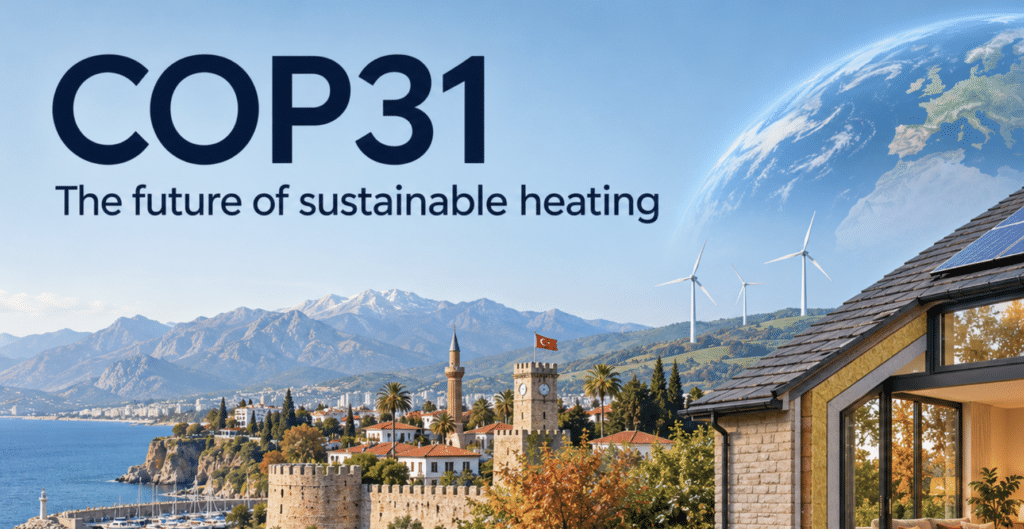
As COP31 begins in Antalya this week, these connections need closer attention. International climate agreements deliver benefits only when they translate into practical changes: better buildings, cleaner energy, affordable improvements, and heating systems that perform well in real homes.
In our December 2024 article, COP29 — Key Points, we explored climate finance and the challenge of turning international ambition into progress. Our November 2025 article, COP30 — A Focus on Home Heating, brought the discussion closer to home, looking at heating technologies, emissions and the need for change.
COP31 provides an opportunity to revisit both themes. What has carried forward from previous conferences? What should we watch for this year? And what does sustainable heating actually mean for households, policymakers and the heating industry?
What is COP31?
COP31 is the 31st Conference of the Parties to the United Nations Framework Convention on Climate Change. It is scheduled for 9–20 November 2026 in Antalya, Turkey.
This year’s conference has a distinctive leadership arrangement: Murat Kurum is nominated as COP31 President, while Australia’s Chris Bowen serves as President of Negotiations. The partnership brings together responsibility for hosting and the wider action agenda with leadership of the negotiations.
The conference brings governments together to negotiate the international response to climate change. Its relevance extends beyond emissions targets to finance, adaptation and the practical delivery of national commitments.
As the conference opens, it still has final agreements to negotiate. Claims that COP31 has already introduced new heating requirements or agreed a particular technology pathway would therefore be premature.
For the heating sector, the useful question is how the discussions could support the changes already needed in buildings and energy systems.
From COP29 to COP31 — finance, ambition and delivery
Our COP29 coverage highlighted one of the most difficult questions in climate negotiations: who pays for the transition?
At COP29 in Baku, countries agreed a climate-finance goal of at least US$300 billion annually by 2035 for developing countries, with developed countries taking the lead. They also called for efforts to scale finance from public and private sources to US$1.3 trillion annually by 2035.
The relevance to buildings is straightforward. Cleaner technologies require investment, and many households and countries cannot fund the necessary changes without support.
However, international climate finance is not the same thing as a grant for a UK homeowner. Domestic heating support depends on national policies and programmes. The connection is that both face the same underlying challenge: making climate action financially achievable.
COP30 in Belém continued this discussion. Its outcomes included initiatives to support implementation, indicators for adaptation and a call for efforts to at least triple adaptation finance by 2035. However, the conference did not secure the stronger fossil-fuel transition language sought by some participants. Progress and unresolved disagreements existed alongside one another.
Australia describes COP31’s focus as delivery: turning Paris Agreement commitments into practical outcomes. For heating, that means looking beyond announcements to the infrastructure, skills and support needed to make change happen.
Why heating matters to the climate discussion
Heating is sometimes treated as a smaller environmental issue than electricity generation or transport. Globally, it is a major part of energy demand.
The International Energy Agency’s Renewables 2025 report states that heat accounted for almost half of total final energy consumption and 37% of energy-related CO₂ emissions in 2024. This includes industrial heat as well as building heating; it is not a statistic about household heating alone.
The report also identifies an important problem: renewable heat is growing, but rising demand can absorb much of that progress. Under its forecast, renewable heat growth during 2025–2030 would meet only around 70% of the increase in global heat demand, leaving fossil-fuel use for heating still rising.
This helps explain why sustainable heating needs two changes together: cleaner ways of producing heat and lower demand for it.
Installing cleaner equipment matters. So does reducing the amount of warmth that escapes through roofs, walls, windows and uncontrolled draughts.
Climate agreements and household heating rules are different
COP conferences influence the direction of policy, investment and international cooperation. They do not normally prescribe which appliance an individual household must install.
The link between a global commitment and a home improvement involves several stages: national climate plans, legislation, building standards, energy-market decisions, funding and local delivery.
This distinction matters when reading headlines. A political commitment is not necessarily a legal requirement. A government consultation is not a final regulation. A technology target is not evidence that every home must follow an identical timetable.
The same care applies to international building initiatives. Launched at COP28, the Buildings Breakthrough seeks to make near-zero-emission and climate-resilient buildings the norm by 2030. It is a collaborative ambition, rather than a rule requiring every existing building worldwide to achieve that standard by the same date.
For households, the practical response is to understand the direction of change while checking the requirements and support that actually apply to their property.
Sustainable heating starts with the building
A heating system cannot be assessed properly without considering the home around it. A draughty house with substantial heat loss presents a different challenge from a well-insulated property. Room sizes, occupancy, ventilation, existing pipework and the space available for equipment can all affect the appropriate solution.
A useful starting point is a whole-home assessment that considers:
1. Where heat is being lost.
2. Which improvements would deliver worthwhile benefits.
3. How ventilation and moisture will be managed.
4. How much heat each room needs.
5. How the household uses the building throughout the day.
Insulation and draught reduction can reduce the energy needed to maintain comfort. They also help prepare a property for changes to its heating system. A whole-building approach is recommended in consumer guidance on heat-pump installations.
That certainly doesn’t mean every home needs a complete renovation before its heating can improve. What it does mean is that improvements should be planned together, with attention to the building’s condition and the household’s priorities. For COP31, this offers a useful test of delivery: will the transition help people improve the buildings they already occupy, as well as setting ambitions for new construction?
Why electrification has a central role
Electrification is central to the transition because heating can increasingly use lower-carbon electricity. However, different electric heating technologies use that electricity differently.
A direct electric heater converts electricity into heat at the point of use. A heat pump uses electricity to move heat from outside air, the ground or another source into a building. A well-designed and installed heat pump can typically deliver around three to four units of heat for each unit of electricity consumed.
This distinction is important when comparing efficiency claims. An electric fire and a heat pump may both use electricity, but they do not consume the same amount of electricity to deliver the same amount of heat.
Direct electric heating can still serve particular needs, including occasional or supplementary room heating, known as zonal heating. But choosing a system for an entire home requires a broader comparison of heat demand, operating hours, tariffs and installation costs.
The useful question is not simply whether an appliance is electric. It is how much electricity the household will need to obtain the comfort it wants.
Affordability must be part of the transition
A technically efficient system is not automatically affordable for every household.
Upfront cost, access to finance, energy tariffs and the suitability of the property all influence decisions. A household facing an unexpected breakdown has different options from one planning improvements several years ahead.
This is why the heating transition needs predictable support and clear information. People should be able to compare:
The complete installed cost, including associated work.
1. Expected annual energy consumption.
2. Running costs under realistic tariffs.
3. Servicing and maintenance requirements.
4. Expected equipment life and future replacement needs.
The UK Climate Change Committee’s June 2026 progress report called for faster electrification and identified slowing growth in heat-pump installations in existing homes. It also highlighted the importance of electricity costs and the relationship between fossil-fuel dependence, household expenditure and energy security.
For policymakers, this means emissions reductions and household affordability need to be designed together. Asking people to change without making the process practical risks delaying the transition.

Where does wood burning fit?
Our previous COP articles discussed wood as a renewable fuel and the role of modern stoves. That discussion needs to distinguish renewability, carbon impact and air quality.
Wood can be replenished through growth, but this does not make every use of wood automatically carbon neutral.
Burning releases carbon dioxide. The wider climate impact depends on the source of the wood, changes in forest carbon stocks, processing, transport, the efficiency of combustion and the period over which emissions and regrowth are assessed.
Modern Ecodesign wood-burning stoves can significantly improve performance compared with older, inefficient stoves and open fires. However, wood combustion efficiency still depends on good operation and fuel quality.
Carbon emissions and clean air need separate attention
Climate impact and local air pollution overlap, but they are not interchangeable measures. A renewable fuel can still produce harmful emissions where it is burned. Equally, an appliance with no combustion inside the home can have emissions associated with its electricity supply, manufacture and eventual disposal.
Domestic wood heating is recognised by the United Nations Economic Commission for Europe as a significant source of particulate matter and other pollutants. Its guidance focuses on reducing these emissions through better practices and technology.
A credible sustainable-heating assessment should therefore ask several questions rather than relying on a single label:
How much energy does the system use?
What are its greenhouse-gas emissions?
What pollutants does it release locally?
How does it perform under everyday operating conditions?
For manufacturers and consumers alike, greater clarity around these questions is more useful than broad claims that an entire fuel category is simply green.
What should we watch for at COP31?
For the future of home heating, five questions will help distinguish useful progress from general ambition.
1. Will national commitments be supported by credible delivery plans?
Targets need practical measures for existing buildings, with funding, responsibilities and timescales that can be examined.
2. Will finance become easier to access?
The international discussion concerns countries with very different resources. Within each country, the same attention is needed for households unable to fund improvements themselves.
3. Will energy efficiency receive as much attention as new supply?
Cleaner energy is essential, but avoiding unnecessary demand can make the transition more manageable.
4. Will progress include skills and installation quality?
A heating transition depends on trained people who can assess buildings, design systems, install them correctly and support customers afterwards.
5. Will reporting focus on real outcomes?
Equipment sales and announced investment are useful indicators, but they do not tell the whole story. Energy use, emissions, affordability and comfort in occupied homes are the outcomes that are important.
These are tests for interpreting COP31’s significance. They are not claims about agreements already reached.
A more practical conversation about sustainable heating
The connection between COP29, COP30 and COP31 is increasingly clear. Finance establishes what may be possible. Climate commitments set the direction, and delivery determines what changes in homes.
For us, participating responsibly in this conversation means explaining the differences between technologies, recognising the conditions attached to environmental claims and helping people understand the wider heating system.
For homeowners, it means considering the building, the energy supply and the appliance together. For policymakers, it means making improvements achievable across different incomes, property types and locations.
COP31 will ultimately be judged on what follows its negotiations. In home heating, that progress should be visible in lower energy demand, reduced emissions, cleaner air and homes that people can afford to keep warm.