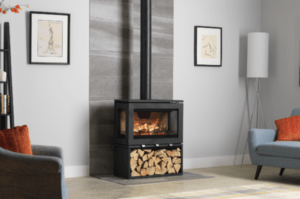
For many, the way a wood-burning stove is simple. You light up, move a slider or two, and heat comes out. In reality, a modern Ecodesign stove is a carefully managed combustion system. The biggest difference between an older stove and a modern Ecodesign model is the way the stove controls, preheats and stages combustion air. The Ecodesign rules for solid fuel local space heaters are now law and came into force on 1 January 2022. Those rules set minimum efficiency and emissions requirements, including limits for particulate matter, organic gaseous compounds, carbon monoxide and nitrogen oxides. For a closed-fronted stove burning logs, the regulation sets a minimum seasonal space-heating efficiency of 65%, plus maximum emissions of 40 mg/m³ PM, 120 mgC/m³ OGC and 1,500 mg/m³ CO at 13% oxygen.
Understanding Airflow:
The easiest way to understand stove airflow is this: primary air starts and supports the fuel bed, secondary air burns the smoke, and tertiary air finishes the burn in the hottest part of the firebox. That is a simplification, but it is a useful one. As a stove manufacturer, we like to describe Ecodesign wood-burning stoves as carefully engineered staged-air systems. Rather than introducing all combustion air through a single inlet, we design our appliances to deliver air in multiple, controlled streams to optimise efficiency and performance.

Primary air: the air that gets the fire established
Primary air is the air that enters low down in the stove, typically through the grate area or the bottom of the firebox, so it reaches the wood directly. From a technical perspective, this stream of air is in direct contact with the logs. From a user perspective, it is the air that helps kindling catch quickly, pushes a new load of wood into flame, and helps the stove reach operating temperature.
Primary air is usually not the main air supply for the whole burn. It is most valuable at the beginning, when the stove is cold, and the fire needs help. Leave it too dominant for too long, and you tend to drive the fire hard against the fuel bed, without giving the upper firebox the best conditions for clean afterburning of the gases the wood releases. In other words, primary air is about getting the fire going, not about extracting the maximum possible heat from the smoke above it. That is where secondary and tertiary air come in.

Secondary air: the air that turns smoke back into flame
Secondary air is where modern stove design becomes much more sophisticated. The defining feature of newer clean-burning stoves is secondary combustion: a second combustion chamber that burns off smoke before it exits through the flue. Stoves inject fresh secondary air into the top of the primary combustion chamber and use multiple air channels and baffles to trap heat in the firebox, allowing the gases to ignite. In many stoves, secondary combustion appears as small jets of flame near the inlets.
In practical stove language, secondary air is usually introduced above the logs, often via the airwash system, as seen in our range, which also helps keep the glass cleaner. It is best described as preheated air, because if cold air were injected into the upper firebox, it would cool the gases and make clean combustion much harder. Smoke is not just waste; it is unburned fuel. When wood gets hot, it releases combustible gases and vapours. If those vapours pass through a hot, oxygen-rich zone, they burn, adding heat to the room. If they do not, they go up the chimney as smoke, soot and creosote-forming compounds. Secondary air exists to give those gases a second chance to burn. That is why a modern Ecodesign stove often seems to come alive once the firebox is hot: the flames are no longer just on the logs, but in the space above them.
Tertiary air: the finishing air for complete burnout
Tertiary air is the least understood of the three, partly because not every stove has it and partly because it is often not user-adjustable. On many modern stoves, tertiary air is an additional stream of combustion air introduced through holes or channels at the rear or upper part of the firebox.
At a user level, the simplest explanation is that tertiary air is the stove’s built-in clean-up crew. Primary air gets the logs going. Secondary air burns much of the smoke above the fuel bed. Tertiary air injects more oxygen into the hottest upper region so that the last stubborn hydrocarbons and carbon monoxide have a better chance of oxidising before they leave for the flue. You often do not operate the tertiary air directly; your stove designer has already decided how much should enter and where it should be aimed. That fixed geometry is a clue that tertiary air is really an engineering tool, not a user convenience. It is there to help the stove burn better, even when the user sees only one or two controls.
Our patented tertiary air-profiling system meets the clean combustion and high-efficiency requirements to exceed the 2022 Ecodesign Directive.
Why Ecodesign stoves use these air streams better than older stoves
Older non-Ecodesign stoves were not all the same, but many relied on a more basic firebox and a less refined version of post-combustion airflow. What makes an Ecodesign stove burn efficiently and cleanly is secondary combustion, which is what differentiates it from older models. They are designed to manage the fire in stages, keep the upper chamber hot enough for gas ignition, preheat the combustion air, and hold gases in the firebox long enough for more complete burnout.
In simple terms, an Ecodesign stove is more efficient than an older non-Ecodesign stove because it wastes less of the wood as smoke. The extra heat comes from burning more of the combustible gases that older stoves often allowed to escape. If you can turn vapours, soot and carbon monoxide into flames inside the stove rather than smoke outside at the chimney, you get more useful heat from each log and fewer pollutants per unit of heat delivered. That is the whole logic of staged air.
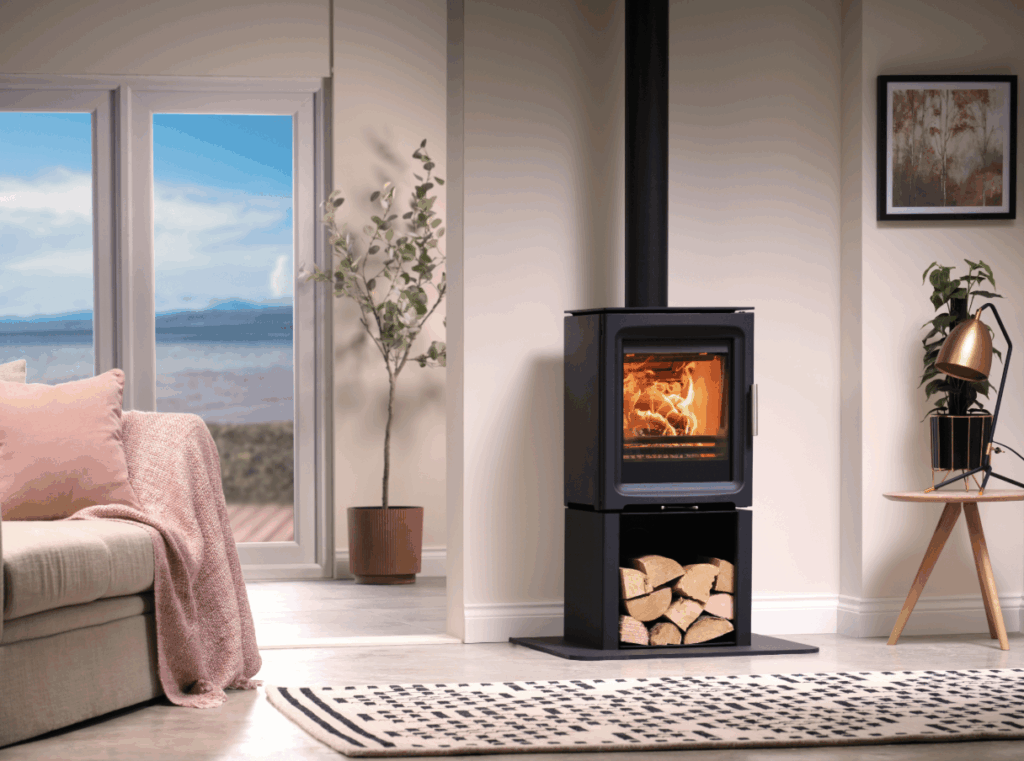
The deeper science: from log to flame to charcoal
Scientifically, a wood fire does not burn in one simple step. First, the remaining moisture must be driven off. Then the hot wood begins to pyrolyse or devolatilise. As the temperature rises, it breaks down, releasing gases, vapours, and tars. Gases evolve broadly between about 200°C and 400–450°C, with tar formation in the 300–450°C range. The volatile-removal stage (primary pyrolysis or devolatilization) occurs at 200–500°C, followed by char oxidation at higher temperatures, typically 500–800°C, depending on conditions.
That is important because the yellow flames you see above a log are mostly gas-phase combustion, not the wood surface itself simply being on fire. After the volatile-rich phase, a more carbon-rich char remains, and that char then oxidises more slowly. A good stove, therefore, has to handle two linked but different jobs: it must support the solid fuel bed, and it must also oxidise the volatile gases leaving that bed. If either job is done badly, combustion becomes incomplete. Incomplete combustion means more CO, more organic vapours, more particles, less heat to the room, and more deposits in the flue.
From a combustion-engineering perspective, the clever part is that more air is not automatically better. The reason is subtle but essential: too much air too early can dilute and cool the flames, while too little air later leaves combustible gases unburned. The same guidance notes that complete burnout depends on thorough mixing and sufficiently long residence time at high temperature. That is why modern stoves use baffles, chamber shape, insulated linings, air-nozzle geometry and preheated air rather than just bigger vents.
So, at the deepest level, primary, secondary, and tertiary air are not just three oxygen feeds. They are a way of controlling the classic combustion variables of temperature, oxygen availability, mixing and time in different parts of the firebox. Primary air helps drying, ignition and fuel-bed reactions. Secondary air promotes hot oxidation of pyrolysis gases. Tertiary air fine-tunes the last stage of burnout in the upper chamber. Ecodesign stoves are more efficient because they choreograph those stages better than older, simpler stoves.
Making sure you run it right
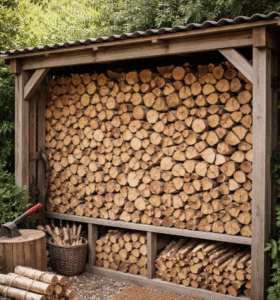
Even the best airflow design cannot rescue bad fuel or bad user operation. Domestic firewood should have a moisture content of 20% or less, Dry wood burns more cleanly and efficiently than wet wood. Wet logs waste energy boiling off water, cool the firebox, and make it harder for secondary and tertiary combustion to light properly. In practice, that means more smoke, dirtier glass and lower useful heat.
That is why the best user habit for a modern wood stove is usually this: light the fire briskly, get the stove hot, use dry logs, reduce primary air once the appliance is established, and let the stove’s secondary and tertiary systems do their job. Exact settings vary by model, but the principle is universal. A modern Ecodesign stove is designed to burn through the smoke, not merely vent it away. Once you understand that, the three air streams start to make perfect sense.