Wood-burning stoves are available in a range of heat output ratings, measured in kilowatts (kW). This rating indicates the maximum heat the stove can produce, and selecting the correct kW output is crucial for efficient and comfortable heating.
Too little output and your room may stay chilly; too much and you risk overheating the space and wasting fuel.
Common Wood-Burning Stove Outputs:
Wood-burning stoves typically range from around 4kW on the smaller end to approximately 8–10kW for the larger models. Our lineup, for example, spans this spectrum, from compact 4–5kW stoves ideal for snug cottages or narrowboats, to 8kW models suited for spacious living areas. Here’s a breakdown of typical stove output categories and some model examples:
Small Stoves (4-5kW): A small stove is typically defined as having an output of approximately 4 to 5kW. These are perfect for heating smaller rooms, cosy cottages, canal boats, or well-insulated modern living rooms. Our Fireline 4kW Stove (FX4) delivers 4kW of heat, pictured below. Despite its petite, narrow design, it delivers large-stove performance in a compact package. The Fireline 4kW’s curved glass door provides a superb view of the flames, and an optional log store (not shown) elevates the stove while adding convenient wood storage.
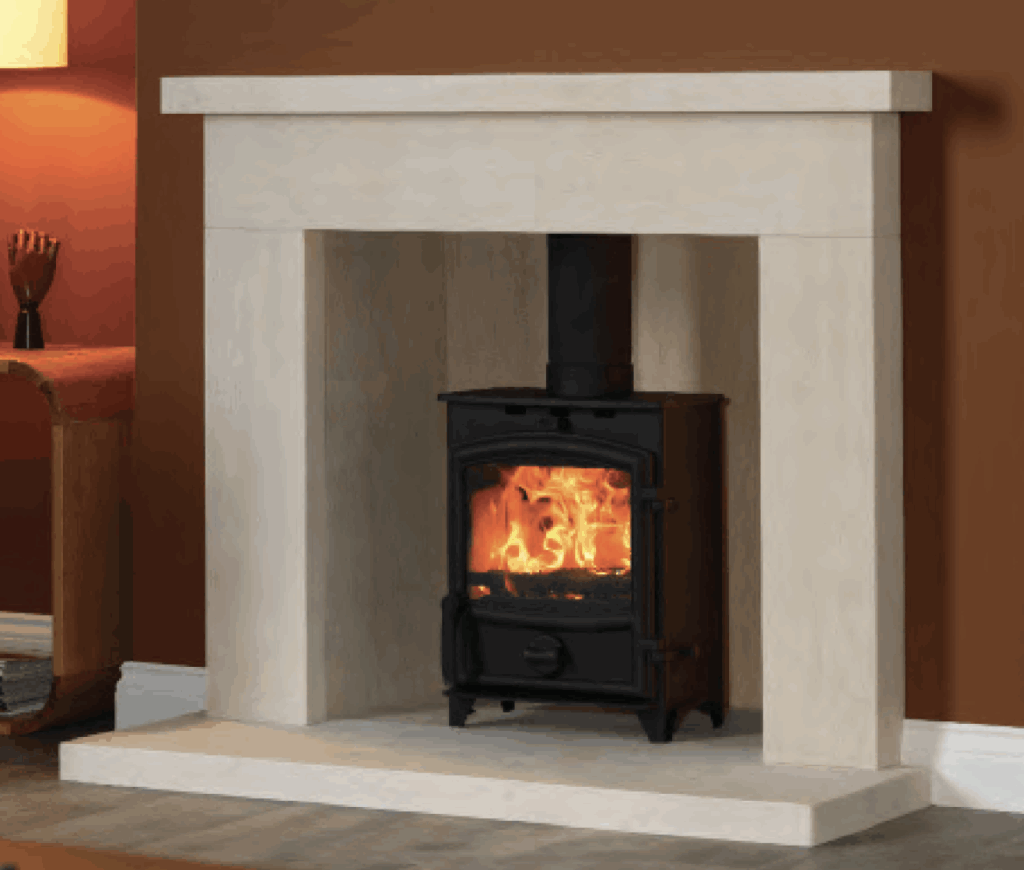
Another example is our Woodtec 5kW Stove, pictured below, a refined 5kW model with modern styling. The Woodtec 5kW is easy to operate, utilising a single advanced air control system and featuring a powerful airwash system to keep the glass clear.
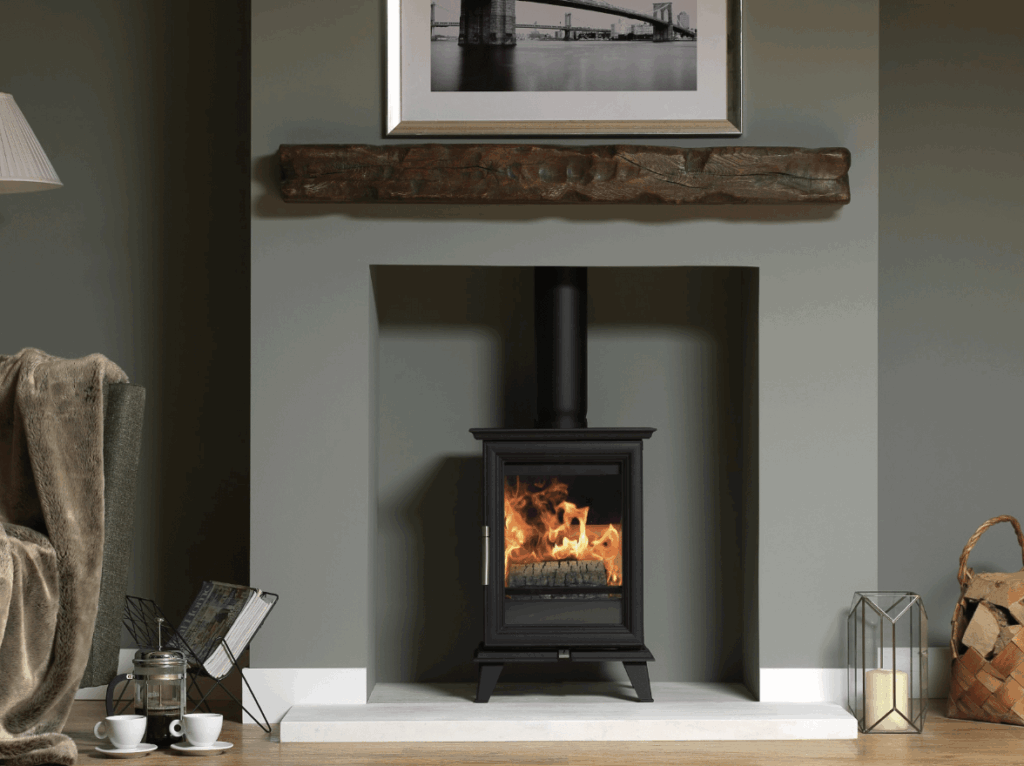
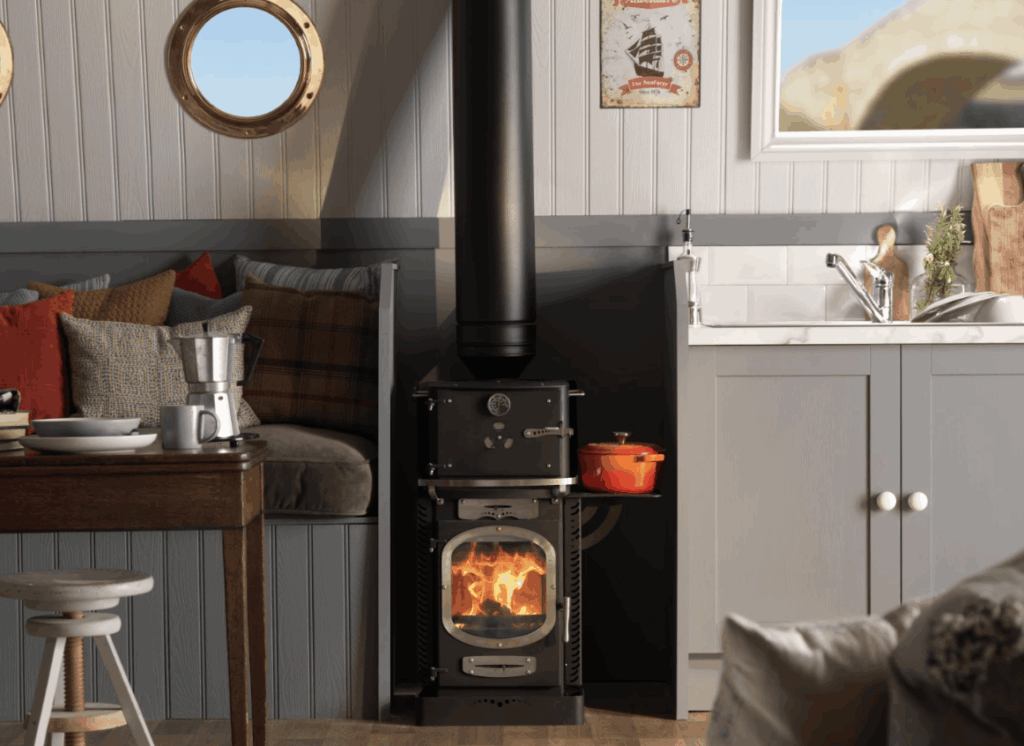
We also offer specialised small stoves, such as the Go Eco Adventurer 5, a 5kW stove pictured below, designed for very tight spaces, including glamping pods, cabins, or narrowboats. It doubles as a cooking stove on its top plate. In short, stoves in the 4-5kW range can pack surprising heat for their size and are often the go-to choice for small to medium rooms.
Medium Stoves (5-6kW): Many of the most popular wood-burning stoves fall within the 5kW range. In fact, a 5kW stove is often considered the standard for average living rooms because it provides ample warmth for a standard medium-sized space, while usually avoiding extra installation hurdles (more on ventilation later).
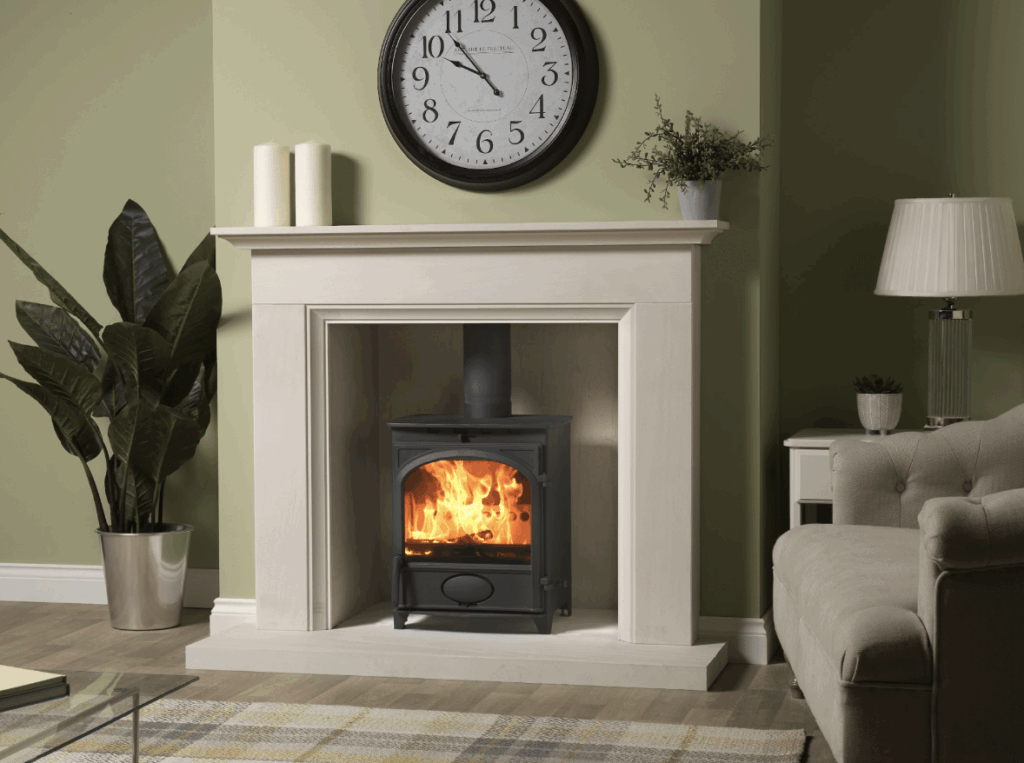
Our 5kW range encompasses several 5kW models in various styles. For example, the Purevision 5kW stove, pictured below, offers contemporary, clean-burning efficiency and is ideal for smaller rooms, where you don’t require the power output of a larger 8kW stove. There are also 5kW “wide” stoves with a wider body or door, providing a larger flame view, which still output around 5kW but accommodate longer logs or feature a different aesthetic.
Medium-sized stoves like these are versatile for many homes; they’ll keep a typical lounge comfortably toasty without running too hot. Additionally, 5kW is a key threshold: in the UK, stoves with a nominal output of up to 5kW generally do not require a dedicated air vent in older homes, whereas higher outputs do. This makes the 5kW class especially convenient for many installations.

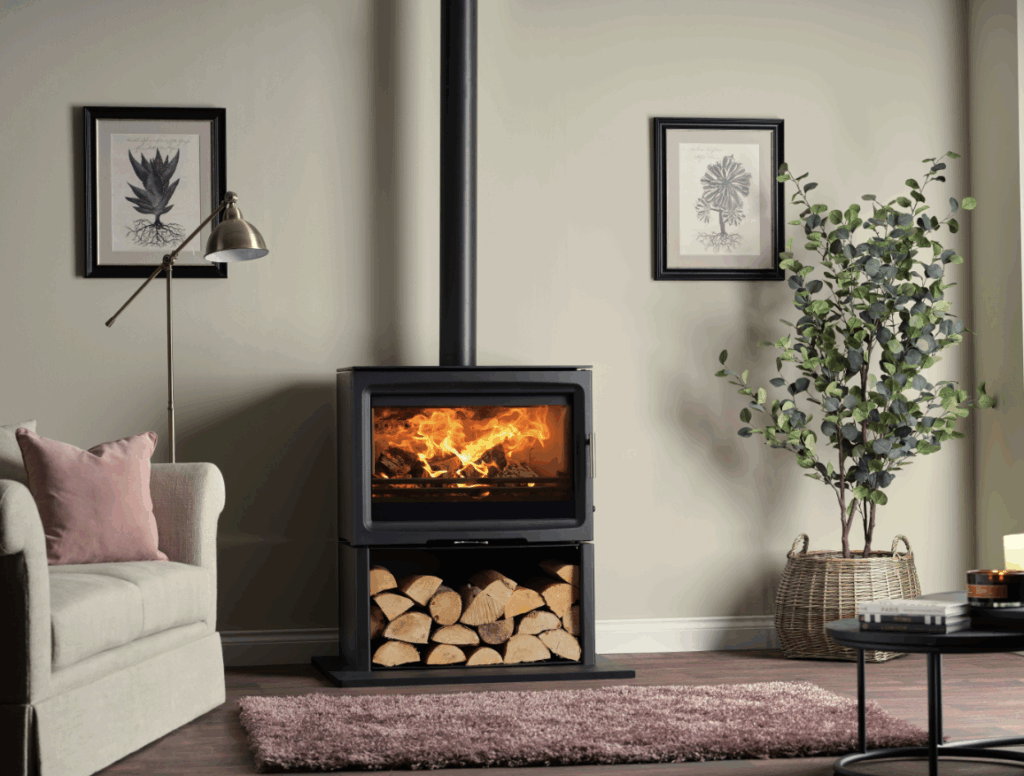
Large Stoves (7-8+ kW): Stepping up to a large wood-burning stove allows you to heat a larger volume, such as open-plan areas, high-ceiling rooms, or older, draughty houses that require more heat. Our larger models include the Fireline 8kW Stove (FX8), pictured below, and the Purevision BPV8 multi-fuel stove. The Fireline FX8, with a nominal 8kW output, is a heavy-duty freestanding stove designed to deliver substantial heat, making it ideal for large rooms or spacious lounges. It features an extra-wide glass window, allowing you to enjoy the flames in larger spaces.
The Purevision BPV8, pictured below, is even more powerful, with a rated nominal output of approximately 8.5kW and the largest size in the range, designed for very large rooms or those requiring substantial heat. In fact, the BPV8’s operating heat output can range roughly from 4.9kW up to 10kW on high, giving it plenty of headroom for the coldest nights.
These high-output stoves feature robust construction and often incorporate design enhancements to withstand the heat. This Purevision 8.5kW model can be fitted with an optional external air kit that directly supplies combustion air from outside the house. This is a clever solution that provides ample oxygen to a large stove and could eliminate the need for indoor vents, even at higher output. While large stoves are excellent for open-plan living areas, big farmhouses, or even heating multiple adjoining rooms, they must be chosen carefully to avoid overwhelming a space.
Choosing the best kW Stove for your home:
How do you determine what heat output you need from a stove? The key is to match the stove’s kW rating to the size of the space you want to heat, while also accounting for your home’s insulation and layout. An overly large stove will run too hot and be throttled down most of the time, which is inefficient, whereas an undersized stove will struggle to keep you warm. Here are some steps and considerations for finding the ideal stove output for your home:
1. Calculate Your Room’s Heating Requirement. A simple rule of thumb for stove sizing is to measure the room’s volume and use it to estimate the required kW. Measure the room’s length × width × height (in meters) to get the volume, then divide by 14 to get a rough kW figure. This calculation assumes you want to raise the room to a comfortable temperature from a cold baseline. For example, if your room is 6 m long, 5 m wide, and 2.5 m high, the volume is 75 m³. Dividing 75 by 14 gives approximately 5.35, suggesting that a roughly 5kW stove would be appropriate. In this case, you’d likely be looking at stoves in the 5kW range for optimal heating. This is a general guide for a typical room and average insulation; it serves as a starting point, not a definitive answer.
2. Consider Insulation and Other Factors. Every home is different. A well-insulated modern home holds heat much better than a draughty period cottage, so you might get by with a lower kW in a new build than the room volume alone suggests. Conversely, a poorly insulated room or one with numerous large windows may require additional heating power.
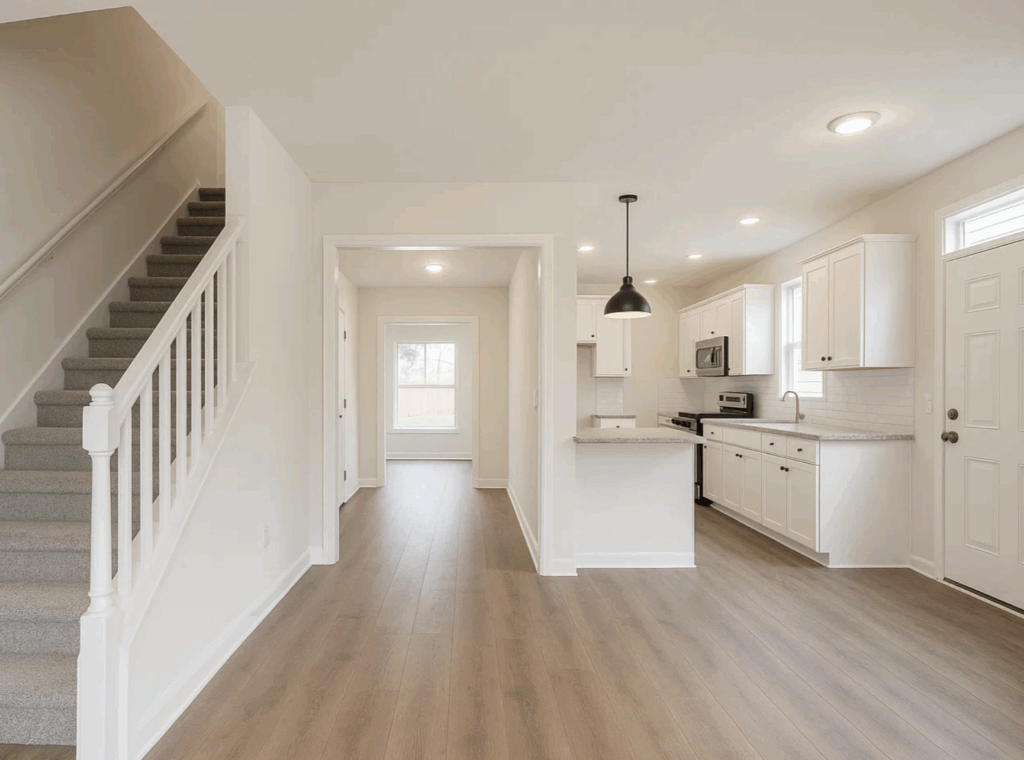
Factors like how warm you prefer the room, the number of external walls/windows, and whether the space is open-plan can all influence the required stove size. For example, if you have an open-plan layout where heat will dissipate to adjacent areas, you may lean towards the higher end of the range or even the next stove size up. Climate matters too; in a very cold region or if you want the stove as a primary heat source, rather than occasional use, err on the side of a little more output. Essentially, treat the volume-based kW estimate as a baseline and adjust for your specific situation. If your home is exceptionally well insulated, you might downsize slightly; if it’s quite leaky or expansive, consider upsizing or using multiple heat sources.
3. Consult Resources or Professionals. It’s wise to use online stove size calculators or seek advice from stove retailers/installers. Many stove retailers offer calculators that let you enter room dimensions, insulation level, and desired temperature, then recommend a specific kW range. Ultimately, a HETAS-certified installer or stove professional can conduct a survey and provide you with a precise recommendation. A professional survey will provide a better understanding of the perfect stove for your space, beyond the simple volume formula.
4. Mind the 5kW Ventilation Threshold. As mentioned, one practical factor is the 5kW rule: building regulations typically require that rooms with stoves exceeding 5kW have a fixed air vent to supply combustion air, thereby preventing the room from drawing too much air. If your calculation indicates that you need a 6kW or 8kW stove, be prepared for the installer to fit an air vent in an external wall. Many homeowners intentionally opt for a 4.9 or 5kW stove to avoid the need for an extra vent, especially in older homes that are naturally a bit leaky and don’t otherwise require one.
However, if your home is very airtight, such as a new construction or recently insulated home, even a 5kW stove might require a vent anyway. The good news is that some stove models (including several Charlton & Jenrick stoves) offer external air kits; these allow the stove to draw air directly from outside via a pipe, rather than from the room. Using an external air supply can satisfy the ventilation requirement and maintain your room’s cosiness, an option to discuss with your installer if you’re going for a higher output stove. In summary, when selecting a stove output, consider how it will be installed and ventilated to avoid unexpected additional requirements.
Making sure you get the right heat output:
Once you’ve selected a stove rating that seems right on paper, there are a few checks and steps to ensure it truly meets your needs:
Double-Check with Real World Usage: Think about how you will use the stove. Is it for occasional cosy evenings, or will it be a daily heating workhorse? If it’s occasional, you might manage with a slightly smaller stove, as you can always supplement with central heating on the coldest days. If it’s your primary heater in winter, don’t undershoot the kW. Also consider the fuel: burning very well-seasoned hardwood will yield a closer approximation to the stove’s rated output, whereas burning wood that isn’t fully dry will produce less heat. A stove’s kW rating assumes ideal fuel and conditions.
Look at the Manufacturer’s Output Range – Real-World Usage: Consider how you will actually manage the nominal output (e.g., 5kW) and the operating range for that model. For instance, the 8kW Fireline stove has a tested output range of about 5.8kW up to 8.2kW. This means you can run it a bit lower or higher than nominal as needed. If your room needs around 6kW on a very cold night, a 5kW stove might struggle, whereas a stove with a nominal 5kW but an upper range of 7kW could handle it when fully loaded. Check the technical specs or ask the dealer about the heat output range, not just the nominal figure. This will give you a sense of the stove’s flexibility.
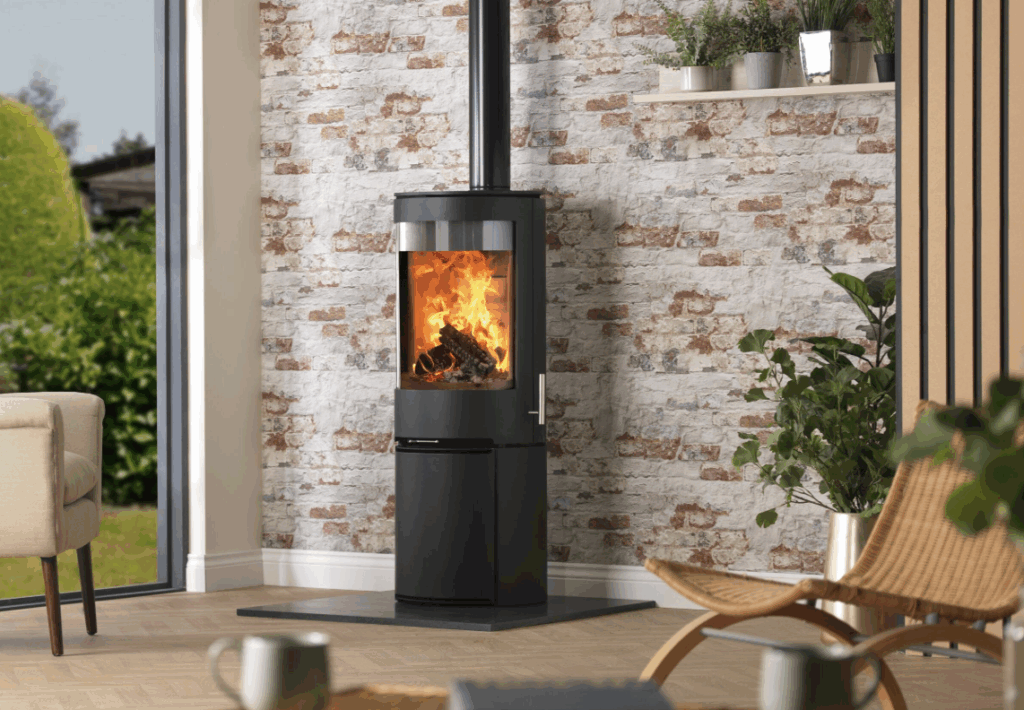
Plan Your Room Layout and Clearance: Make sure the physical size and placement of the stove in your room is appropriate, because where you install it can affect how well it heats the space. A centrally located stove or a corner stove, as long as it has proper clearance, can distribute heat more evenly. Our cylindrical corner stoves, for example, all have an output of around 5kW, which is ideal for standard living spaces. Placed in a corner, they can comfortably heat the room without overpowering it. Ensuring the stove isn’t tucked away behind furniture or in a recess that blocks heat radiation will help you fully benefit from its kW output.
Purevision PVR Cylinder Stove:
Future-proofing: If you anticipate changes, such as room extensions or improvements in insulation, factor those into your plans. You don’t want to buy a stove that’s just right for now but too small after a renovation. On the other hand, if you plan to super-insulate your house, an originally needed 8kW stove might become overkill in a couple of years. It’s a balancing act; again, a stove with a broad output range or one size up/down might be considered depending on your plans.
Professional Installation and Advice: Finally, work with a qualified installer. They will confirm whether your chosen stove is appropriate and safe for the room. They might do a ventilation test or inspection to ensure compliance. An experienced professional will have seen the consequences of both mistakes and can steer you to the right choice if you’re uncertain.
By following these steps, calculating needs, checking specifications, and consulting experts, you’ll greatly increase the chance that the kW output you select is the right solution for your home.
Why an oversized or undersized stove can be a problem:
It’s worth emphasising the downsides of getting the sizing wrong, because this can be a common issue for first-time stove buyers:
If the Stove’s Too Large: Bigger Isn’t Always Better with Stoves. A stove with a higher kW than you need will overheat the room quickly. You might find yourself opening windows in the middle of winter, which defeats the purpose of efficient heating. Running a stove too low, to compensate for it being too powerful, can also cause issues. When a high-capacity stove is damped down constantly, it often results in incomplete combustion, and the fire smoulders instead of burning cleanly. This can lead to a build-up of soot and creosote in the chimney and brown stains on the stove glass, because the stove isn’t burning hot enough to stay efficient. You’re essentially wasting wood and money.
Additionally, as mentioned, an oversized stove may require extra installation, such as vents or air bricks in your room, since it needs more ventilation. For example, an 8-10kW stove definitely requires proper ventilation, installing one without an air supply could be unsafe and is against building regulations.
If the Stove’s Too Small: On the flip side, under-sizing has its own problems. A stove that’s too small for the space will struggle to maintain a comfortable temperature. You’ll probably find you have to run it at maximum output all the time, refuelling constantly to try to eke out more heat. Even then, the room may never reach the warmth you want on a cold evening. Operating any stove continuously at maximum can shorten its lifespan; the high burn rates can wear out internal parts more quickly. You also risk over-firing the stove, which occurs when you load too much wood or run the air controls wide open for too long, in an attempt to generate more heat. This can potentially damage the stove or flue.
Essentially, an underpowered stove will be inefficient because it is being pushed beyond its ideal operating range. An undersized unit may simply not provide sufficient warmth for the space. This can lead to frustration, as the whole point of a wood stove is to be cosy. If you realise too late that the stove isn’t keeping up, the remedies are not great; you might need to supplement with electric/gas heat or replace the stove with a larger model. Thus, it’s far better to size correctly up front than to live with a chilly room due to an underpowered stove.
Selecting the right kW output for a wood-burning stove is one of the most important decisions in buying a stove. It ensures you get maximum enjoyment, efficiency, and value from your investment. The good news is that with the wide range of stove outputs and models available today, there’s a perfect match for every home.