Why people switch, what changes technically, and why Ecodesign models pollute less
There’s something timeless about an open fire: the sound, the smell and the incredible ambience. But if you want a fire to do much more than just look nice, if you actually want usable heat, good performance, and lower emissions, an open fire, unfortunately, is fighting you on almost every level.
That’s why so many homeowners end up moving from an open fire to an Ecodesign wood‑burning stove. The change isn’t just cosmetic. It’s a shift from uncontrolled to engineered combustion, and that has a big impact on efficiency, fuel use, smoke production, and what ends up in the air outside (and inside) your home.
What an open fire is doing from a combustion point of view
When you burn wood, you’re not simply burning a log. Wood combustion happens in stages:
Drying: energy is spent driving moisture out of the wood.
Pyrolysis: heat breaks wood down and releases combustible gases and vapours, the smoky part.
Flaming combustion: those gases burn if there’s enough temperature and oxygen in the right place.
Char combustion: after volatiles are driven off, the remaining carbon-rich char burns more steadily.
Open fires struggle most with the volatile stage. Wood contains a high fraction of volatile matter, which needs good mixing, high temperature, and enough residence time to burn cleanly.
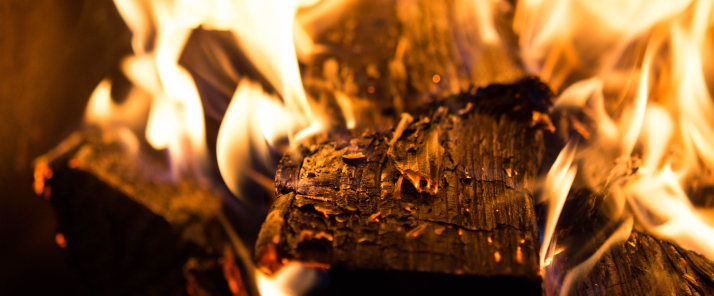
The problem is that an open fire is basically an open mixing bowl connected to your chimney. You get:
* High, uncontrolled excess air rushing through the firebed
* Fast dilution and cooling of the flue gases
* Little or no secondary combustion (meaning smoke and unburnt gases often escape before they can finish burning)
Essentially, open fires are inefficient combustion devices that produce significant unburnt combustibles, largely due to excess uncontrolled air and the lack of secondary combustion.
Why are open fires smoky and poor at heating a room?
Open fires often feel hot when you’re right in front of them because you’re getting radiant heat. But the overall heat balance of the house can be disappointing because a large portion of the combustion heat leaves in the exhaust gases. Warm room air is constantly pulled up the chimney and replaced by colder outside air, and in some conditions (cold outside air, poor combustion, smouldering), the fireplace can even create a net heat loss in the home, which is far from ideal.
That draughty lounge feeling many people associate with fireplaces isn’t just imagined, it’s a direct consequence of how open fires move air, and when combustion is incomplete, especially during lighting, slumbering, or using damp logs, you also see far more smoke, soot, and tarry deposits, which can build up in the flue.
Pollution: what’s actually in the smoke?
Wood smoke isn’t one single thing. It’s a mix that can include:
* Fine particulate matter (PM2.5/PM10): tiny particles that penetrate deep into the lungs
* Carbon monoxide (CO): formed when carbon doesn’t fully oxidise to CO₂
* Volatile organic compounds (VOCs) and organic gaseous compounds (OGCs): unburnt or partially oxidised vapours
* Black carbon and other soot-like material
* Polycyclic aromatic compounds (some are carcinogenic), especially under incomplete combustion conditions
In the UK, inefficient domestic burning is treated as a contributor to fine particulate pollution, and government guidance explicitly flags PM2.5 as a key concern from open fires.
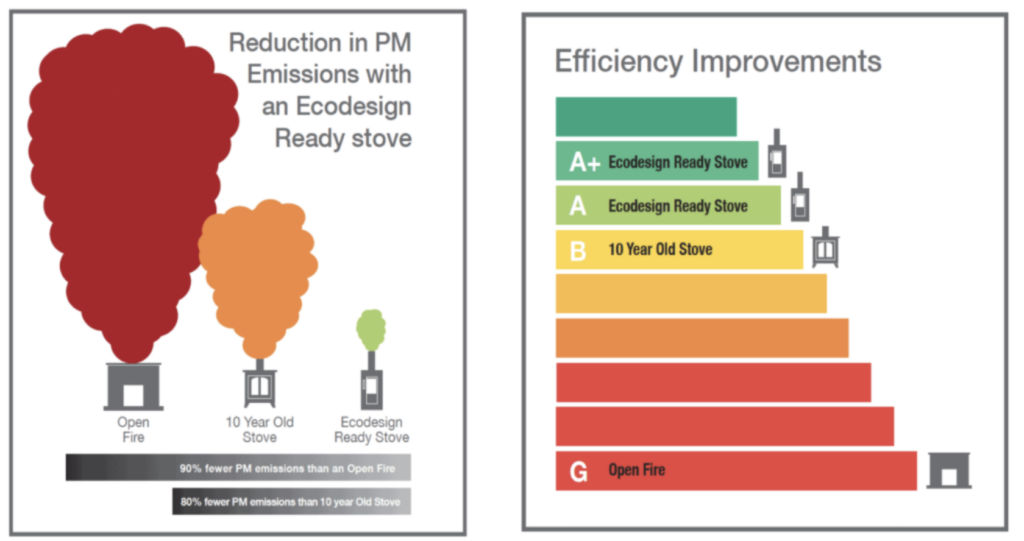
A University of Surrey study monitoring real homes found that open fireplaces produced the highest emissions and increased PM2.5 exposure up to seven times compared with an Ecodesign stove.
Our Woodtec 8kW Double Sided Wood Burning Stove:

What makes an Ecodesign stove different?
An Ecodesign stove is so much more efficient because it is an enclosed, controllable combustion system.
A DEFRA-commissioned technical review describes the fundamental difference: open fireplaces have limited or no controls to manage combustion, while enclosed stoves allow greater control, especially of air supply. That control enables several design features that open fires simply can’t replicate – controlled airflow and higher combustion temperatures. Ecodesign stoves regulate how much air enters the firebox (primary air for the fuelbed, and secondary air for the gases above it). Keeping combustion hot also helps reduce smoke and CO.
Secondary combustion
Ecodesign stoves are engineered so the smoky gases released during pyrolysis essentially get a second chance to burn. Adding secondary combustion can reduce emissions by routing unburned gases into a hot, insulated zone where they mix with preheated air.
Longer residence time
Because the firebox is enclosed and baffled, gases spend longer in the hot zone, more time to finish burning, less time leaving as visible smoke.
Better heat transfer
Ecodesign stoves are designed to transfer more heat into the room (radiant + convective), rather than sending it up the flue.
What Ecodesign actually means in practice
Ecodesign isn’t just a marketing word – far from it. It’s tied to regulated requirements for seasonal efficiency and emissions limits for solid fuel local space heaters. All stoves in the UK must be Ecodesign certified, which became law on 1 January 2022.
The Ecodesign regulation sets minimum seasonal space heating efficiency levels and maximum emissions limits. It includes limits for:
Particulate matter (PM)
Organic gaseous compounds (OGCs)
Carbon monoxide (CO)
Nitrogen oxides (NOx)
So, when people say Ecodesign is cleaner, they’re mostly pointing at two things:
* More heat per log (higher efficiency means less fuel for the same warmth)
* Cleaner combustion (lower PM/CO/OGC under test conditions and typically far less visible smoke)
Why do people move from an open fire to a stove?
Most people don’t switch because they suddenly stop liking open fires. They switch because they want one or more of these practical outcomes:
* Real heat, not just ambience: more usable heat into the room, less wasted up the chimney
* Lower fuel consumption: efficiency gains mean fewer logs for the same comfort level
* Better control: you can regulate burn rate and temperature instead of fire doing whatever it feels like
* Cleaner burning and less smoke: especially noticeable outside the home and in the room itself
* Greater compliance and future-proofing: Ecodesign and (where relevant) Smoke Control Area rules influence purchasing decisions
* Safety and cleanliness: fewer sparks, less soot spillage, typically less draught and smell
There’s also a lifestyle reason, stoves are easier to live with day to day. You can light them more predictably, keep the room warmer for longer, and you’re not constantly battling the chimney pulling heat out of the house.
Is converting from an open fire to a stove a hard job?
In the UK, solid fuel installations are building work and must meet Building Regulations requirements (Approved Documents include J for combustion appliances and F for ventilation, among others).
What typically happens in a straightforward conversion
If you already have a fireplace recess and chimney:
* Site survey and appliance selection
* Check fireplace opening, recess dimensions, clearances, hearth, and room ventilation
* Size the stove correctly (too large can encourage slumbering; too small won’t heat well)
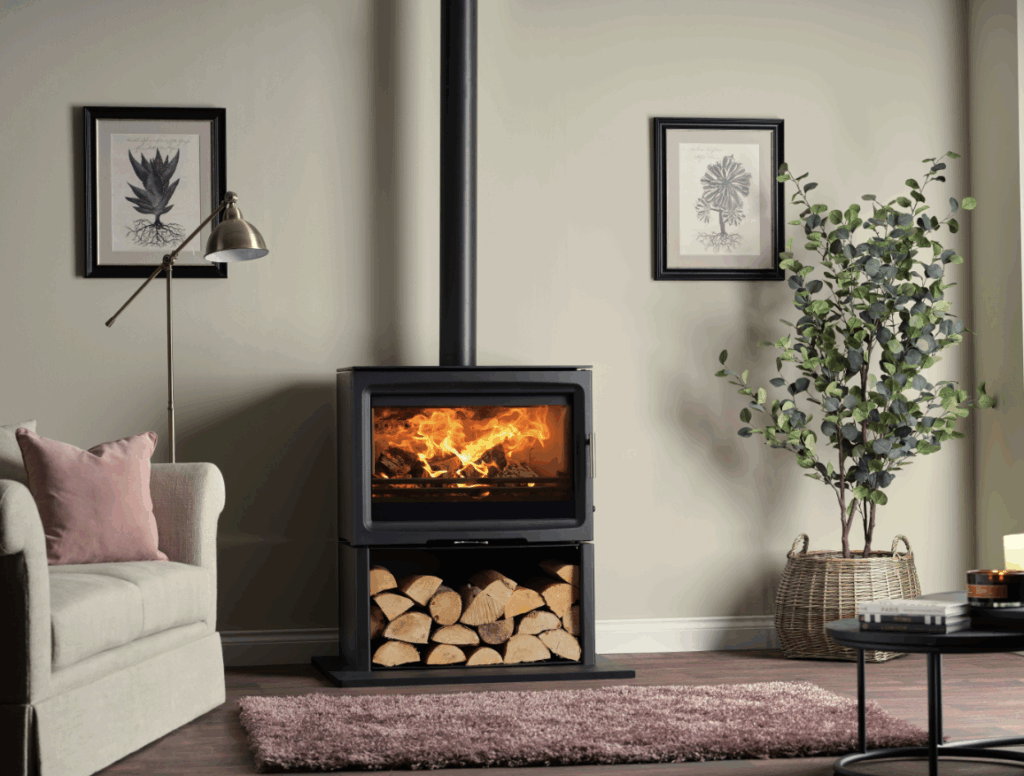
Our Purevision BPV8 Wood-Burning Stove
Chimney inspection and sweeping
* Sweeping removes soot/tar and confirms the flue condition
* Problems found early can save a lot of hassle later
* Flue lining or adapting the flue system
* Many installs use a suitable liner to improve draft, safety, and performance
Hearth and closure plate work
* Ensuring the fireplace and surrounding materials meet safety and heat protection requirements
* Installation, testing, commissioning, and sign‑off
* Correct connection, smoke test/checks, CO alarm, handover instructions
When it becomes more complex
Converting can get more complex if:
* The chimney is damaged, oversized, damp, or unsuitable without major remedial work
* You need additional ventilation in a modern airtight room
* The fireplace recess needs structural changes
* You’re in a listed building or conservation context (where alterations may need extra permissions)
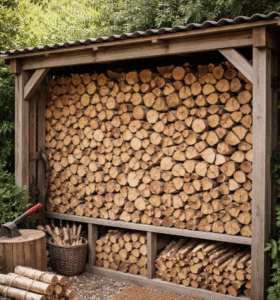
The fuel matters more than people think
Even the best stove can perform poorly if the fuel is poor. We mention this many times in our articles.
Wood should be dry, with around a 20% moisture level. To achieve this ideal moisture level, wood should be seasoned for at least six months, or up to two years for hardwood like oak. Wet or green wood is the primary cause of excessive chimney smoke. Burning damp wood produces less heat and more creosote, a tar‑like residue that accumulates in chimneys and increases fire risk.
So if you want cleaner burning, here is the perfect mix:
* Ecodesign stove
* Dry, appropriate fuel
* Correct operation (avoid long, smouldering burns)
* Regular sweeping and maintenance

In Conclusion:
Switching from an open fire to an Ecodesign wood‑burning stove is one of the biggest upgrades you can make if you love real flames but want far better performance. Open fires have uncontrolled air, limited secondary combustion, and tend to create more incomplete combustion, so they waste heat and produce more smoke.
Ecodesign stoves are engineered to burn gases more completely, use less fuel for the same heat, and meet regulated efficiency and emissions limits.
Moving from an open fire to an Ecodesign stove is an exciting installation project, not a quick swap. But when done correctly, it replaces a beautiful but inefficient heat source with something that’s both more practical and significantly cleaner-burning.