A moisture meter is one of the smallest and most affordable tools a wood-burning stove owner can keep in the log store, yet it can make a considerable difference in heat output, fuel consumption, appliance cleanliness, and burn quality.
We have looked at moisture meters before. In our original article, Selecting the Best Moisture Meter, we introduced the main differences between pin-type and pinless meters and discussed the features to consider when choosing one. In this article, we are taking a deeper dive. We will explain what a moisture meter actually measures, how the different technologies work, why readings sometimes vary, and how to test firewood correctly rather than simply pressing the meter against the outside of a log.
We will also look closely at the benefits of measuring moisture. For stove owners, this is not merely a number on a digital display. It is a practical way to establish whether the fuel being placed in an appliance is sufficiently dry to burn efficiently and cleanly.
What does the moisture content of wood mean?
Moisture content describes the quantity of water contained within a piece of wood. Freshly felled wood can contain a substantial amount of water. Depending on the species and growing conditions, recently cut timber may have a moisture content of 50% or more. A 1kg freshly cut log could contain around 500–600ml of water. Before that log can burn effectively, much of this water must be heated and converted into vapour. This is important because the energy used to evaporate water is energy that is not being delivered into the room as useful heat. Excess moisture can also reduce the temperature within the firebox, making complete combustion more difficult. That can result in more smoke, soot, particulates, tar and creosote.
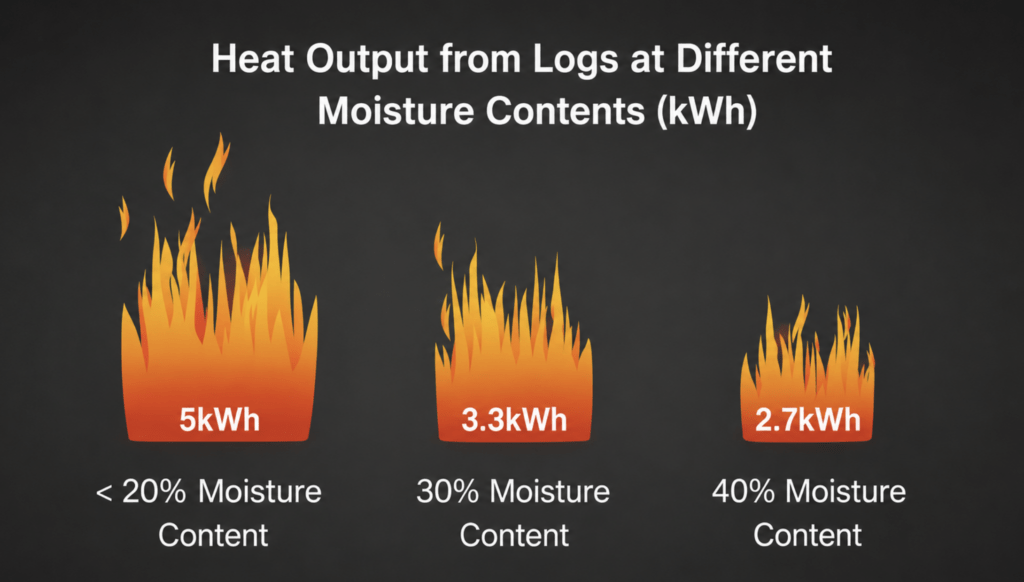
For most wood-burning stoves, firewood should have a moisture content of 20% or less, although the instructions supplied with the stove should always take priority. We recommend aiming for 20% or slightly lower, while Woodsure uses 20% as the threshold for firewood intended for immediate use in a domestic stove.
The diagram below shows the dramatic effect of moisture on heat output:
Wet-basis and dry-basis readings
One frequently overlooked detail is that moisture content can be expressed in two different ways.
Wet-basis moisture content compares the weight of the water with the total weight of the wet wood:
Wet-basis moisture content = water weight ÷ total wet weight × 100
A 1kg log at 20% moisture content on a wet basis therefore contains approximately 200g of water and 800g of dry wood matter.
Dry-basis moisture content compares the weight of the water with the oven-dry weight of the wood:
Dry-basis moisture content = water weight ÷ oven-dry wood weight × 100
The same 1kg log containing 200g of water and 800g of dry wood would have a dry-basis moisture content of 25%.
Wet basis is normally used when discussing wood fuel, including the Ready to Burn threshold. However, some moisture meters designed primarily for construction, joinery or flooring may display dry-basis readings. This is why it is important to check the meter’s instructions and confirm which basis it is using rather than assuming every percentage is directly comparable.
What is a moisture meter actually measuring?
A handheld moisture meter measures an electrical property of the wood that changes as moisture content changes. The instrument then uses an internal calibration to convert that electrical response into an estimated moisture percentage.
In other words, the measurement is indirect. Handheld moisture-meter readings are inferential because the meter measures an electrical parameter and compares it with a calibration curve. Wood species, temperature, moisture distribution, probe geometry, meter design, and how the operator uses the instrument can all influence the result.
This does not make moisture meters unreliable. It means they just need to be used correctly and consistently. A good meter used on a freshly split surface can provide a fast and extremely useful indication of whether firewood is ready to burn. However, pressing the pins lightly against wet bark or testing only one convenient log is unlikely to produce a representative answer.
How does a pin-type moisture meter work?
As we explained in our original moisture-meter article, a pin-type meter has two or more metal probes that are pushed into the wood. These pins form the contact points for a small electrical circuit.
Dry wood strongly resists the flow of electrical current. As its moisture content rises, its electrical conductance increases and its resistance falls. The meter measures this electrical behaviour and converts it into a moisture-content reading.
Technically, these are often described as resistance meters, although conductance meter is also an accurate description: resistance decreases as moisture rises, while conductance increases. The electrical relationship is particularly strong below the wood’s fibre-saturation region, making this technology well suited to assessing whether firewood is around the 20% target. Above the fibre-saturation region, a precise percentage becomes more difficult to determine, although the meter can still establish that the timber is very wet.
The pins measure a relatively small and localised area. This can be an advantage because the user can select the precise point and, with suitable pins, the approximate depth to be tested. It also means that a single reading should not be treated as representative of an entire log store.
For firewood, pin meters are generally the most practical choice because they can be inserted into the newly exposed centre of a split log. This gives a much more useful result than testing only the weathered outside surface.
Why pin depth is important
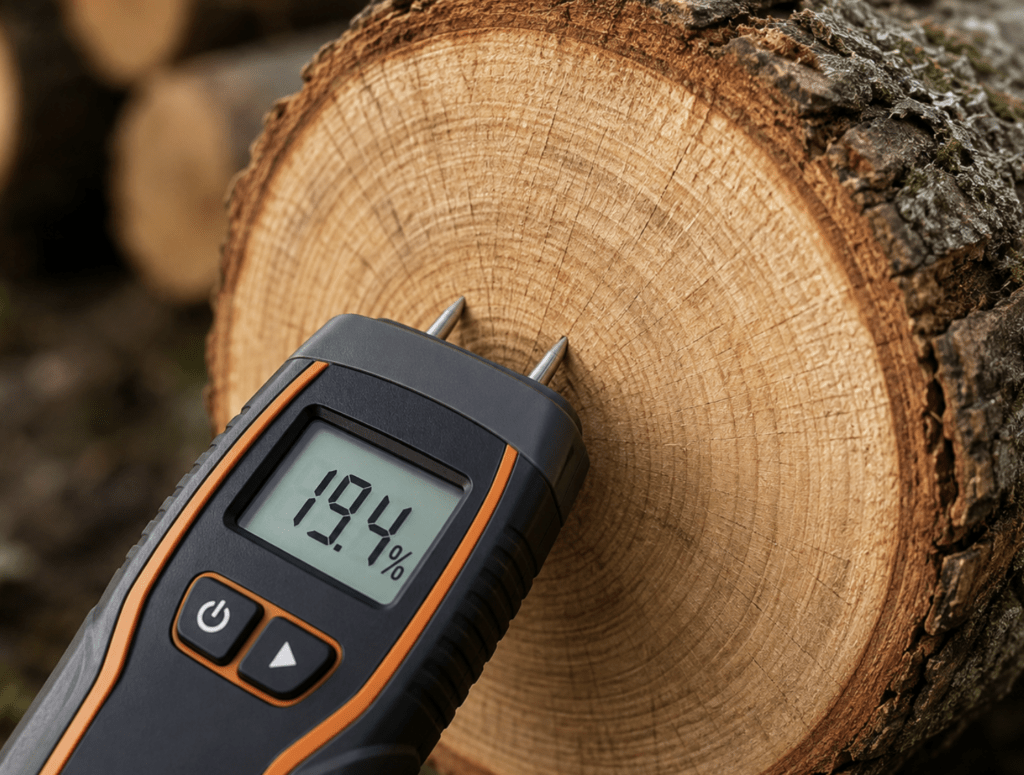
A shallow reading may be dominated by the drier outer layer of a log. A deeper reading is more likely to reveal the condition of the wood nearer its centre.
The pins should therefore be inserted firmly to the depth recommended by the meter manufacturer. Simply resting their tips on the wood may produce an unstable or unrepresentative result. Some professional applications use longer insulated pins because they can isolate a specific depth and reduce the influence of surface moisture.
For ordinary domestic firewood, the simplest and most reliable solution is normally to split the log and test the centre of the new face rather than trying to reach the centre through the bark.
How does a pinless moisture meter work?
Pinless meters do not pass current directly between penetrating probes. Instead, they place the wood within an electromagnetic field and measure its dielectric response. Water has very different dielectric properties from dry wood fibre. As the quantity of moisture changes, the capacitance, dielectric constant or energy loss measured by the instrument also changes. The meter applies a calibration and displays either an estimated percentage or, on some material modes, a relative reading.
The major benefit is that the surface is not punctured. A pinless meter can be moved quickly across a wide area, making it particularly useful when checking finished joinery, flooring, furniture or decorative timber where small pinholes would be undesirable.
However, a pinless reading can be influenced by:
1. The density and species of the wood.
2. The thickness of the material.
3. The meter’s designed scanning depth.
4. Gaps or voids behind the surface.
5. Metal or other materials beneath the timber.
6. Poor contact between the sensor and an uneven surface.
7. Moisture concentrated close to the surface.
Although a pinless field penetrates beneath the surface, its response is normally weighted towards the material closest to the sensor. The precise scanning depth varies between instruments, and a reading should not automatically be assumed to represent the centre of a thick log.
This is one reason pinless meters are less convenient for rough, curved pieces of firewood. They tend to perform best when the sensor can sit flat against a reasonably smooth and uniform surface.
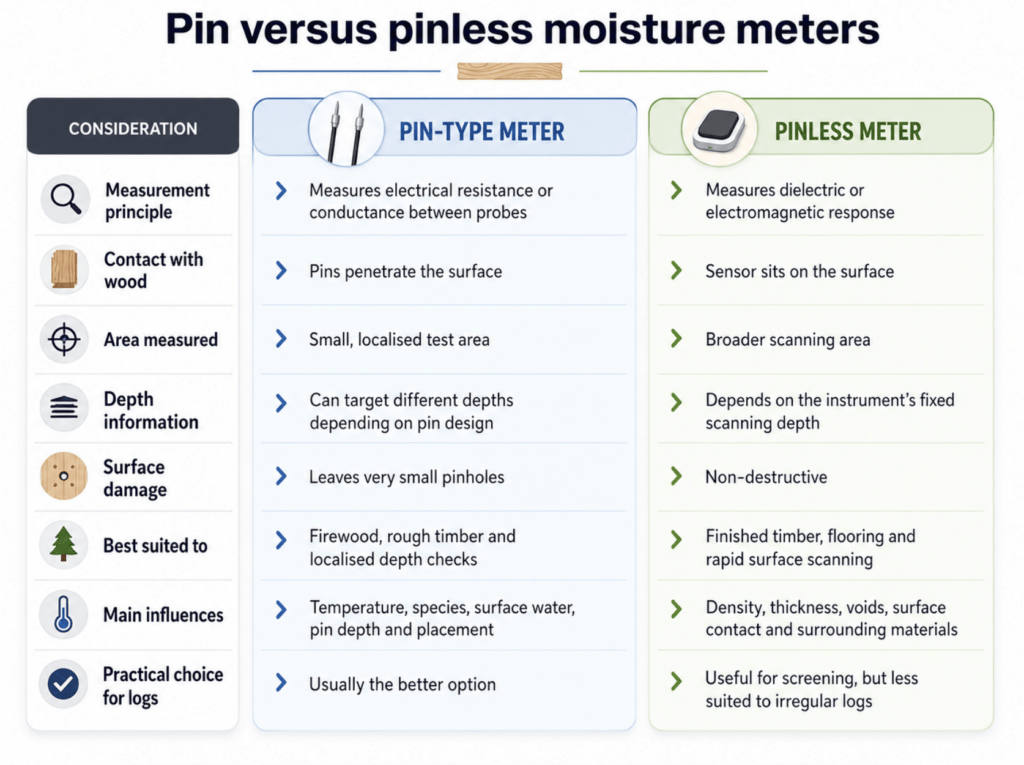
Neither design is universally superior. The application determines which meter is most appropriate. For a stove owner primarily checking split logs, our view remains the same as it was in our original moisture-meter guide: a straightforward pin-type wood meter is normally the most useful choice.
The main benefits of using a moisture meter
1. More useful heat from each log
Water in firewood must be heated and evaporated before the wood can sustain efficient combustion. As moisture rises, more of the fuel’s energy is diverted into this process, and less useful heat is available for the room.
Forest Research lists a typical net calorific value of approximately 4.1kWh per kilogram for air-dry log wood at 20% moisture content. The precise value varies, but the principle is consistent: moisture content has a direct and strong relationship with the practical energy value of wood fuel. A meter therefore helps a stove owner distinguish between a log that merely looks dry and one that is genuinely ready to release its energy effectively.
2. Easier lighting and more stable combustion
Wet logs are often difficult to light and can struggle to remain alight. They may hiss, release visible steam and produce a lazy, smoky flame. The fire may appear to improve only after considerable heat has been used to dry the surface of the fuel.
Dry wood reaches an effective combustion temperature more quickly. This helps the stove establish a cleaner flame and allows its air controls and combustion system to operate closer to their ideal conditions.
3. Less smoke and particulate pollution
When excess moisture cools the firebox, some of the gases released by the wood may not burn completely. This incomplete combustion can increase visible smoke, fine particles, carbon monoxide and other unwanted products.
4. Cleaner stove glass
Blackened glass is often associated with low firebox temperatures and incomplete combustion. Wet fuel can produce more soot and tar, which may settle on the glass before the stove’s airwash system has the opportunity to keep it clear. Using properly dried wood will not eliminate every possible cause of dirty glass. Restricted air controls, poor draught, an unsuitable fuel load or incorrect operation can also contribute. Nevertheless, confirming that the logs are at or below the recommended moisture content removes one of the most common variables.
5. Fewer tar and creosote deposits
When combustion temperatures are too low, tars and other partially burned compounds can pass into the flue. As these gases cool, some may condense and form deposits. Low combustion temperatures caused by excess fuel moisture may encourage incomplete combustion. Water may also recondense in the flue, potentially contributing to corrosion, deposits, restriction and an increased risk of blockage or fire.
A moisture meter does not replace chimney sweeping, servicing or proper stove operation. It does, however, help reduce an avoidable contributor to excessive deposits.
6. Better protection for the stove and flue
A stove is designed and tested to run on fuel within a specified range. Continually burning unsuitable wet fuel can prevent the appliance from reaching an effective operating temperature and may cause unnecessary contamination of the firebox, baffle, flueways and chimney system.
By checking fuel before it enters the appliance, owners can address the cause rather than repeatedly cleaning the symptoms.
This is especially important for highly efficient modern Ecodesign stoves. Their combustion systems are engineered to extract more useful heat while controlling emissions, but they still depend on suitable fuel and correct operation.

7. Greater confidence when buying firewood
Descriptions such as “seasoned”, “dry” or “kiln-dried” can be helpful, but storage after processing remains important. Even correctly dried logs can absorb moisture again if they are exposed to rain, ground moisture or poorly ventilated conditions.
A meter provides a practical spot check when a delivery arrives. It can also reveal whether different parts of a load have different moisture levels. Logs taken from the outside of a load may not match those packed into its centre, which is why representative sampling is important. We advise selecting logs from different parts of a stack and repeating the test periodically because moisture content can change during storage.
A consumer moisture meter is not a substitute for official certification or laboratory testing, but it gives the householder useful evidence rather than relying entirely on appearance.
8. Better management of home-seasoned logs
Anyone processing their own firewood needs to know when the seasoning process is complete. Calendar time alone is not enough. Drying rate is affected by species, initial moisture, log diameter, whether the wood has been split, airflow, stack design, exposure, climate and time of year. Two logs cut on the same day can dry at different rates if one is smaller, more exposed to moving air or stored in a different part of the stack.
Regular readings allow the owner to monitor progress, identify damp areas in a log store and move slower-drying logs where ventilation is better.
9. Less reliance on visual guesswork
Dry wood may be lighter, duller in colour and cracked at the ends. Two dry logs may also make a sharper sound when struck together. These are useful clues, but none provides a percentage.
A log can have cracked ends while remaining wet at its centre. Its outside can feel dry shortly after rain has stopped, or it can feel damp because of temporary surface moisture even though the core is suitably seasoned.
A correctly used moisture meter turns these visual clues into a measurable decision.
Moisture meters and the Ready to Burn rules
In England, wood supplied for domestic burning in units of less than two cubic metres must be certified as Ready to Burn. This confirms that it has a moisture content of 20% or less. Wood supplied in larger quantities can be sold for further seasoning, but the supplier must provide advice explaining that it should not be burned until it has dried sufficiently.
The regulations concern the supply of wood in England. They should not be described as a single UK-wide sales rule.
For consumers, the Ready to Burn logo is the clearest way to identify wood sold for immediate domestic use under the English scheme. A personal moisture meter remains useful because wood can change condition after purchase if stored poorly.
It is also important to understand the distinction between a spot check and certification. Woodsure uses oven testing in its laboratory to determine moisture content accurately. A handheld pin meter provides a rapid estimate for domestic quality control; it does not independently certify a supplier or replace the scheme’s formal test process.
How to test firewood correctly with a moisture meter
The method matters just as much as the meter. A high-quality instrument can still produce misleading results when it is used on the wrong part of the log.
1. Read the meter’s instructions
2. Confirm that the instrument is intended for wood and establish:
2a. Whether it displays wet-basis or dry-basis moisture.
2b. Whether it has selectable wood-species groups.
2c. Whether temperature correction is automatic or manual.
3. How deeply the pins should be inserted.
4. Whether it has a calibration-check function.
5. Whether a separate firewood mode is provided.
6. Check the condition of the meter
Inspect the pins for damage or contamination and make sure they are securely fitted. Confirm that the battery is not low. Where the instrument includes a calibration check, use it in accordance with the manufacturer’s guidance.
7. Select a representative sample
Do not choose only the driest-looking log from the top of the pile. Woodsure recommends selecting at least three logs from different parts of the store. A useful domestic sample could include one from near the top, one from the middle and one from a lower or less exposed area. For a new delivery, take logs from different sections rather than testing several pieces from the same accessible corner. The greater the variation within the load, the more samples you should check.
8. Consider the temperature of the wood
The electrical resistance of wood changes with temperature. A cold log and a warm log at the same true moisture content may not produce identical indicated readings unless the meter compensates for temperature. Woodsure recommends testing firewood close to room temperature and advises that frozen wood cannot be tested reliably. Where logs have been stored in freezing conditions, allow them to thaw before measuring.
Do not leave a freshly split face exposed for an unnecessarily long time, however, because its surface condition will begin changing.
9. Split the log through its centre
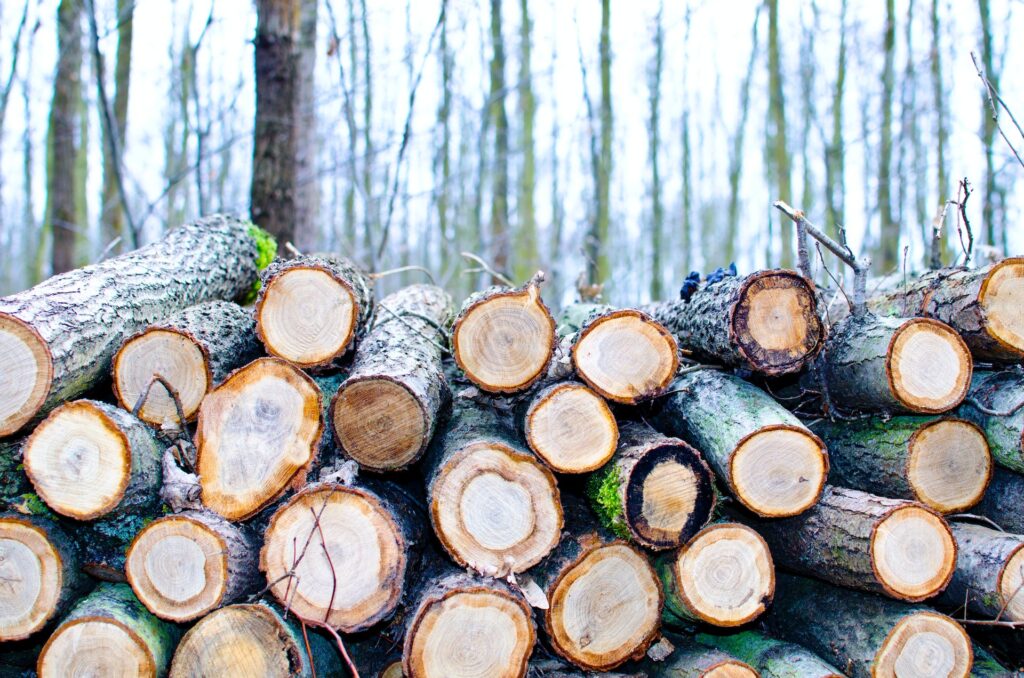
This is the most important part of the process. Do not rely on a reading from the bark, outside surface or end of an intact log. The outside usually dries before the centre, while an exposed end can behave differently from the middle of a longer piece. Split the log immediately before testing so that the meter can access a newly exposed internal face. Both HETAS and Woodsure recommend measuring at the centre of a freshly split surface. The official wording accompanying England’s solid-fuel regulations also advises measuring a freshly split face for the best reading.
10. Remove free surface water
Where the wood has recently been exposed to rain or condensation, wipe visible water from the newly split surface before taking a reading. Free water bridging the pins can create an artificially high result. Surface moisture is not irrelevant; it may indicate poor storage, but it should not be allowed to distort a test intended to estimate internal moisture content.
11. Place the pins correctly.
Press the pins firmly into the centre of the split face. Position the line between the pins across the grain and avoid knots or irregular grain. Follow the individual meter manufacturer’s instructions where they specify a particular orientation.
Avoid testing:
Through bark.
Directly over a knot.
In a deep split or crack.
On visibly decayed material.
Where the pins may contact a nail, staple or other metal.
On treated, painted or contaminated wood.
Wood preservatives, salts and other chemicals can alter electrical conductance and produce misleading readings. Treated or painted timber should not be used as domestic firewood in any case.
Take several readings
Take readings at more than one position across the newly split face, then repeat the procedure on the other selected logs.
Take a number of readings and calculate an average for the sampled load. It is also sensible to note the highest individual readings. An average can show overall progress, but it can conceal a number of logs that are still significantly wetter than the remainder.
When deciding whether to burn a particular log, the condition of that log matters more than the average of the entire store.
12. Record results over time
A simple record can make a moisture meter much more useful. Note the date, sample location and approximate range of readings.
This can reveal:
How quickly the store is drying.
Whether lower rows are absorbing ground moisture.
Whether rain is reaching the sides of the stack.
Whether larger logs need resplitting.
Whether a particular delivery is drying unevenly.
Whether supposedly dry wood has reabsorbed moisture.
Consistency is often more useful than obsessing over a single decimal place.
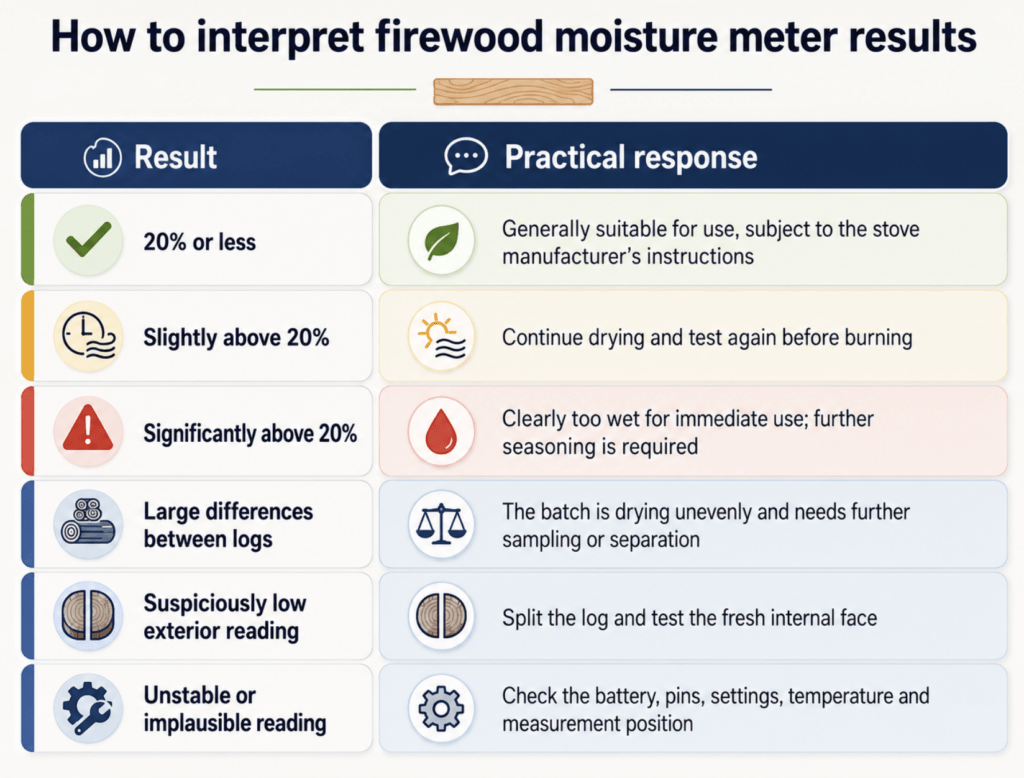
Note: If moisture is too low 10% or less, the log will burn too quickly and create excessive heat, which can, in some circumstances, damage your stove, which is also not ideal.
What features should a firewood moisture meter have?
Our earlier article on selecting the best moisture meter looked at measurement range, accuracy, species settings, measurement depth, durability and display features. Those remain the main buying considerations.
For a stove owner, we would prioritise the following.
1. A proper wood or firewood mode. Make sure the percentage scale is intended for timber rather than a relative building-material scale. Ideally, confirm that the instrument can display wet-basis firewood moisture or provides clear conversion guidance.
2. A useful range around the critical threshold. The key decision for most stove owners happens around 20%. A spectacularly wide advertised range is less valuable than dependable performance within the normal firewood range.
3. Firm, replaceable pins. The probes must withstand repeated insertion into split timber. Replaceable pins can extend the life of the instrument.
4. Species correction. Species selection or a correction table can improve consistency, especially where the user burns a mixture of hardwoods and softwoods.
5. Temperature compensation. This is particularly helpful when testing logs stored outdoors during winter.
6. Calibration checking. A built-in test or supplied reference device allows the user to identify a low battery, damaged meter or calibration problem before relying on the result.
7. A clear display and hold function. A backlit screen and reading-hold button are useful when testing logs in a darker store or at an awkward angle.
8. Sensible durability. A protective pin cap, robust casing and secure battery compartment may be more valuable to a domestic owner than data logging or smartphone connectivity.
9. Advanced functions. These can be useful for firewood producers, surveyors and tradespeople, but they are not essential for occasional domestic checks.
A moisture meter cannot replace good-quality fuel, correct log storage, responsible stove operation, regular servicing or chimney sweeping. What it can do is remove one of the largest areas of uncertainty from wood burning.
By testing a representative selection of freshly split logs, owners can establish whether their firewood is genuinely ready rather than merely dry on the outside. This can mean more useful heat, easier lighting, less smoke, cleaner glass, fewer deposits and better value from every load of fuel.
Our previous article, Selecting the Best Moisture Meter, provides a useful introduction to choosing between the available types. The deeper lesson is that selecting the instrument is only the beginning. Understanding what it measures and using it correctly is what turns a simple handheld device into an effective part of responsible wood burning.