A comfortable home doesn’t need every room heated to the same temperature at the same time throughout the day. A living room where everyone gathers in the evening has different heating needs than a spare bedroom, an occasionally used dining room, or a home office.
That is where zonal heating comes in.
Rather than taking a one-size-fits-all approach, zonal heating focuses warmth where and when you need it. Done properly, it can improve comfort and reduce unnecessary heating. The important word, however, is properly: effective zoning means controlling the heating across your home, not simply switching on an additional appliance.
At Charlton & Jenrick, we offer gas fires, electric fires and wood-burning stoves, giving homeowners different ways to introduce a dedicated source of warmth to their living spaces. Each can contribute to a zonal heating approach, but each has different strengths, running costs and practical requirements.
So, how does zonal heating work, what are its benefits, and which of these three options is best?
What is zonal heating?
Zonal heating means managing different parts of your home as separate heating areas, or “zones”. A zone might be a single room, an open-plan living space, or an entire floor.
The aim is to match heating to the way you actually use your home. You might need a comfortable home office during working hours, a warmer living room in the evening and suitable bedroom temperatures overnight, without maintaining exactly the same conditions everywhere throughout that entire period.
There are two main ways to achieve this.
One is to use the controls on your main heating system. Thermostatic radiator valves, programmable controls and suitably configured smart heating systems can help regulate individual rooms or groups of rooms. The other is to use a local heat source, such as a fire or stove, to provide warmth directly in the space you are occupying. These approaches can work together.
For example, a living-room fire could provide extra warmth when you sit down in the evening, while the main heating maintains appropriate temperatures elsewhere.
The essential principle is to avoid unnecessary heating. Zonal heating should never leave occupied rooms uncomfortably cold or let the rest of the house develop damp problems, which can happen if a room or area of a house has no heating in cold weather. Zonal heating warms the areas you’re in while keeping the rest of the unoccupied house at a lower temperature, but not freezing cold.
The main benefits of zonal heating
Many households have a predictable pattern of room use. During the day, one person might work in a study while the rest of the home is largely unoccupied. Later, the household may spend several hours together in the living room.
For this household, we would consider whether the heating schedule reflects those changes. Does the dining room need to be as warm as the study all afternoon? Does the entire house need a temperature boost because the living room feels slightly cool?
Zonal heating provides a way to answer those questions room by room, rather than applying the same response everywhere.
Comfort is personal. Someone sitting still for several hours may want more warmth than someone moving around the house.
A dedicated room heater can provide that additional comfort without requiring every other room to become warmer too. This is one of secondary heating’s useful roles: meeting a local need alongside the main heating system.
For us, this is an important distinction. The objective is not simply to reduce temperatures. It is to provide the right conditions in the right places.
The potential to reduce heating costs
Avoiding unnecessary heating can reduce costs, but the result depends on what your zonal arrangement replaces. Using a room fire instead of heating several otherwise unused spaces may be worthwhile. Running that same fire while leaving the central heating unchanged may simply increase your total consumption.
Fuel prices are important.
A more expensive fuel for a small, carefully controlled heating requirement can sometimes cost less overall than cheaper fuel to heat a much larger area. Equally, an efficiently zoned central heating system may already be the economical option.
We therefore recommend looking at the whole heating arrangement, rather than judging savings from the fire’s running cost alone.
Flexibility between seasons
Consider a cool spring evening when the living room needs a little extra warmth, but the rest of the home is comfortable. A local heat source gives you another option besides extending the main heating schedule.
The same thinking can apply to an autumn morning in a home office or a brief evening spent in a snug. These are useful examples of matching heating amount and duration to a specific need.
A fireplace with a practical purpose
A fire can be more than a decorative feature. When chosen carefully, it becomes part of how you manage comfort at home.
Our approach is to consider appearance, output, controls and installation together. A beautiful fireplace should also suit the room and the way you intend to use it.
Gas fires and zonal heating
Gas is a strong option for homeowners who want a real flame, convenient operation and regular room heating without the day-to-day work involved in burning logs.
How a gas fire supports zoning
A gas fire provides heat directly in the room where it is installed. You can operate it separately from the central heating schedule, so the room can get extra warmth when needed.
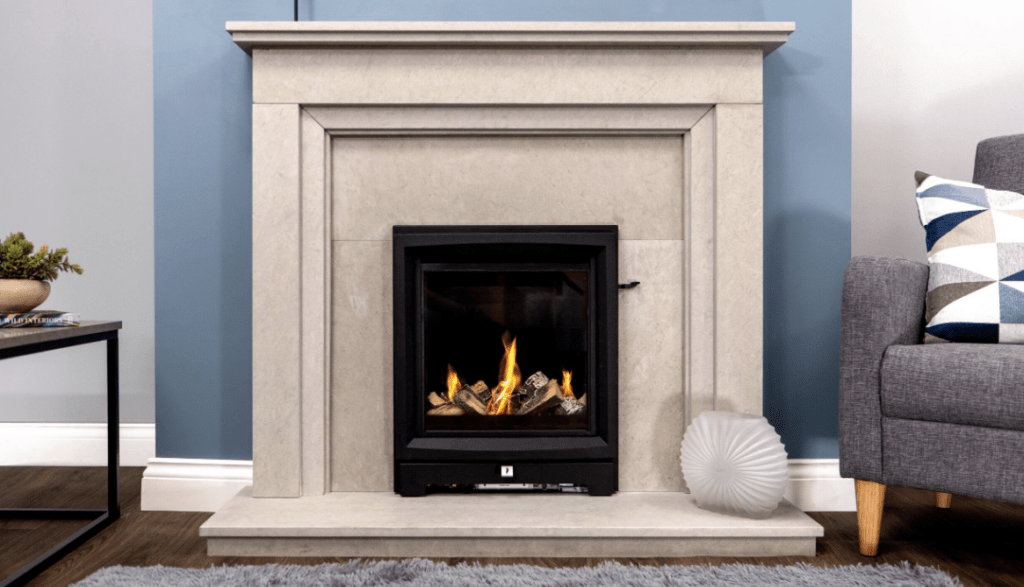
Controls vary by model. For example, our Paragon Core BF, pictured below, is available with remote or slide control and has a stated heat output of 3kW. This illustrates an important point: choosing a gas fire for zoning is not necessarily about selecting the highest-output appliance. It is about finding one that suits the room.
In a suitable setup, the gas fire can handle some or all of that room’s heating needs while the central heating is adjusted accordingly.
The advantages of gas
A real flame without handling fuel. Gas offers the visual appeal of combustion without bringing in logs, lighting kindling or removing wood ash. For someone who wants to come home and enjoy a fire with relatively little preparation, that convenience is a major attraction.
Controllable warmth. Unlike a loaded wood-burning stove, a gas fire does not require a batch of logs to finish burning before the fuel supply can be stopped. That makes it a useful option where heating needs change during the evening.
Potentially attractive running costs. Mains gas currently costs substantially less per unit of energy than standard-rate electricity under Ofgem’s average capped Direct Debit rates. Appliance efficiency must still be considered, but this gives an efficient mains-gas fire a useful starting advantage for regular heating.
The first two benefits are particularly relevant to everyday usability. A fire that is easy to operate and adjust is more likely to be used in a way that matches your needs.
A chimney is not always necessary
Not having an existing chimney does not automatically rule out a gas fire. Our balanced-flue options include appliances designed for suitable installations without a conventional chimney.
What should you consider before choosing gas?
The property needs a suitable fuel supply and an appropriate installation. If a model is available for LPG, calculate running costs using the actual LPG price, not mains-gas figures.
Maintenance also remains important. Gas appliances should receive the recommended safety checks and servicing, carried out by a Gas Safe registered engineer qualified for the appliance and fuel concerned. Gas Safe Register recommends annual checks and servicing unless the manufacturer specifies otherwise.
We also recommend checking both the maximum output and the available lower settings. A fire that looks ideal but produces more heat than the room comfortably needs will not be a good zoning choice.
Our assessment: gas is particularly compelling for regular living-room heating where a suitable mains-gas connection and flue arrangement already exist, especially when convenience and genuine flames are priorities.
Electric fires and zonal heating
Electric fires are an adaptable option for adding controllable warmth to a particular room, especially where installing a combustion appliance is difficult or undesirable.
How an electric fire supports zoning
An electric fire can operate independently of the main heating system, providing local warmth when needed. Thermostatic controls and timers on suitably equipped models help match that warmth to a room’s temperature and your routine.
Our iRange i750e Deep, pictured below, for example, includes a seven-day programmable timer and thermostat, with two heat levels selected automatically to maintain the chosen temperature and a maximum heat output of 2kW.
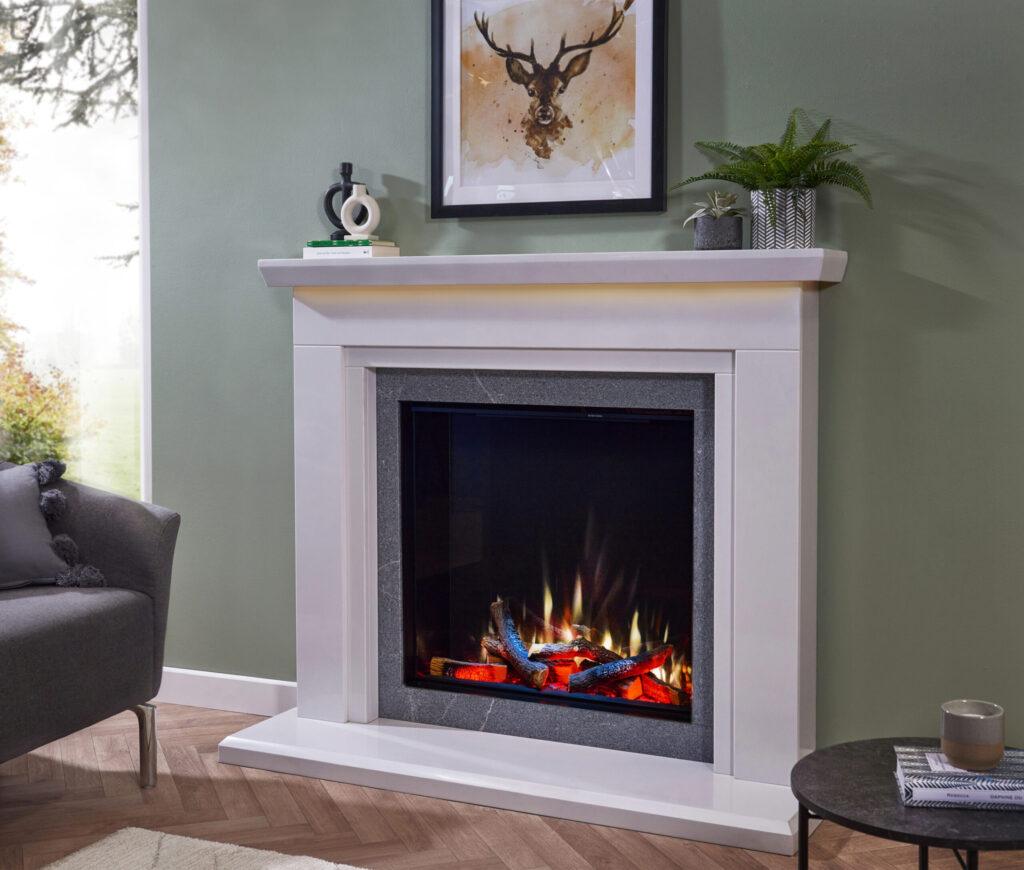
For a room that needs occasional extra warmth, these controls can matter more than simply choosing a high output.
The advantages of electric
Installation flexibility. An electric fire does not require a combustion flue or a gas supply. This opens up possibilities for media walls, feature walls and rooms where a gas fire or wood-burning stove would be impractical. The electrical connection, enclosure and clearances must still meet the selected appliance’s requirements.
Straightforward control. No fuel to load and no fire to establish. On thermostatically controlled models, the heater responds to room temperature rather than relying solely on the user to decide when the room feels warm enough.
No combustion in the room. Electric fires don’t burn fuel, so they don’t produce combustion smoke, soot, or ash. Their wider environmental impact still includes the electricity they use. No combustion at home does not mean no environmental footprint.
Flame effects without additional room heating. Suitable models allow the visual display to be enjoyed without switching on the heater. This is particularly useful when the room is already comfortable: the fireplace can remain a focal point without deliberately adding unnecessary heat. The display still uses electricity, so it should not be described as free to operate.
Where electric is less suitable
Electricity costs can become significant when direct electric heating runs for long periods or heats several rooms. Direct electric systems are relatively straightforward to install but typically run at higher costs than other fuels.
Electric fires should also be distinguished from heat pumps. A heat pump moves heat rather than producing it solely through electrical resistance, so it can provide several units of heat for each unit of electricity consumed. An electric fire should not be assumed to offer the same energy performance.
Our assessment: electric is often the most practical choice for occasional top-up heating, flexible installation, and a flame display you can enjoy independently of heat.
Wood-burning stoves and zonal heating
Wood-burning stoves offer a different experience: a genuine log fire, hands-on operation, and a dedicated source of warmth for the room where they are installed.
They can suit households that spend extended periods in one main living space and enjoy the routine of lighting and tending a stove.
How a wood-burning stove supports zoning
A room-heating stove supplies warmth directly to the space around it. In the right arrangement, it can reduce the heat the room needs from the central heating system.
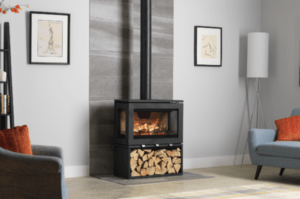
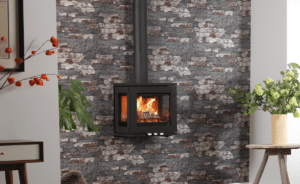
Our Fireline 5kW range, example pictured below, includes the FX5 and FQ5 models, each with a nominal output of 5kW. These appliances demonstrate how a stove can combine a substantial flame view with a specified room-heating output. The right choice still depends on the property, not the output figure alone.
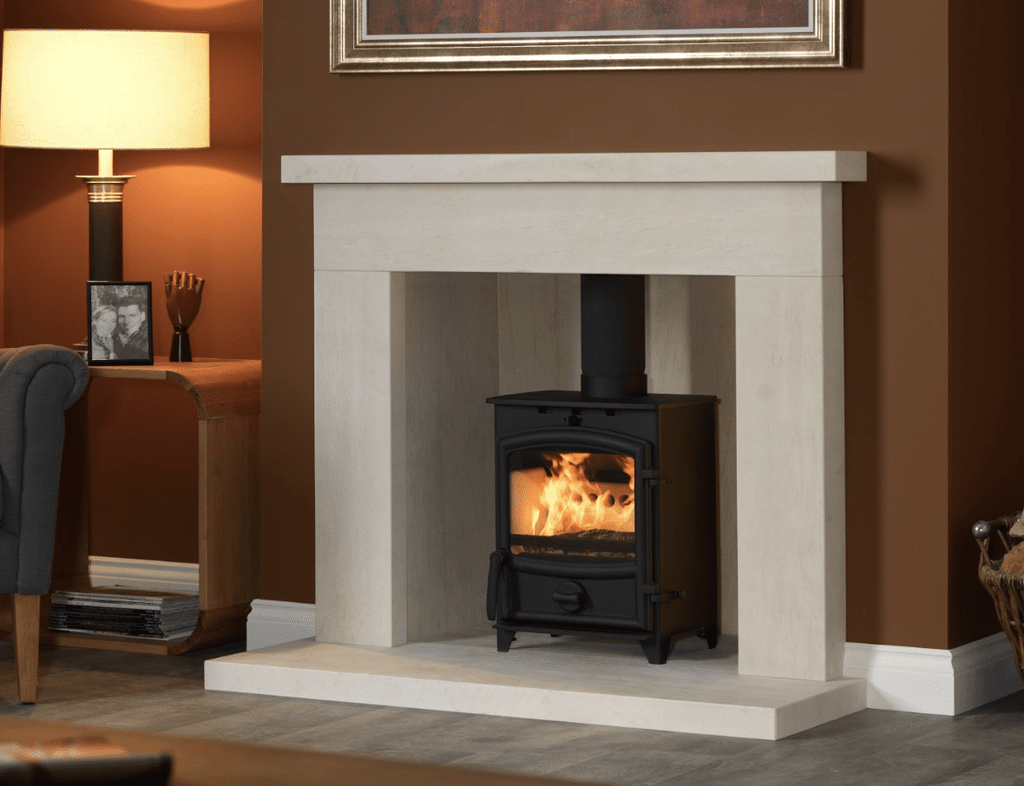
A stove is generally a different proposition from a brief electric top-up. Its output changes through lighting, established burning and the final stages of a fuel load. A nominally rated 5kW stove does not continuously produce exactly 5kW throughout every stage of operation.
The advantages of wood
The experience of a real log fire. For many homeowners, the flame movement, glowing embers and involvement in maintaining the fire are central to its appeal. Zonal heating lets that experience serve a useful heating purpose in the room where you spend time.
A good match for longer periods of occupancy. We would consider a stove particularly relevant to a household that uses its main living room for several hours at a time, rather than one needing a few minutes of additional warmth before leaving.
An alternative fuel supply. Logs provide a heating option separate from a mains-gas connection. A conventional room-heating wood-burning stove that does not require electricity can also provide useful warmth during a power cut.
Potentially competitive fuel costs. Wood can be economical where suitable dry fuel is available at a favourable delivered price. However, the calculation needs to include moisture content, fuel quantity, appliance performance and maintenance. The price of a bag or delivery alone does not establish the cost of useful warmth.
Dry fuel is essential
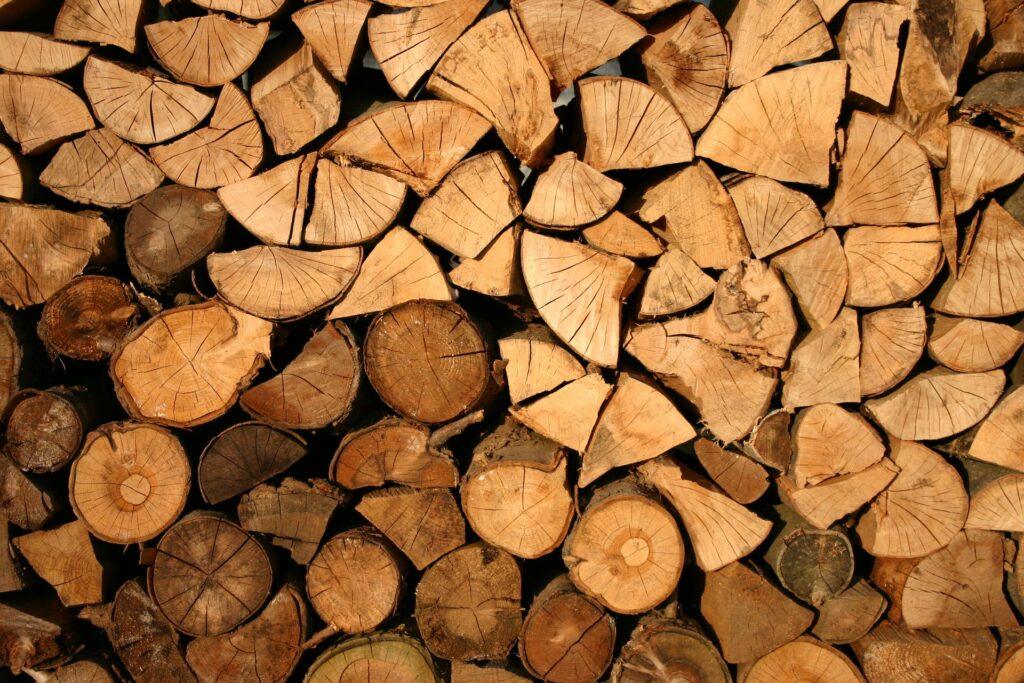
Wood quality has a direct bearing on how the stove is used. We recommend suitable dry logs with a moisture content of 20% or less. In England, wood sold in quantities of less than two cubic metres must be certified as Ready to Burn, confirming a moisture content of 20% or less. That is a rule governing relevant fuel sales; it should not be confused with permission to burn any fuel in any appliance or location.
It is also important to use only permitted fuels and avoid treated or painted waste wood. Good fuel choice is part of responsible stove operation, not an optional extra.
Correct sizing matters more than maximum output. An oversized stove can make a room uncomfortable and encourage the user to restrict the air supply excessively to reduce its output. That is not an efficient solution. Prolonged low-output operation, or slumbering, can lead to incomplete combustion and deposits in the appliance and chimney. Oversizing is one reason users may be tempted to operate a stove this way.
For zonal heating, we recommend choosing an appliance that can operate properly while delivering an appropriate amount of warmth, not buying an unnecessarily powerful stove and then trying to suppress its performance.
Gas, electric or wood: how do the running costs compare?
The fairest starting point is the cost of useful heat delivered to the room, rather than the price of the fuel alone. A kilowatt, or kW, describes power. A kilowatt-hour, or kWh, describes an amount of energy. An appliance delivering 2kW continuously for four hours supplies 8kWh of heat.
For a fuel-burning appliance, the basic calculation is:
Cost per kWh of useful heat = fuel cost per kWh ÷ appliance efficiency expressed as a decimal.
For wood sold by weight, the calculation also needs the energy content per kilogram.
An illustrative comparison
For 1 October to 31 December 2026, Ofgem’s average capped Direct Debit unit rates in Great Britain are 26.32p/kWh for electricity and 7.97p/kWh for gas. Actual rates vary by region, tariff and payment arrangement. These are not Northern Ireland rates.
For the wood example below, we have assumed a delivered price of 50p per kilogram. This is an illustrative price, not a claim about the market average. Forest Research gives a typical net energy content of 4.1kWh/kg for logs at 20% moisture content.
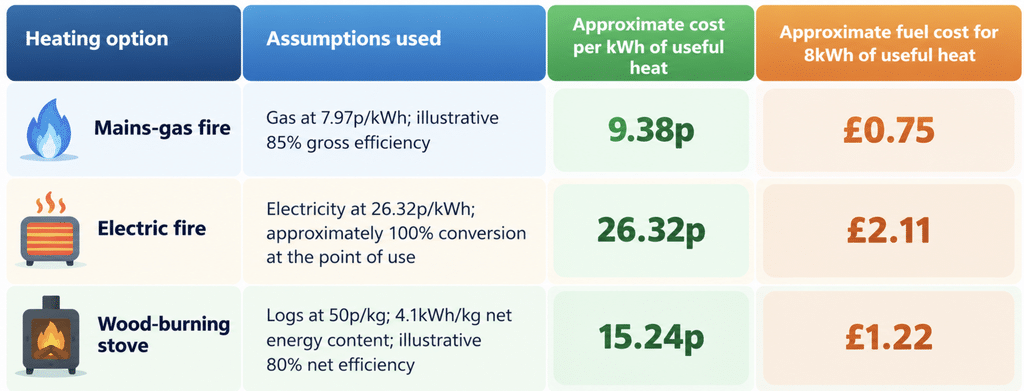
The efficiencies above are calculation assumptions, not performance claims for particular products. Gas efficiency matches the gross-energy billing basis, while the wood calculation uses net energy content and net efficiency. Always check product efficiency figures for their measurement basis.
The wood example compares delivered heat; it does not suggest that any particular stove can or should run continuously at 2kW.
What does the comparison tell us?
Under these assumptions, gas has the lowest fuel cost for the same quantity of useful room heat, followed by wood and then electricity. Change the log price, tariff or appliance performance, and the comparison changes. It also excludes installation, servicing, sweeping, repairs and any additional electrical consumption associated with a fuel-burning appliance.
Standing charges need separate analysis. They generally remain payable as long as the relevant energy supply is retained, even when little or no energy is used. Using a stove instead of a gas fire for an evening does not remove the gas standing charge from an otherwise connected home.
Most importantly, the table does not compare heating one room with heating an entire property.
A higher-cost unit of heat may still produce a lower total bill when you need substantially less heating. Conversely, replacing already well-controlled radiator heating with a new room appliance may offer little financial benefit once all costs are included.
Which is best for zonal heating?
Our answer depends on what “best” means for your home.
Best for regular heating where mains gas is available – gas
For a living room used frequently, an appropriately sized, efficient gas fire offers a persuasive combination of controllable heat, genuine flames and relatively low fuel cost under the pricing assumptions above. We would put gas high on the shortlist where the supply and installation conditions are already suitable, and where convenience is more important than the experience of handling logs.
It is not automatically the cheapest new installation, nor a guarantee of savings over an existing zoned heating system. However, for regular room heating, it is a strong practical candidate.
Best for occasional warmth and installation flexibility – electric
For shorter heating periods, modest top-ups and rooms without a suitable combustion flue, electric is often the most straightforward choice.
Its appeal is particularly strong where the fireplace is also wanted as a year-round visual feature. A suitable electric model can provide atmosphere without requiring the heater to run.
We would also favour electric where avoiding combustion emissions at the appliance is a priority, while still taking electricity consumption and running costs seriously.
Best for the log-fire experience and extended room use – wood
For homeowners who enjoy lighting and tending a real log fire, a correctly sized stove can be an excellent focal point and a useful source of sustained warmth.
We would place wood on the shortlist where suitable installation conditions, dry fuel storage, responsible sourcing and regular maintenance are all realistic.
Its strengths should be weighed against its less immediate control and its combustion emissions. We would not recommend wood on the basis that it is automatically the cheapest, cleanest or lowest-carbon option.