A beautifully chosen wood-burning stove does more than warm a room. It creates a focal point, influences the furniture layout, and helps set your home’s atmosphere. Discover how inset, freestanding, double-sided and wall-mounted designs can create four very different looks.
Imagine your ideal evening at home. Perhaps you are curled up in an armchair beside a stove tucked into an old stone fireplace. Maybe the setting is a light-filled contemporary living room, with a sculptural cylinder stove standing against a simple backdrop. Or perhaps you picture a long, relaxed dinner, with the same fire enjoyed from both the dining table and the sitting room beyond.
Each arrangement begins with a different design decision: not simply which stove to choose, but how it should fit into the room.
Across our Fireline, Go Eco and Purevision ranges, we offer a wide range of wood-burning stove styles, from traditional hearth-centred designs to contemporary cylindrical and wall-mounted options. Some are wood-burning-only appliances, while others also offer multi-fuel capability. Here, the focus is on choosing a stove for the character and pleasure of a real wood fire.
The four categories below are useful starting points. A cylindrical stove, for example, can be freestanding or available in a dedicated wall-mounted version, as our Purevision BPVR demonstrates. The key question is what you want the stove to contribute to your interior. Do you want the fire to feel integrated into the architecture, or would you prefer the stove itself to stand out? Should it provide an intimate focus for one seating area, or bring two spaces together?
1. Inset stoves: for an integrated, carefully framed focal point
An inset stove sits within a suitably constructed fireplace opening or wall. The visible emphasis falls on the door, the flame picture and the surrounding trim. This approach is particularly appealing if you prefer a more streamlined fireplace composition. Think of an inset stove as a framed view of the fire. The surrounding architecture becomes as important as the appliance itself: the width of the chimney breast, the wall finish, the proportions of a stone surround, and the relationship between the hearth and the floor.
A contemporary look without unnecessary visual clutter
For a modern interior, we would start with a restrained arrangement: a well-proportioned inset stove, a simple wall finish and a hearth that complements the room rather than competing with it.
Our Fireline Ecostar 5 Inset Stove range lends itself to this approach. Its clean lines and smooth finish are available in two sizes, with installation options for a fireplace or a hole-in-the-wall setting, using either a three- or four-sided trim.
In the photo below, we have an Ecostar inset against a pale stone hearth and a generously upholstered chair in oatmeal linen. Add contrast elsewhere with dark picture frames or slender black furniture legs. The stove then feels connected to the wider scheme, rather than like a single dark object placed in an otherwise pale room.
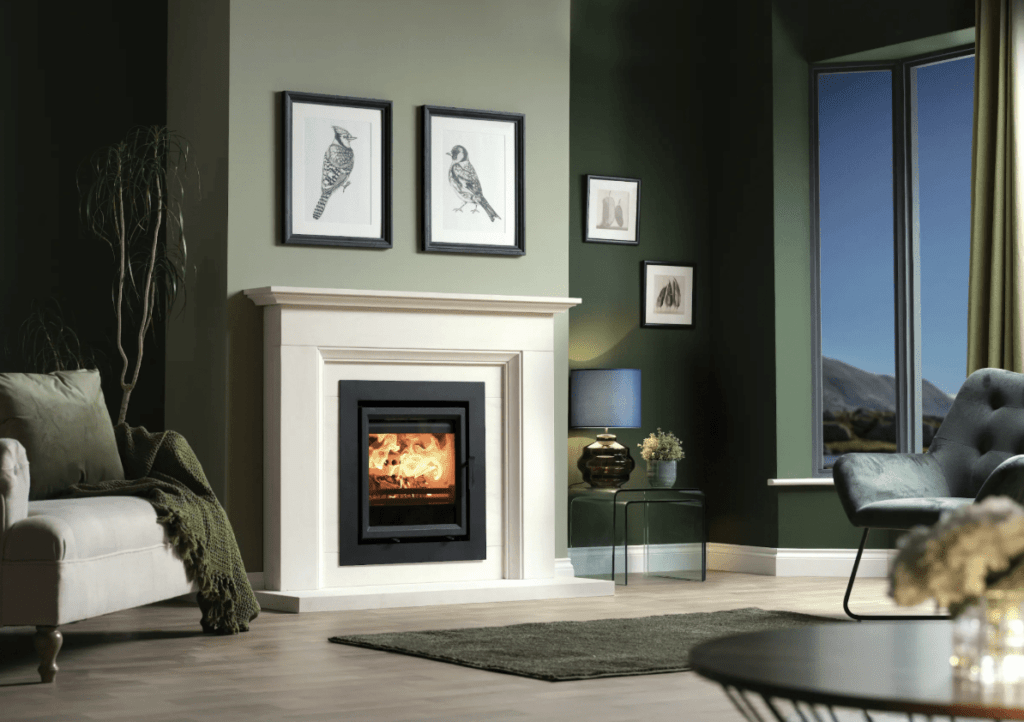
For something more dramatic, consider a deeper wall colour away from the immediate fireplace construction: olive, charcoal or a muted, earthy brown. We would keep the surrounding finishes relatively quiet, allowing the movement of the flames to provide the room’s main visual interest.
Inset doesn’t have to mean minimalist
An inset stove can also be a beautiful choice for a room with traditional proportions. Within a limestone surround, the fire becomes part of a more established fireplace composition. The mantel and stonework provide the architectural character, while the inset appliance keeps the overall arrangement neat.
Our Purevision 5kW Inset range includes standard and wide models, both with a nominal output of 5kW. We also offer a choice of three- and four-sided trims, and a grey paint finish is available alongside black.
That choice of proportions is important. A wide model is worth exploring when the chimney breast is broad, and a smaller fire might appear visually lost. A more compact model may create a better balance within a narrower surround. For a quietly elegant sitting room, we would pair this style with warm neutral walls, a restrained stone fireplace and furniture with gently rounded edges. Consider a grey stove finish if you prefer a softer visual contrast; black creates a stronger outline. The goal isn’t to match every material exactly. A little variation between the stone, upholstery and wall colour gives the room depth.
Use scale and trim to refine the design
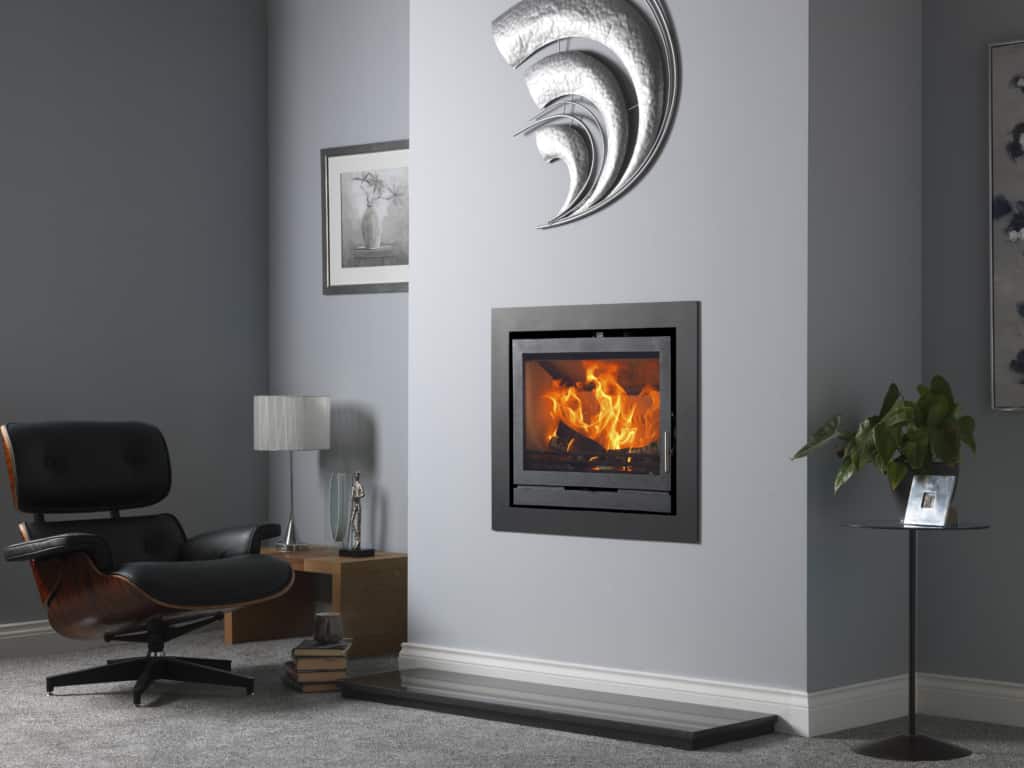
Our Fireline FPi8 Inset Stove, pictured below, offers an 8kW option, with a large ceramic glass window and a choice of three- or four-sided trims in 25mm, 50mm and 75mm widths. A narrow trim can support a crisp, understated composition. A broader trim gives the fire a more definite border, which may feel better balanced within substantial stonework.
However, a larger-looking fireplace should not automatically mean a higher-output stove. Heat output needs to suit the space, rather than being selected simply to fill a generous opening. Our standard and wide Purevision 5kW inset models remind us that visual width and nominal output are separate considerations.
What to consider before choosing an inset stove
The streamlined appearance requires planning behind the finished surface. An inset needs sufficient installation depth and an appropriately prepared opening; a shallow-looking front does not mean the entire installation occupies little space. Depending on the existing fireplace and chimney, preparation can also be more involved than the finished result suggests. We would therefore design the stove, surround, hearth and wall together. Avoid selecting the appliance first and treating everything around it as an afterthought.
Choose an inset stove when you want the fire to feel like a carefully integrated part of your home’s architecture, whether that means a contemporary feature wall or an elegant traditional fireplace.
2. Freestanding stoves, including cylinder stoves: for character, flexibility and sculptural presence
With a freestanding stove, the appliance itself becomes a more visible part of the interior. Its body, door, base and relationship with the hearth all contribute to the overall look. Freestanding does not necessarily mean standing alone in a room. A stove can sit within a suitable fireplace chamber or be positioned elsewhere where an appropriate flue arrangement is possible. It remains a fixed installation, not something to move around with the furniture.
This category offers several very different design directions.
The classic fireplace: welcoming and rooted in the room. For many homes, the most appealing arrangement is still a freestanding stove within a characterful fireplace. Our Purevision Countryman range, pictured below, combines a traditional-style, full-sized cast-iron door with a choice of standard and wide models, each available in standard-depth and slimline versions. Optional stands and log stores provide further ways to shape the finished installation.
We would use the Countryman as the starting point for a room that feels comfortable rather than overly formal. Think muted green walls, a well-loved leather chair, wool upholstery and a fireplace chamber that introduces a little texture. In a cottage, existing stonework or brickwork may provide all the character needed. In a newer house, a simple, well-specified fireplace chamber can create a focal point without adding elaborate imitation-period details.
Restraint is useful here. When the fireplace already has a strong texture, we would avoid surrounding it with several more competing finishes. Let the stove and the chamber lead, then use fabrics and colour to soften the wider room.
Work with an existing fireplace’s proportions
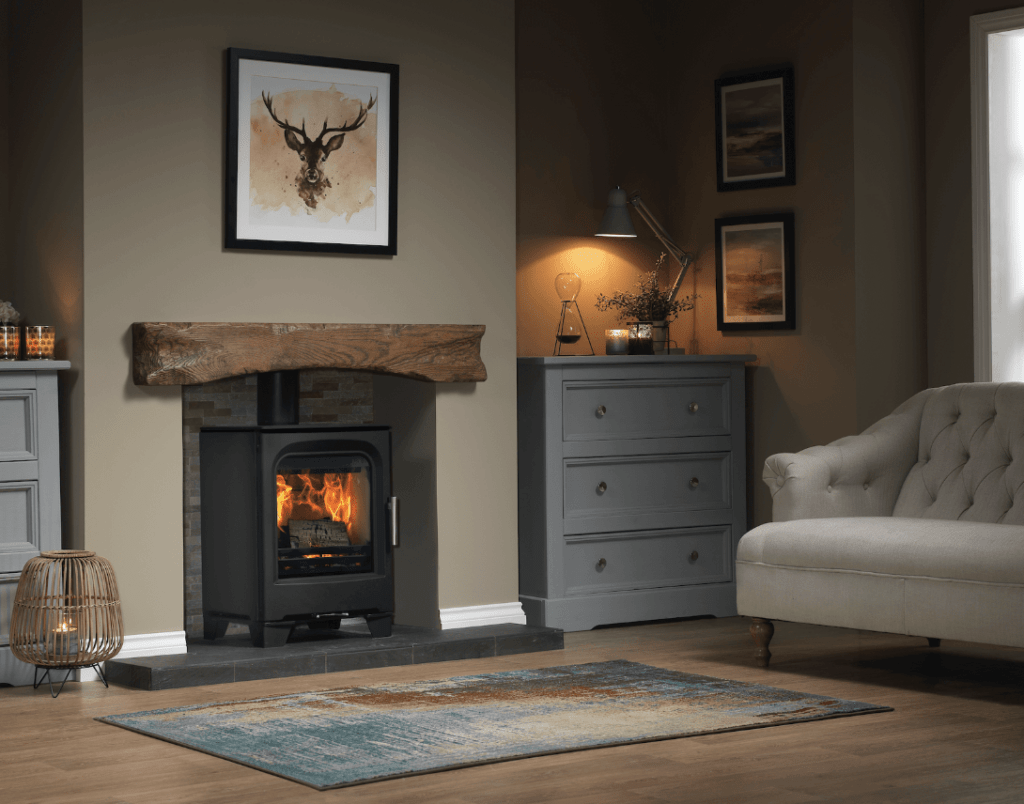
A good stove choice should respond to the opening, not fight against it. Our Go Eco Excel 5kW Wide Low Lintel, pictured below, is designed specifically for low-lintel fireplace openings. Its shorter format and 300mm slimline body depth offer an option worth exploring where the proportions of an existing fireplace are restrictive.
From a design perspective, a lower, wider stove can sit comfortably within a horizontal opening. It may help preserve the character of a fireplace that would look quite different if substantially altered. The essential distinction is between an appliance that physically fits and an installation that works safely. Required clearances, the flue connection and maintenance access must still be assessed; the stove should not look, or be, squeezed into place.
A contemporary freestanding stove: make the base part of the design
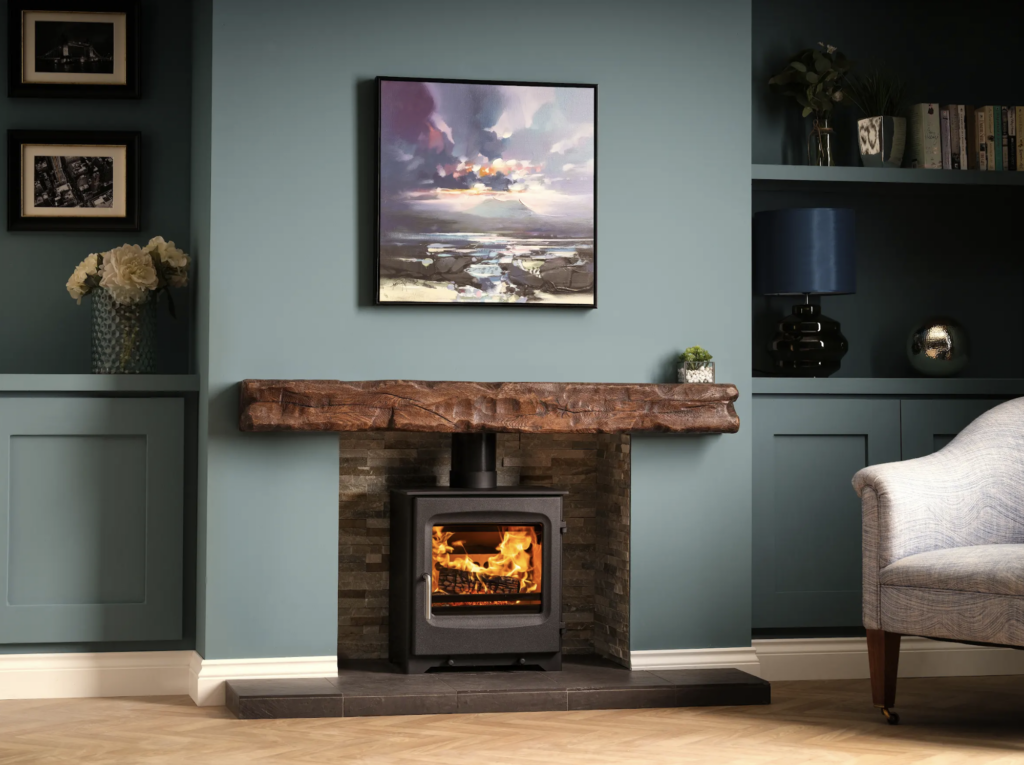
For a cleaner interior, look beyond the firebox and consider how the stove meets the floor. Our Fireline Ecostar 5 Freestanding Stove range, pictured below, offers a pedestal stand, 70mm and 200mm leg stands, and log store accessories. These options let the same contemporary stove style take on different proportions.
We would explore a lower arrangement in a room with low-slung seating and a strong horizontal emphasis. A pedestal creates a more upright, sculptural composition, while a log store gives the stove a more substantial base. Picture a contemporary living room with a simple stone hearth, textured cream upholstery and a small number of carefully chosen pieces. Raising the stove can give the fire a more deliberate place in that composition, rather than letting it disappear below the main sightline.
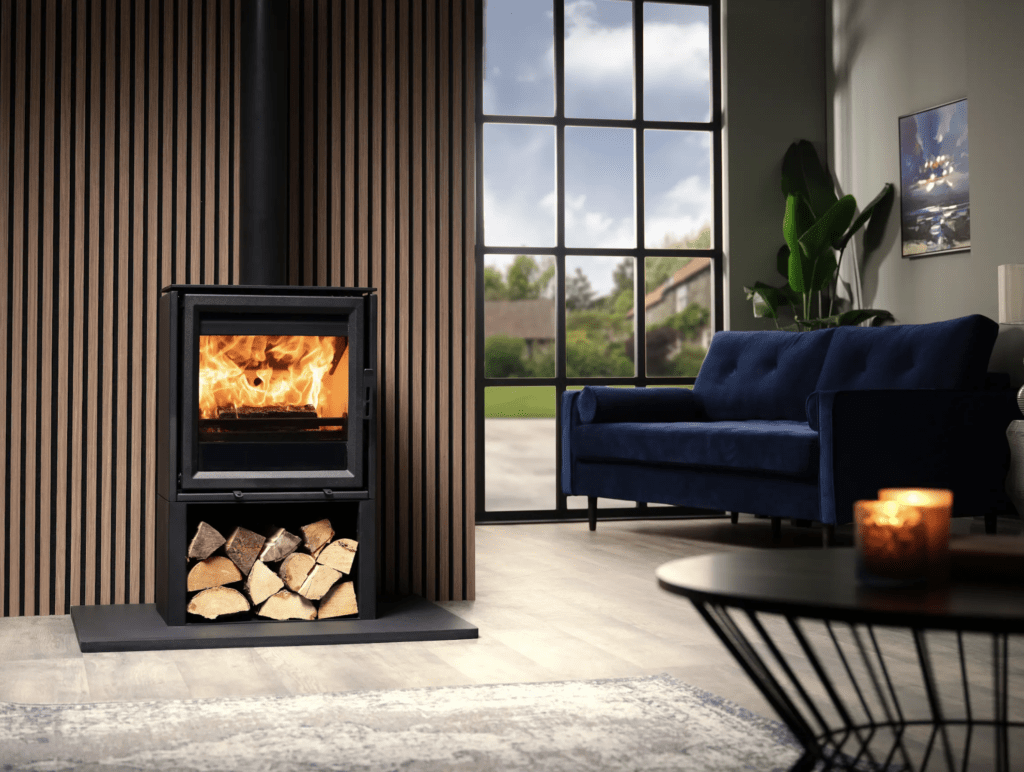
Our Woodtec 5kW range offers another route, with standard, wide, extra-wide and other formats. On applicable models outside the Woodtec Style variants, optional stands, log stores and black or oak handles allow further personalisation.
We would consider an oak handle when a room already includes natural timber furniture and the stove needs a subtle connection to it. A black handle supports a more unified, graphic appearance. Small details like these can make a carefully planned room feel coherent.
Cylinder stoves: introduce a different shape
A cylindrical stove deserves particular attention when the room contains a lot of straight lines. Rectangular windows, fitted cabinetry, long sofas and angular tables can create a strongly geometric interior. A curved stove introduces a different shape without needing a decorative surround.
Our range offers several distinct interpretations.
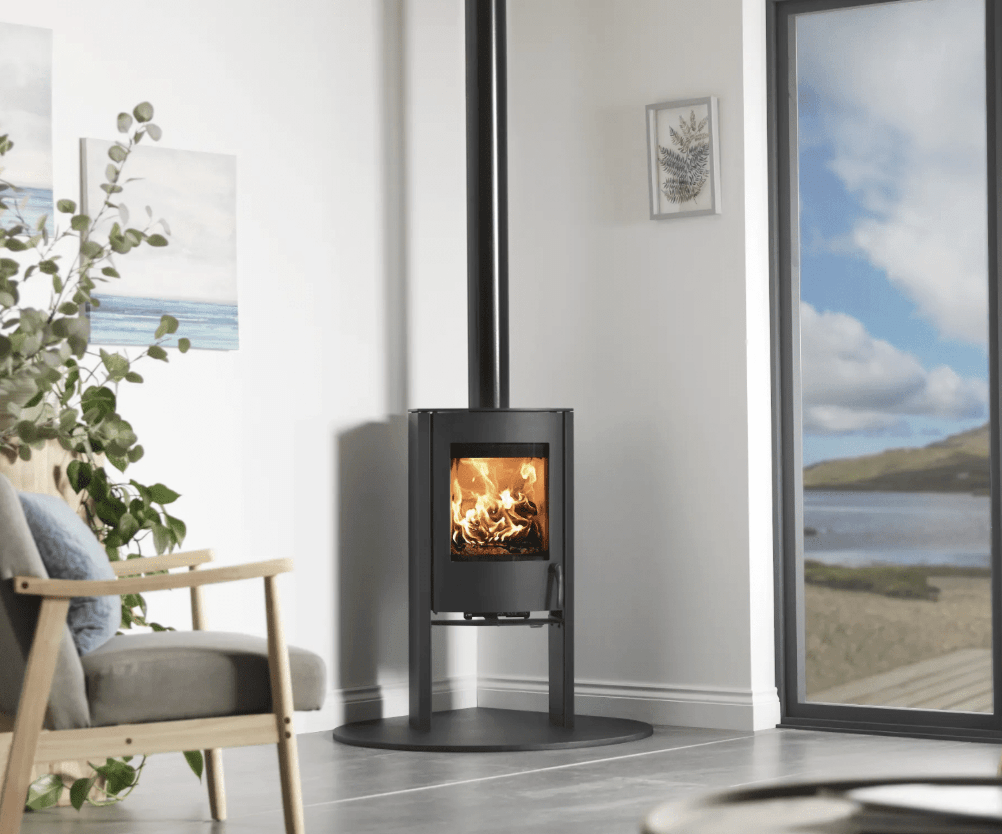
Our Go Eco Circulus – pictured below, has a cylindrical form and raised legs that lift the firebox and flames closer to eye level. It is a wood-burning-only model with a 5kW output. It would fit well in a relaxed contemporary room with rounded furniture, a soft neutral palette and plenty of visual space around the stove. Its raised-leg silhouette provides a useful alternative to a more solid, full-height base.
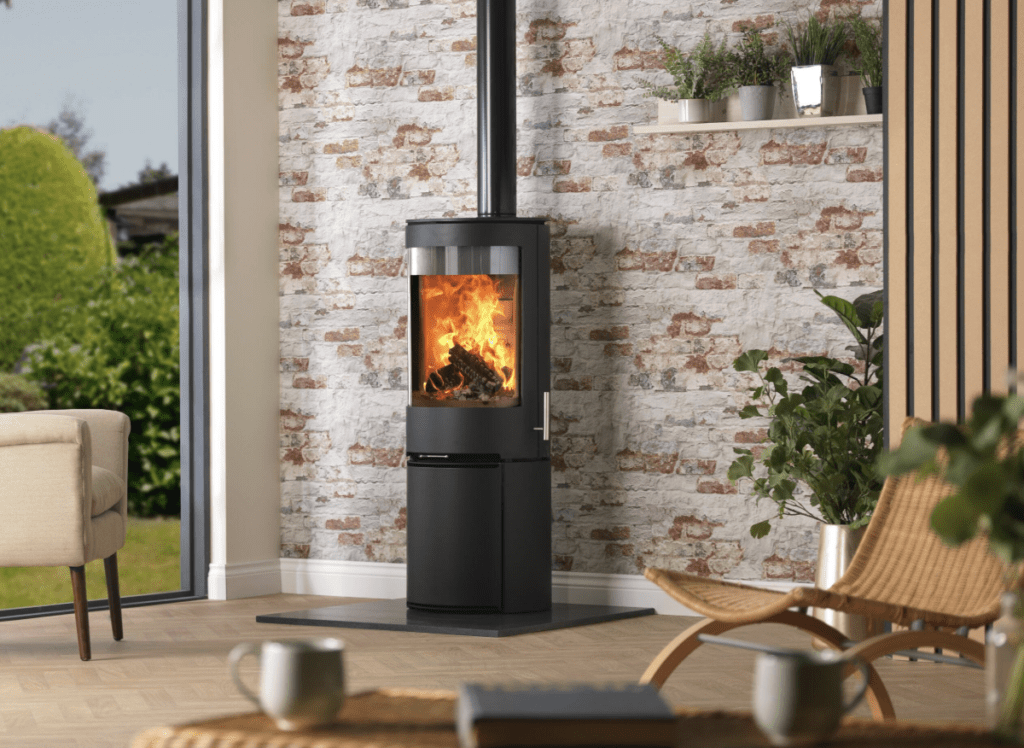
Our Woodtec FCS Cylindrical stove pictured below combines a curved glass window with an integrated log store beneath the firebox.
That arrangement creates a more continuous vertical form. An ideal stove when you need it to hold its own against a taller wall or create a clear focal point in a room without an elaborate fireplace. The stored logs add a natural texture within a purpose-designed part of the appliance.

Our Purevision BPVR Cylinder pictured below, shows curved ceramic glass with an up-to-180-degree panoramic view, together with high or low pedestal and log store options. For this design, we would consider a seating arrangement that uses more than one viewing angle: perhaps a sofa facing the stove and an armchair turned toward it from the side. The shape invites you to think beyond a single, straight-on view.
Think about the whole installation, not just the stove body
A cylinder stove may look compact, but its installation still includes the hearth, flue and required clearances. A corner position also needs its own assessment; a curved body does not automatically make every corner suitable. Where there is no existing chimney, a suitably designed twin-wall flue system may open up possibilities, but consider the flue route early, because the visible flue becomes part of the interior composition while also serving an essential function.
Choose a freestanding stove when you want the appliance itself to contribute character, whether that is the familiar appeal of a country fireplace, the clean outline of a contemporary stove or the sculptural quality of a cylinder stove.
3. Double-sided stoves: for connecting spaces around one fire
A double-sided stove introduces a different way to organise a home: one fire, enjoyed from two opposing sides. Our Woodtec 8kW Double Sided Wood-Burning Stove pictured below, has glass on opposite faces to create a tunnel-like view, with access from both sides. It also offers optional stand and log store accessories.
This is different from a stove with front and side viewing windows. Rather than providing several angles on one main seating area, a double-sided design can become a shared feature between two distinct spaces.

Give an open-plan room a sense of structure
A large open-plan room can benefit from a clear focal point. We would recommend a double-sided stove where the living and dining areas need to feel related, but not indistinguishable.
A well-designed fireplace chamber between the two areas can create separation while keeping the fire as a shared feature. The chamber and the flue route above it must be planned into the construction. Imagine a sitting area on one side, with a deep sofa and soft lighting, and a dining table on the other. Rather than arranging both spaces around separate focal points, the fire gives them something in common.
The result need not be a fully symmetrical layout. In fact, we would often let each side respond to its own furniture and use, while keeping the fireplace materials consistent.
Coordinate the two sides without making them identical
A double-sided installation offers an opportunity to connect different moods. For example, we would consider a pale, understated finish on the dining-room side and a richer, more enveloping wall colour in the sitting room. Carrying the same hearth material or a related stone finish through both areas can provide continuity.
Alternatively, in a country-style renovation, textured stone around the shared fireplace could work with a relaxed kitchen-dining scheme on one side and softer upholstery on the other. The key is to choose a small number of connecting elements. Repeating every colour, fabric and accessory can make two spaces feel unnecessarily matched.
Design the views from both rooms
Before deciding on the position, sit where you expect to spend time. What will you see from the sofa? Will the fire be visible from the dining table when chairs are occupied? Does a high-backed chair interrupt the view? What sits beyond the glass on the opposite side?
That last question is easy to overlook. We would frame a calm view through the fireplace rather than aim it directly towards a busy preparation area or an awkward corner. Height also deserves attention. A fire that looks ideally positioned from a dining chair may feel rather high from a low sofa. Compare the available base options against the furniture you actually intend to use, not just the proportions of an empty room.
Allow the fireplace to organise movement, not obstruct it
A shared fireplace should help the layout make sense. We would keep the main walking route comfortably clear of the stove and its hearth. Both operating sides need appropriate clearances and practical access, so plan furniture alongside installation.
This is especially important where one side faces a dining area. Pulling out chairs, walking around the table and tending the stove should not all depend on the same restricted space. Remember that two views do not mean two separate heaters.
Our Woodtec double-sided model has a nominal output of 8kW for the appliance as a whole, not 8kW on each side. Assess the heating requirements of the connected spaces accordingly; the two-sided appearance should not be treated as a guarantee of identical temperatures in both areas.
We would explore this option early in a renovation, particularly where it involves forming a new opening or constructing a shared fireplace feature. It is a decision with consequences for the layout, not simply a final decorative addition.
Choose a double-sided stove when you want two spaces to share the atmosphere of one fire, and you are prepared to design both sides of the installation with equal care.
4. Wall-mounted stoves: for a lighter-looking, architectural statement
A wall-mounted stove offers a distinctive visual effect: the firebox appears to float above the hearth. Unlike an inset stove, it is not primarily recessed into an opening. The body remains visible and projects into the room, supported by a dedicated wall-mounting arrangement. Our Purevision range includes both Linear wall-mounting options and a specific wall-mounted BPVR version.
We would consider this style when a room needs a strong focal point, but a conventional floor-standing base feels too visually heavy.
Choose between angular and curved forms
Our Purevision Linear Wood-Burning Stove, pictured below, features three sides of glass and includes a wall-mounting bracket as an accessory. Its more angular form suggests a crisp, contemporary composition. We would pair it with a backdrop with limited distractions and keep the front and side windows visually prominent, rather than crowding the stove with nearby furniture.
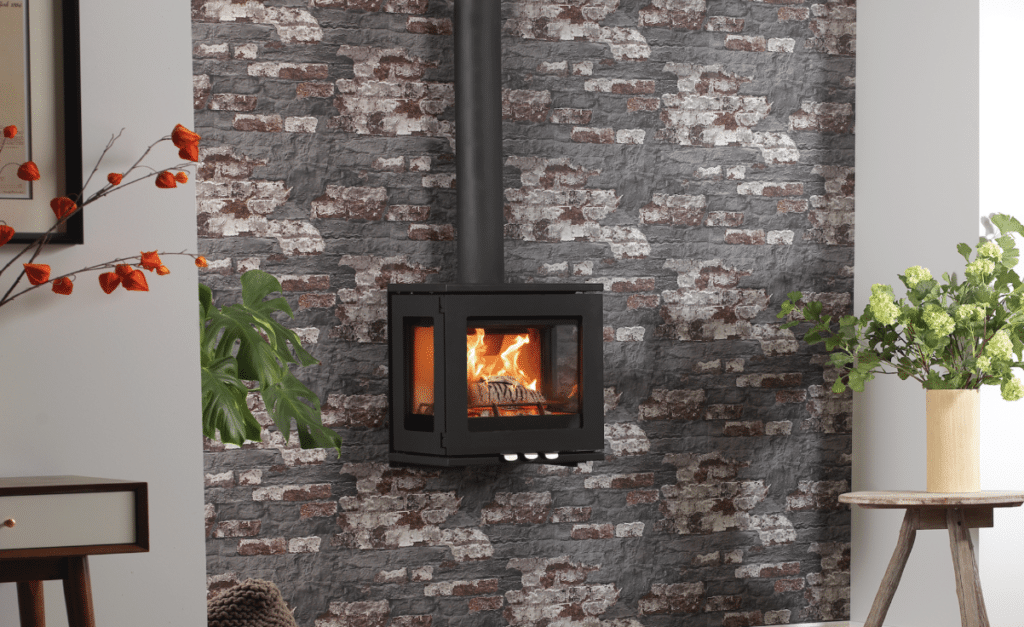
For an industrial-inspired interior, a well-specified brick finish could add texture behind the dark outline. For a softer scheme, consider a restrained, warm neutral backdrop, with colour and tactile materials introduced elsewhere in the room.
Make the empty space part of the composition
Much of the appeal of wall mounting lies in the absence of a pedestal or legs. We would preserve that visual simplicity. Rather than immediately filling the area beneath and around the stove with objects, let the gap remain an intentional part of the design.
A restrained hearth and a clear backdrop can make the firebox appear almost like a piece of functional sculpture. Repeating its dark finish in one or two details elsewhere, a lamp base or furniture frame, for example, helps connect it to the room.
Avoid overworking the wall itself. Competing shelves, busy artwork and several different surface finishes can dilute the effect. The stove already provides shape, depth and movement.
Find the right viewing height
Position a wall-mounted stove for how the room is used. We would test the proposed height from the main seating positions. It is easy to judge a stove while standing in an empty room, then discover that the fire feels too high when viewed from the sofa.
A useful design exercise is to mark out the proposed appliance position and hearth footprint before installation. Then check the view from the doorway, the sofa and any secondary seating.
The flue matters here, too. Its visible line forms part of the composition. Ask your installer to establish the viable route before deciding exactly how the finished wall should look.
Bringing the design together: how to choose your stove
The best choice balances the look you love with how your home actually works. Start with the room’s heating needs. Ask a specialist to assess the appropriate output before choosing a model on looks alone. Room size and insulation affect the heat required, and an oversized stove can encourage unsuitable low-output operation. A generous flame picture or substantial visual presence does not necessarily require the highest available heat output.
Once you’ve established the right options, you can compare their proportions with confidence. Compare the complete footprint
by assessing the stove, hearth, surrounding clearances, door movement and furniture layout together.
The smallest appliance body is not automatically the least intrusive installation. Equally, a wall-mounted stove may look lighter without making the floor beneath available for other uses. The installation requirements for the chosen model must remain central to the layout.
Choose materials as a coordinated scheme
Bring samples of your proposed wall colour, flooring, hearth and upholstery together. We would look for balance rather than exact matching: a smooth stove against textured stone, a dark appliance within a pale surround, or a curved body in a room with strong straight lines.
The fireplace’s construction and nearby finishes must also suit the installation. Check materials and clearances before ordering, including their relationship to timber beams, shelves, and combustible furnishings.
Plan for everyday living
Think beyond the photograph. Where will you keep fuel? Is there comfortable access for refuelling and cleaning? Does the layout still work when dining chairs are pulled out, or visitors arrive? Will the room need a fireguard? Our guidance recommends appropriate guarding, especially in homes with children or pets, along with safe operation and regular maintenance. Consider these practical details as part of the design from the beginning.
Choose the atmosphere you want to come home to
An inset stove can make the fire feel integrated and composed. A freestanding stove can bring familiar character or a striking sculptural shape. A double-sided stove can connect two areas around one shared feature. A wall-mounted stove can create a lighter-looking, distinctly contemporary focal point.
None belongs exclusively to one type of house. A clean-lined stove in a period room, or a characterful Countryman installation in a newer home may look fine. Success lies in the relationship between the appliance, its setting, and the people using the space.
Explore our wood-burning stove range, then visit one of our showrooms with photographs, room measurements and a few material samples. Seeing the proportions and finishes in person and discussing the installation with a specialist can help turn an appealing idea into a room you will love living in.