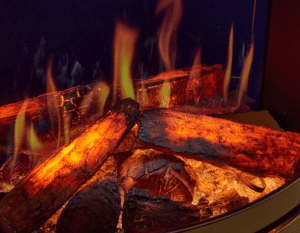
A wood-burning stove usually brings to mind a comfortable living room, a favourite armchair, and a welcoming fire keeping the cold out.
But what happens when the stove is meant to live outside?
At first, the idea might seem unusual. Without walls to retain the warmth, surely the heat simply disappears into the garden? Why choose an outdoor stove over a conventional fire pit or patio heater?
The answer starts with recognising that outdoor heating has a different purpose from indoor heating. It is not about bringing an entire space up to a set temperature. It is about making the area where you are sitting more comfortable and giving you a reason to stay.
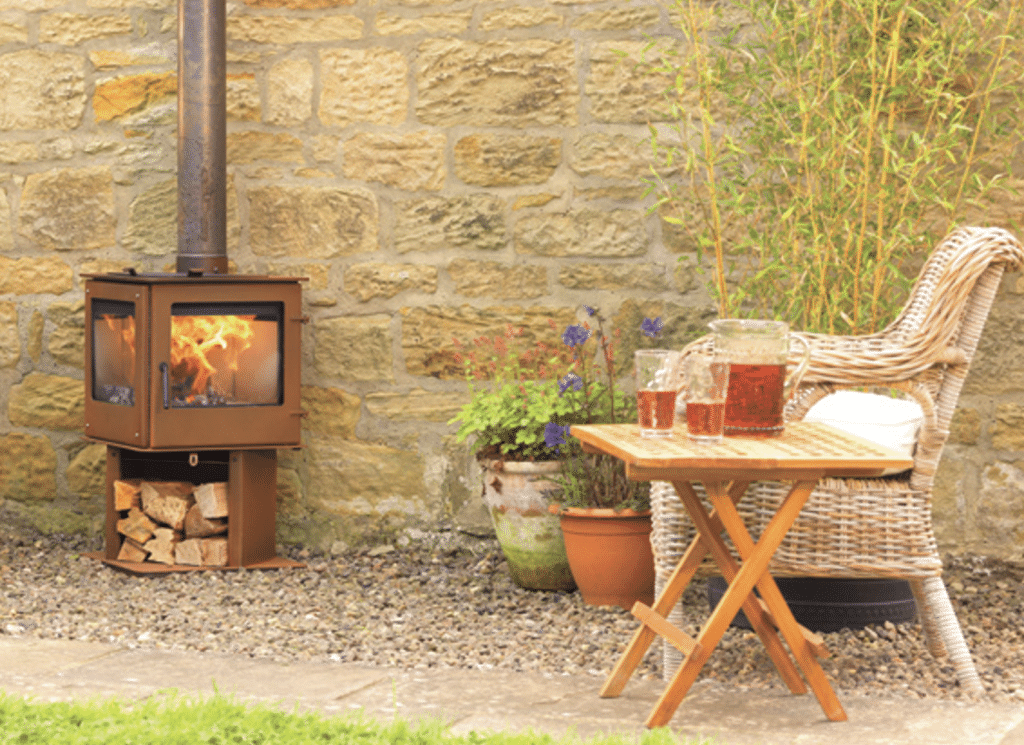
Our Go Eco Panofire brings that idea to life. With panoramic glazing, a weathering steel finish and an integrated cooking surface, it takes the familiar appeal of a wood-burning stove into an altogether different setting.
Think of it as a fireside without the four walls.
How can a wood-burning stove keep you warm outdoors?
To understand why an outdoor stove works, it helps to look at how heat reaches us.
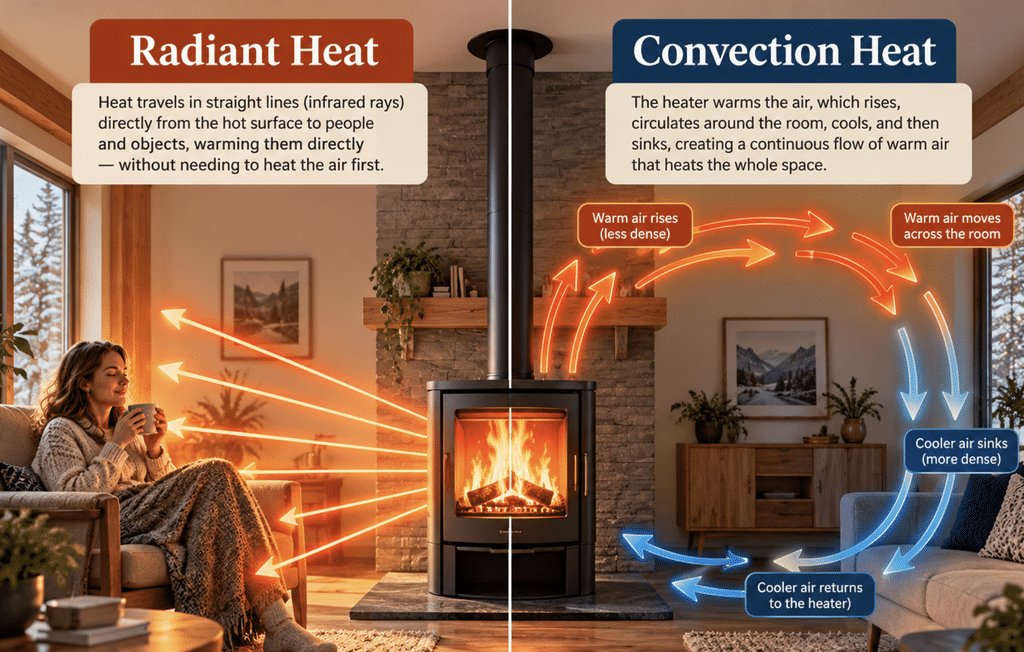
A stove does more than warm the surrounding air. Its hot surfaces also release radiant heat: energy that travels directly towards nearby people and objects. This is why you can feel warmth from a hot surface without touching it or waiting for all the air around you to heat up.
Indoors, both radiation and convection contribute to comfort. Convection occurs as air warms, rises and circulates. The room’s walls and insulation help limit how quickly that warmth escapes.
Outside, warmed air can disperse much more readily. However, radiant heat can still reach someone sitting near the stove. You don’t need to heat the whole garden to feel its effect. It is a useful distinction: an outdoor stove provides localised warmth, rather than trying to create an indoor climate in the open air.
There are limits, of course. Wind increases heat loss from your body, and conditions will influence how comfortable you feel. An exposed garden on a cold, blustery evening will not feel the same as a calmer outdoor setting. The Panofire is therefore best understood as part of an outdoor experience.
An authentic wood-burning stove, designed for a different setting
The Panofire has a 7kW nominal heat output, an approximate output range of 5–8kW, and 79.4% efficiency. It is a wood-burning appliance with a top flue connection. Those figures provide useful information about the appliance, but outdoor performance needs a little interpretation.
The efficiency figure describes its tested performance in converting fuel energy into heat output. It does not mean that 79.4% of the wood’s energy will reach the people sitting beside it. Once heat leaves the appliance, its usefulness depends on the surroundings, including positioning, distance and weather.
Similarly, a 7kW nominal output does not translate into a guaranteed number of square metres of heated patio. Outdoors, there is no enclosed room in which to retain and distribute that heat.
How can this stove become part of a comfortable, well-planned outdoor seating area?
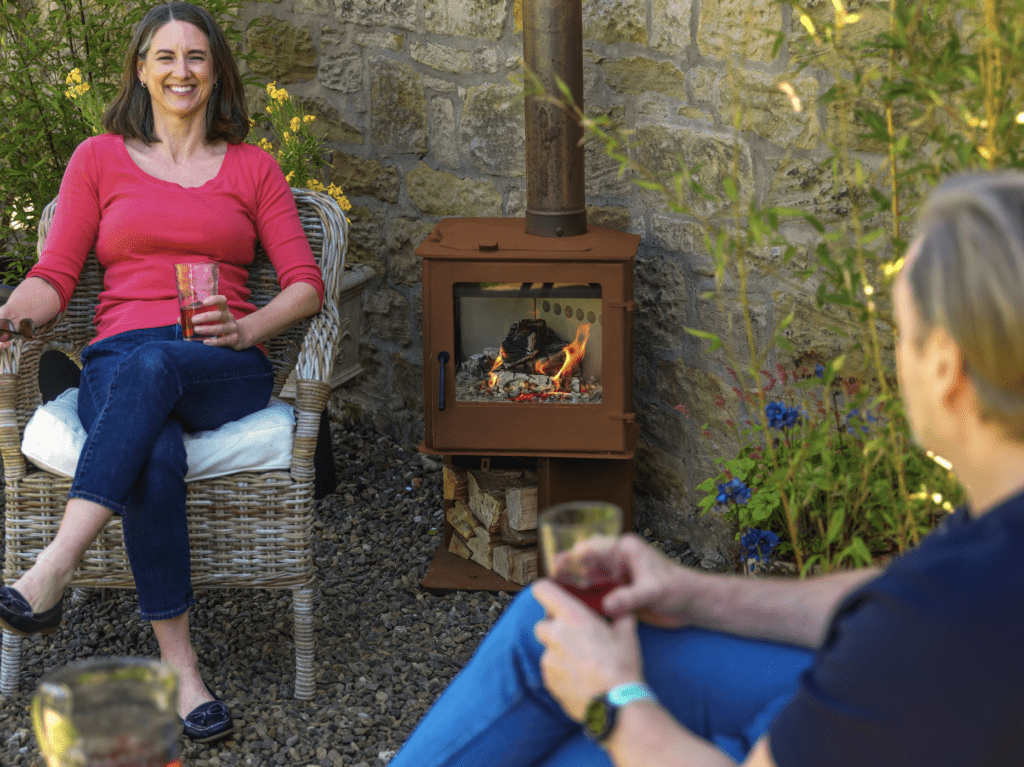
Warmth is only one part of a real fire’s appeal. The view matters too. The Panofire features dual-aspect ceramic glass, allowing the flames to be viewed through two faces of the stove. Its pedestal raises the firebox, while the space below incorporates a log store and heatshield.
Picture a pair of comfortable chairs angled towards the glass window, with enough space to move around safely. Or a seating area where the stove becomes a focal point between the garden and a suitable masonry backdrop. The two viewing faces give you something useful to plan around. Consider where people will sit, which way the stove will face, and how the flames will look from different seats. It is not just about finding a place for the appliance to stand. It is an opportunity to create somewhere people will choose to spend time.
Why weathering steel makes sense outside
The Panofire’s appearance is deliberately different from the familiar painted finish of many indoor stoves. Its Corten steel construction develops a weathered patina, giving it a rustic character.
Weathering steel is formulated to develop a protective surface layer under suitable conditions. Alternating wet and dry exposure helps the surface evolve from its initial oxidation into a more established patina. Its colour changes over time, rather than remaining a uniform factory finish. That changing surface is part of the attraction.
In a contemporary garden, its earthy tones can contrast with crisp paving and restrained planting. In a more traditional setting, the same finish can sit comfortably alongside brick, stone and established greenery.
Instead of treating the stove purely as equipment to conceal, consider it part of the garden’s overall appearance.
However, weather resistance should not be confused with it being maintenance-free. A durable exterior does not remove the need to look after the firebox, glass, seals and flue.
What makes it different from an open fire pit?
A traditional open fire bowl offers a direct, exposed-fire experience. The Panofire takes a different approach by placing the logs within a stove body and combining that enclosure with managed airflow and a flue. Its features include a single-slider air control, an airwash system and a patented tertiary air system.
Combustion depends on supplying oxygen in the right places. When wood heats up, it releases combustible gases; introducing air above the fuel can help those gases burn rather than escape unburned. Tertiary air provides an additional air supply within the combustion system.
An airwash directs airflow across the inside of the glass to help limit deposits. It assists with maintaining the flame view, rather than making glass cleaning unnecessary. Fuel quality and correct operation still matter. For someone deciding between different outdoor fires, the distinction is about the experience they prefer. Do they want the simplicity of an open fire bowl, or the glazing, controls and more defined fireplace form of an outdoor stove?
Neither question is answered by appearance alone. Think about tending the fire, cleaning afterwards and how the appliance will fit into everyday use.
The flue is an essential part of the design
The Panofire’s flue is not simply a decorative extension. The fire requires a suitable connected flue with a minimum 3m length and a 5-inch diameter. It must also be properly secured. This is one reason to consider the complete installation rather than choosing the stove body in isolation.
Look at the space above the intended position as well as the space around it. Discuss the proposed location and flue arrangement with your retailer before finalising the garden layout.
It is much easier to include the stove in the design from the start than to discover later that the chosen position is unsuitable.

More than a heater: cooking on the Panofire
One of the Panofire’s most appealing features is its ability to sort of make the fire part of the meal as well as the evening.
A top-mounted griddle lifts to reveal a grill section, adding a cooking function to the outdoor stove. You can use the flat top for griddle cooking.
This opens up a different way to think about outdoor entertaining.
Rather than treating cooking and relaxing as two separate stages, the fire can remain part of the occasion. A simple supper, something prepared in a suitable pan, or food cooked on the griddle can become the reason to gather outside in the first place. The appeal does not depend on elaborate recipes. Sometimes the pleasure is in taking an ordinary meal into a different setting.
Outdoor-only really does mean outdoor-only
The Panofire is expressly intended for outdoor use, not installation inside a home, garage or other enclosed building. Using it incorrectly in an enclosed space can allow dangerous carbon monoxide to accumulate. An enclosed summerhouse is therefore not an alternative location when the weather turns.
Plan for an appropriate open-air setting, with safe access for loading and tending the stove. Keep combustible furniture, fences, foliage and other flammable materials well away from the heat source, and never leave a lit outdoor fire unattended.
Comfortable seating and decorative accessories should follow a safe layout, not determine it.
Before buying, take photos and measurements of the proposed position and share them with your retailer. Discuss the ground surface, surroundings, and flue to determine whether the space is suitable before any landscaping work begins.

Why dry wood matters just as much outside
It is tempting to think that fuel quality matters less when burning outside. In reality, outdoor burning still affects the air around you and your neighbours. We advise using correctly seasoned wood and following the appliance instructions at all times. Wet wood produces more air pollution, while garden waste can also create substantial smoke. An outdoor stove should not be used as a convenient way to dispose of prunings, old decking, or household rubbish.
For suitable firewood, the Ready to Burn mark confirms a moisture content of 20% or less. Store purchased logs properly so they don’t get wet before use.
The Panofire’s integral log store is a useful feature, but it is sensible to think of long-term fuel storage as a separate part of the overall plan: where will the main supply stay dry?
A little preparation makes the experience easier. Choosing good fuel, keeping the area organised and learning the controls are all part of owning a stove.
A different kind of fireside
An outdoor stove is about helping you enjoy your time outside. The Go Eco Panofire offers a distinctive offering: a visible, carefully framed fire that can become part of both outdoor cooking and relaxation.
Its appeal is not about trying to heat the sky. It is about giving the garden a fireside of its own.
Explore the Go Eco Panofire with your nearest Charlton & Jenrick retailer, and discuss how an outdoor stove could fit safely and comfortably into your garden.