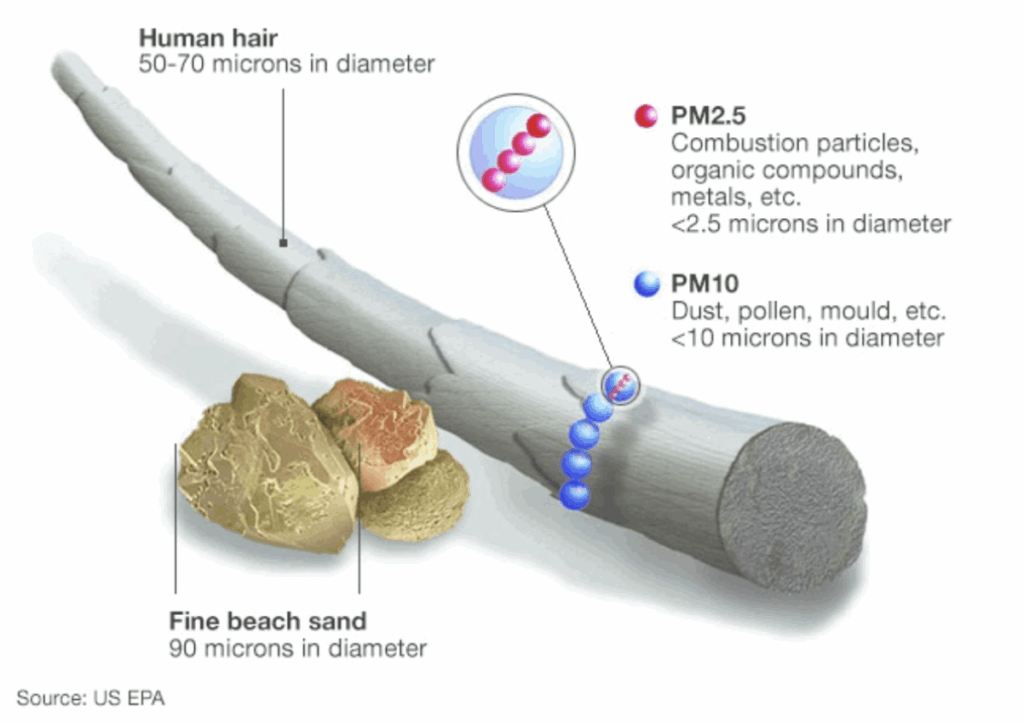
Comparative sizes of particulate matter: PM2.5 (red particles) and PM10 (blue) are minuscule compared to a human hair (50–70 µm in diameter) and grains of sand (90 µm). These fine particles can be inhaled deeply into the lungs, whereas coarser PM10 (dust, pollen, mould, etc.) is under 10 µm in diameter.
µm – a micrometre (one millionth of a metre).
What Are PM2.5 and PM10?
Particulate matter (PM) refers to tiny particles suspended in the air. PM10 denotes particles with diameters of 10 micrometres or less (about one-fifth the width of a human hair), including dust, pollen, and mould spores. PM2.5 refers to even finer particles 2.5 micrometres or smaller, roughly 20–30 times thinner than a human hair. These particles are largely generated by combustion processes (vehicle engines, power plants, domestic burning) and chemical reactions in the atmosphere. Because of their microscopic size, PM2.5 particles can penetrate deep into the lungs and even enter the bloodstream. By contrast, PM10, which includes PM2.5 as a subset, can be trapped higher in the respiratory tract, but still poses health risks.
The Health Impacts
Health impacts of PM2.5 are especially serious. Epidemiological studies have linked long-term exposure to PM2.5 with increased risk of respiratory diseases, heart disease, strokes, and even lung cancer. Children exposed to high PM2.5 can develop reduced lung function and asthma. Public health experts emphasise that there is effectively no safe level of PM2.5; even low concentrations can incrementally harm health. This is why governments and the World Health Organisation set strict guidelines for air quality. For example, the WHO recommends an annual average PM2.5 limit of just 5 µg/m³ to minimise health risks. By comparison, the UK’s current legal limit for annual PM2.5 is 25 µg/m³, with plans to tighten it. Reducing fine particle pollution has become a priority for environmental and health policy due to these impacts.
Pollution from UK Domestic Heating
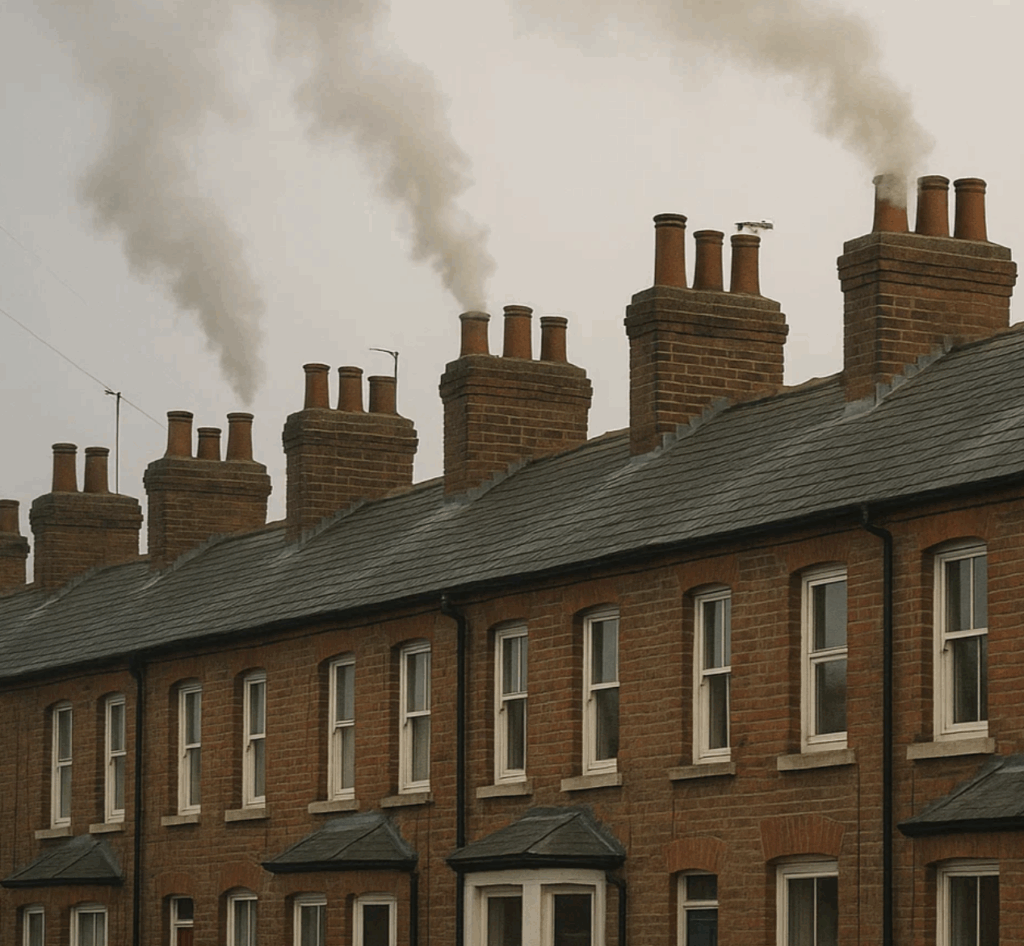
In recent years, the UK has focused more on pollution from domestic heating, particularly smoke from burning wood. Historically, discussions of air pollution focused on vehicle exhaust and industrial emissions. However, as cleaner car technology and industrial controls have advanced, the relative contribution of home heating, especially burning wood on open fires and burning unseasoned wood, has become more evident. Domestic wood burning on inefficient open fires and burning unseasoned wood has now emerged as a key source of particulate pollution.
Health and environmental authorities have grown concerned. Well-meaning but highly misleading media headlines warn about wood-burning stoves being more polluting than traffic, and community groups have raised alarms about the health effects on vulnerable populations (children, asthmatics, the elderly). The ultra-fine soot and chemicals in wood smoke not only contribute to outdoor smog but can also infiltrate homes, affecting indoor air quality. Because of these issues, domestic wood burning has been under scrutiny in the UK press and by policymakers looking to curb pollution.
UK Air Quality Trends and Standards
The UK’s overall particulate emissions have declined dramatically over the past few decades. Thanks to cleaner industry and vehicle standards, annual PM2.5 emissions in 2023 were about 76% lower than in 1990. Emissions from sources like coal power plants and diesel engines have dropped significantly, and total PM2.5 tonnage is the lowest on record. The UK met its initial 2020 target of a 30% reduction in PM2.5 emissions from 2005 levels, and it is working toward a 46% reduction by 2030 in line with international commitments.
Careless Wood-Burning
However, these gains have been partly offset by increases in other sources, which include careless domestic wood burning. Government reports noted that while transport and industrial emissions fell, emissions from residential wood combustion rose in the 2010s, peaking around 2020. By 2021, domestic combustion accounted for 27% of UK PM2.5 emissions. It is important to remember that all domestic combustion appliance types are accounted for under this single figure in the Emissions of Air Pollution in the UK data. These include open fires, older stoves and modern, Ecodesign wood-burning stoves.
Note – Of the total emissions attributable to domestic combustion, only 4.8% is attributable to modern, Ecodesign wood-burning stoves, and in the wider context, that is just 1.3% of total UK PM2.5 emissions.
Recognising the need for cleaner air, the UK government has set new targets under its Environment Act and clean air strategies. The current annual limit for PM2.5 (25 µg/m³) is set to be tightened, with a goal to reach 10 µg/m³ by 2040 (bringing the UK in line with the EU’s 2030 target). There is also pressure from health experts and local leaders to move faster; some advocate meeting the 10 µg/m³ target by 2030 instead, given the urgency of health impacts. Achieving these goals will require addressing domestic emissions alongside traffic and industry.
Policies Addressing Wood-Burning Emissions
The UK has introduced a range of policies to tackle pollution from careless wood burning while balancing the fact that many households rely on stoves for heating. Rather than an outright ban on wood-burning stoves, the approach has focused on cleaner technology and fuels:
Banning dirty fuels: Since May 2021, the sale of wet (unseasoned) wood and traditional house coal for home use has been banned or restricted. Wet logs produce excessive smoke and PM because of their high moisture content. Now, only dry seasoned or kiln-dried wood (labelled “Ready to Burn”) and smokeless coal alternatives can be sold in England. Burning dry wood can cut particulate pollution by up to 50% compared to fresh logs, so this policy ensures people use cleaner fuel in their stoves or fireplaces.
Ecodesign standards for stoves: In January 2022, Ecodesign regulations came into force, meaning all new wood-burning stoves sold in the UK must meet strict emission and efficiency standards. An Ecodesign stove burns much cleaner than older models, emitting far less PM, carbon monoxide, and other pollutants. These standards were part of an EU-wide initiative (retained by the UK) to improve air quality. By mandating that only low-emission stoves can be sold, the government essentially phases out dirty stoves over time as old appliances are replaced.
Smoke control areas: The UK’s Clean Air Acts have long allowed cities to designate Smoke Control Areas, where only approved smokeless fuels can be used and any wood or coal must be burned in an exempt (low-emission) appliance. These rules have been tightened recently. In many urban areas, it is illegal to emit visible smoke from a chimney. In 2024, ministers also gave local authorities stronger powers to enforce smoke limits and even issue on-the-spot fines for households whose stoves break the rules. Essentially, if you operate an old polluting stove or burn improper fuel in a city, you could face penalties, though enforcement has been a challenge in practice.
Public awareness and support: Campaigns have been launched to inform the public about clean wood-burning practices. For example, the “Ready to Burn” labelling scheme helps consumers choose low-moisture wood, and programs exist to help low-income households upgrade to cleaner heating.
No outright ban: Notably, the UK government has, rightly so, ruled out a complete ban on wood-burning stoves, recognising that many people depend on them, and that there is a huge difference between burning wood on an open fire or a non-Ecodesign stove compared to correctly burning seasoned wood on a modern Ecodesign stove.
The focus is instead on ensuring that, if people do burn wood, they do so in the cleanest possible way. Something we have mentioned time and again in our content.
Older, high-emitting stoves and open fireplaces are the primary targets for phase-out. In fact, proposals are being discussed that could amount to a partial ban on the most polluting stoves in dense urban areas. For instance, there are calls to forbid using open hearths or non-compliant old stoves in cities, effectively requiring upgrades to Ecodesign models.

Overall, it’s encouraging to see UK policy is steering homeowners towards cleaner stoves, cleaner fuel, and smarter burning habits rather than eliminating wood heating altogether. This approach aims to strike a balance between air quality goals and the practical and cultural values of using wood as a fuel.
Ecodesign Wood-Burning Stoves: The Game Changer
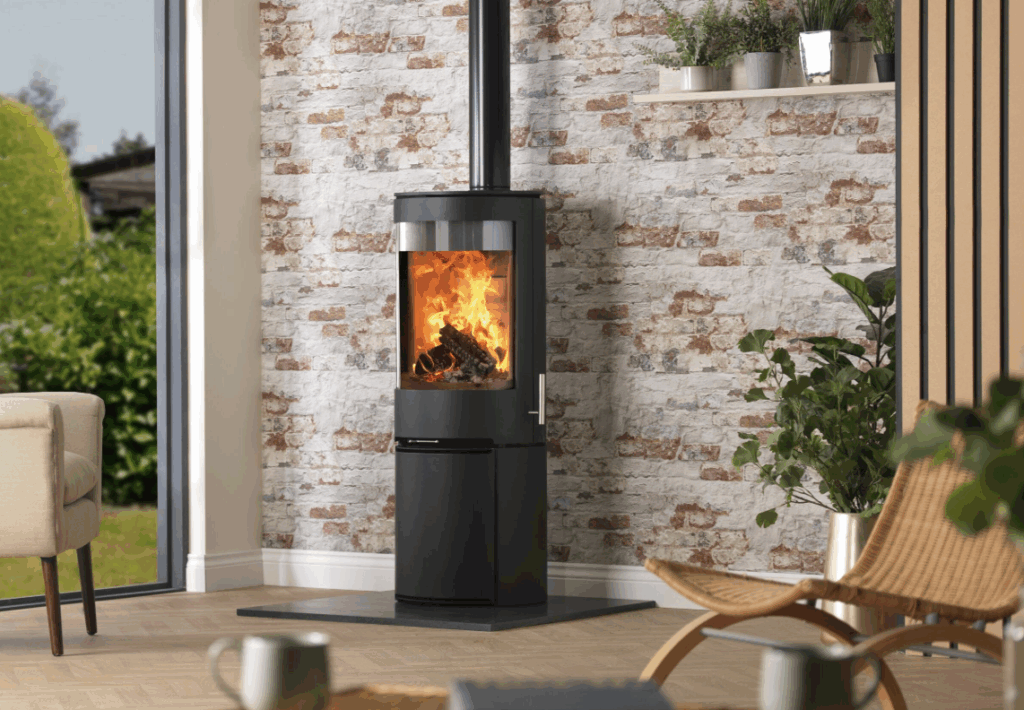
Modern Ecodesign wood-burning stoves are a game-changer for reducing emissions. Unlike old-fashioned open fires, essentially just a fire in a hearth, or earlier-generation stoves, the latest models are engineered for efficient combustion. They feature improved insulation, airflow design, and secondary burn systems that help ignite the smoke and volatile gases before they exit the flue. The result is more heat extracted from each log and far less particulate matter and smoke released.
The UK’s National Atmospheric Emissions Inventory report in 2025 noted that PM2.5 and PM10 emissions fell by an additional 7–8%, attributing part of this decline to the uptake of cleaner stoves. Upgrading to a modern stove is making a measurable difference in air quality statistics.
One reason wood-burning stoves remain attractive is that wood fuel can be a sustainable, renewable energy source. Unlike natural gas, oil, or coal, which are fossil fuels releasing carbon that was long stored underground, wood is part of the biocarbon cycle. Trees absorb carbon dioxide as they grow; when wood is burned, that CO2 is released, but new trees can take it up again. If managed responsibly, this creates a carbon loop that can be neutral over the span of tree regrowth.
In principle, heating with wood harvested from sustainably managed forests or waste wood has a much lower net greenhouse gas impact than heating with fossil fuels. In fact, UK climate strategy acknowledges biomass, including wood, as a component of renewable energy.
Beyond Carbon
Beyond carbon considerations, there are other environmental benefits. Using wood from well-managed woodlands can support local forestry jobs and help maintain healthy forests. Regular harvesting, such as coppicing, can even promote biodiversity by opening up space for new growth.
A final consideration
The key takeaway here is that it’s essential to differentiate between open fires and old stoves and Ecodesign wood-burning stoves, which have been a game-changer. Also, only burning seasoned wood can’t be emphasised enough. Follow these rules and Ecodesign wood-burning stoves will continue to play a part in a green lower-carbon future.