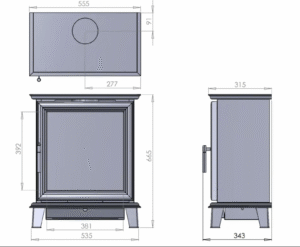
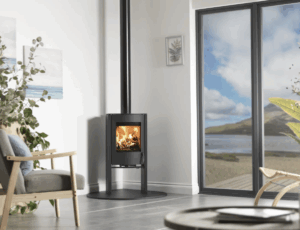
Under new government proposals, newly installed wood-burning stoves may be required to carry a health warning highlighting the air pollution they can produce. While these measures are rooted in valid concerns about emissions, they risk oversimplifying the issue by failing to acknowledge a crucial distinction: when used correctly and fuelled with properly seasoned wood, modern wood-burning stoves can provide an efficient, low-carbon, and environmentally responsible source of heat.
Dry, well-seasoned wood burns at a higher temperature and with far greater efficiency than wet or unseasoned wood. As a result, it produces significantly fewer harmful particulates and emissions, while releasing largely only the carbon dioxide that the tree absorbed from the atmosphere during its growth. In this sense, wood differs fundamentally from non-renewable fossil fuels. When sourced responsibly, it is a renewable resource, and its environmental impact is governed far more by how it is burned than by the simple presence of a stove in the home.
It is no surprise, then, that wood-burning stoves have surged in popularity in recent years. Growing awareness of Ecodesign, combined with a broader desire to reduce reliance on the energy grid and rising fuel costs, has led many households to view wood as a practical and sustainable heating option. Modern stoves are designed to maximise combustion efficiency, minimise waste, and significantly reduce emissions when used as intended.
However, these environmental benefits depend entirely on informed and responsible use. If you burn wood, it is essential to understand what you are burning and the consequences of burning it incorrectly. Unseasoned or wet wood contains a high moisture content, which prevents clean combustion and leads to excessive smoke, increased particulate pollution, and a buildup of harmful deposits in the stove and flue. Put simply, no matter how advanced or efficient a stove may be, burning unseasoned wood undermines its performance and negates its environmental advantages.
What Is Unseasoned Wood?
Unseasoned wood refers to firewood that hasn’t been properly dried or cured. Freshly cut wood, also known as green or wet wood, has a high moisture content, often as much as 50-60%, depending on the type of wood. When wood is seasoned, it is allowed to dry out over time, typically for 6-12 months, which reduces its moisture content to around 20% or less. Some hardwoodslike oak, can take upwards of two years to season. An alternative to seasoning wood is having it kiln-dried.
Ready to Burn – If you’re buying logs in quantities of less than 2 m3, they must be certified as Ready to Burn (have a moisture content below 20%). Learn more about this scheme here.
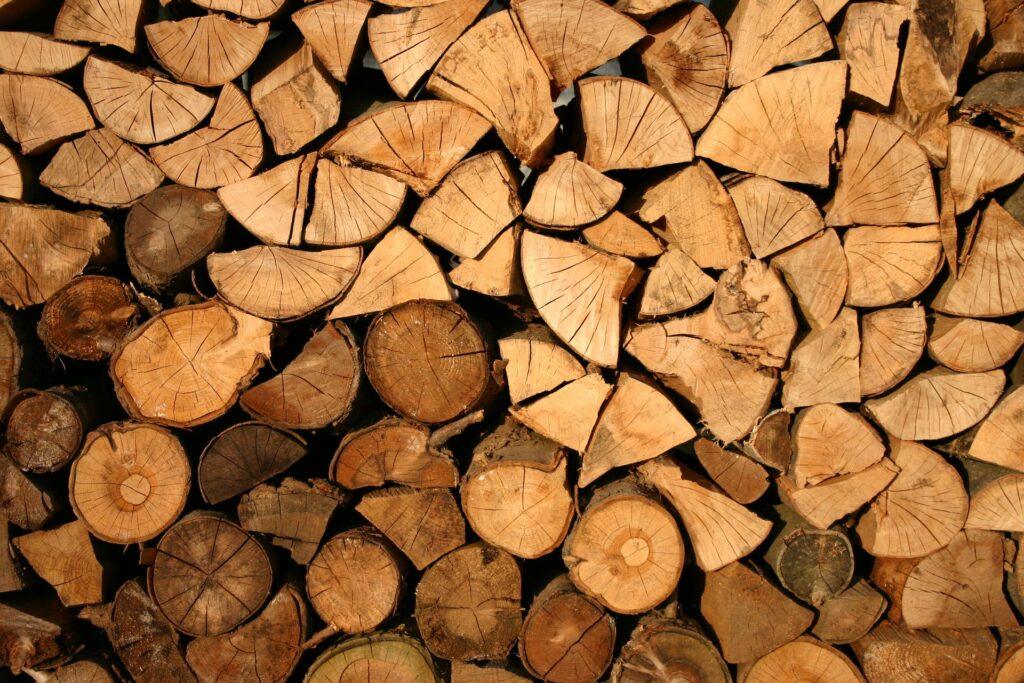
Moisture Content of Wood by Type (in Freshly Cut or Green Wood)
Oak (Red and White) – 40-60%
Oak is dense and heavy, with high moisture content when freshly cut. It is one of the most popular hardwoods for firewood, but it takes longer to season.
Ash – 50-60%
Ash burns well when properly seasoned and has a similar moisture content to oak when freshly cut. It is easier to split and dries relatively quickly.
Beech – 50-60%
Beech is another hardwood that retains a high moisture content when freshly cut. It is known for producing good heat output once seasoned.
Maple (Sugar, Red) – 45-55%
Maple has a high moisture content when fresh and, like ash, can dry out faster than oak. Once seasoned, it burns cleanly and provides good heat.
Birch – 45-55%
Birch wood has a high moisture content when fresh, but it dries faster than many other hardwoods. It burns quickly and produces a decent amount of heat.
Pine (Eastern White, Red Pine) – 40-50%
Softwoods like pine have a slightly lower moisture content when freshly cut compared to hardwoods. However, they still require seasoning to burn efficiently.
Douglas Fir – 45-55%
Douglas Fir is a softwood with moderate moisture content when fresh. It is commonly used for firewood in the Pacific Northwest but requires proper seasoning for optimal burning.
Spruce (Norway, Sitka, Black Spruce) – 40-50%
Spruce is another softwood with a relatively high moisture content when fresh. It burns quickly, so seasoning is important to improve efficiency.
Fir (White Fir, Balsam Fir) – 40-50%
Like spruce, fir has a high moisture content when freshly cut. It burns hot but fast, and proper seasoning is necessary to avoid excessive smoke and creosote buildup.
Cherry (Sweet, Black) – 50-60%
Cherry wood is a dense hardwood with a high moisture content when fresh. However, it dries relatively quickly and burns with a pleasant aroma once seasoned.
What Happens When You Burn Unseasoned Wood?
Lower Efficiency and Less Heat
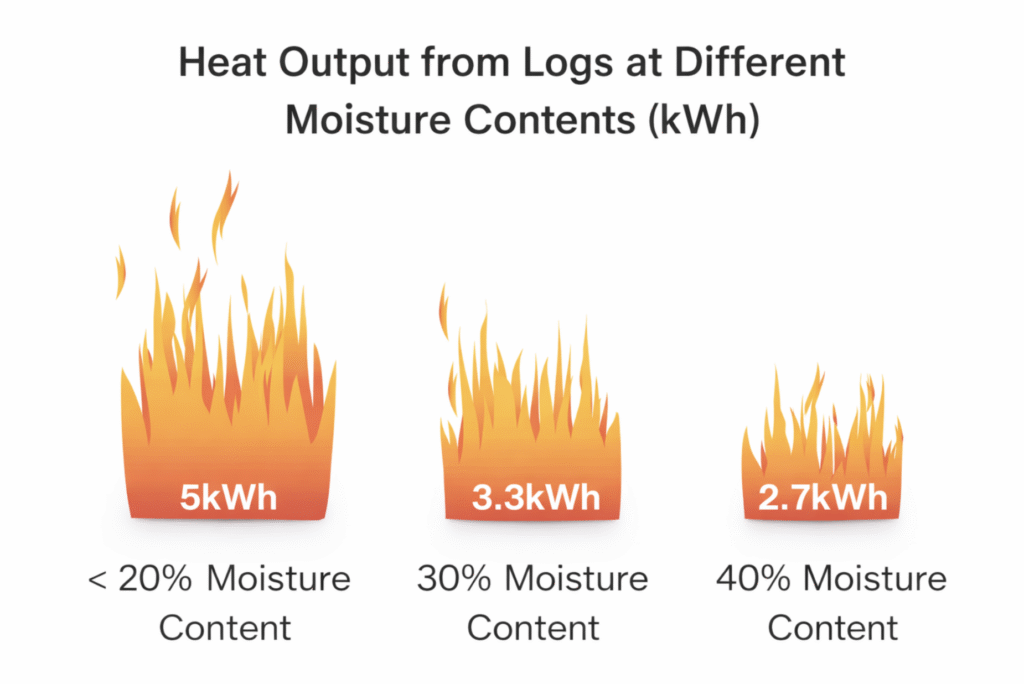
One of the most immediate and often overlooked consequences of burning unseasoned wood, despite the broader focus of recent government labelling proposals, is a significant loss of efficiency. Because unseasoned wood, as mentioned earlier, contains a high level of moisture, much of the energy generated by the fire is consumed simply evaporating water rather than producing usable heat. As a result, far less warmth is delivered to the room, leading householders to burn more fuel to achieve the same level of comfort. In practical terms, this means that burning unseasoned wood not only increases emissions but also wastes energy and money, reinforcing the very concerns highlighted by the proposed warning labels.
More Smoke and Pollution
Unseasoned wood produces substantially more smoke than properly seasoned fuel, a key issue at the heart of the government’s proposed stove labelling. Its high moisture content prevents clean, complete combustion, resulting in excessive smoke being released into the air. This smoke not only creates unpleasant odours in and around the home but also contributes directly to poor air quality. It contains a range of harmful pollutants, including carbon monoxide, fine particulate matter, and volatile organic compounds (VOCs), all of which pose risks to human health and the wider environment, precisely the impacts the new warning labels are intended to draw attention to.
Creosote Buildup
Burning unseasoned wood also greatly increases the build-up of creosote in a stove’s flue and chimney, an issue often overlooked amid discussions around government warning labels and emissions. Creosote is a highly flammable residue formed when wood burns incompletely, and it readily adheres to the inner surfaces of the flue and chimney. Over time, this accumulation can become a serious fire hazard. If left unchecked, excessive creosote build-up can ignite and cause a chimney fire, potentially leading to extensive damage to a property or even total loss. While regular chimney inspections and professional cleaning are essential for safety, the most effective way to limit creosote formation is to burn properly seasoned wood from the outset.
Soot and Residue in the Stove
Burning unseasoned wood can lead to more soot and residue building up inside your stove. This can cause the stove to become congested more quickly. A congested stove will not burn as efficiently, leading to more frequent cleaning and maintenance being required. Additionally, the excess soot can negatively impact the stove’s lifespan.
Increased Wear on the Stove and Chimney
The byproducts of burning unseasoned wood, excess moisture, creosote, and soot, can also cause long-term wear on your stove and chimney system. Over time, the moisture from the unseasoned wood can cause rust or corrosion, which can damage the stove’s components and reduce its efficiency. The longer this is allowed to continue, the more likely it is that costly repairs will be needed.
Difficult to Start and Maintain a Fire
Unseasoned wood is harder to ignite and sustain than seasoned wood. The high moisture content in unseasoned wood makes it more difficult to get a fire started, and once the fire is going, it tends to burn at a lower temperature. This can make it challenging to maintain a steady flame, requiring more effort to keep the fire alive. In some cases, you may need to add more fuel frequently, contributing to inefficiency.
Why You Should Always Use Seasoned Wood
Better Heating Efficiency: Properly seasoned wood burns hotter and more efficiently, providing more heat with less fuel. This allows you to keep your home warm without burning through piles of wood.
Cleaner Burns: Seasoned wood produces less smoke, less soot, and fewer harmful emissions. This is better for both the environment and your health.
Less Creosote and Maintenance: Using seasoned wood greatly reduces the amount of creosote buildup in your chimney, decreasing the need for regular cleaning and reducing the risk of dangerous chimney fires.
Longer Stove Lifespan: Proper wood maintenance, such as burning seasoned wood, helps preserve the life of your stove and chimney by reducing the wear and tear caused by moisture and corrosive substances.
How to Tell if Wood Is Seasoned
The simplest way to check if wood is properly seasoned is by looking for visual and tactile cues:
Colour: Seasoned wood tends to be darker and more cracked than unseasoned wood.
Sound: When you knock two pieces of seasoned wood together, it should produce a sharp, hollow sound, while unseasoned wood will make a dull thud.
Weight: Seasoned wood is significantly lighter than unseasoned wood, as the moisture has evaporated.
Cracks: Look for visible cracks on the ends of the logs—this indicates that the wood has dried properly.
Moisture Meter: If you have one, you can use a moisture meter to check the wood’s moisture content.
While it may be tempting to burn freshly cut wood rather than wait for it to season, the disadvantages of doing so far outweigh any short-term convenience, especially in light of the government’s proposed warning labels. Burning unseasoned wood results in poor efficiency, excessive smoke, and increased creosote buildup, all of which undermine both environmental performance and household safety. It can also accelerate wear and damage to your stove and chimney, reducing their lifespan and increasing maintenance costs. Ultimately, responsible fuel choice is central to addressing the very concerns these labels aim to highlight, and the simplest way to burn cleaner, safer, and more efficiently is to use properly seasoned wood.
Read more related articles here:
Selecting a moisture meter
How is wood kiln-dried
Best wood to burn on a stove