Choosing a gas fire should be enjoyable. Consider the flame picture, the fireplace style, and the thought of settling down beside it on a cold evening.
Then you reach the technical information.
What is the difference between a Class 1 and Class 2 chimney? Does a higher kilowatt figure always mean a better fire? What makes a balanced flue different? And how does a gas fire’s efficiency relate to the colourful A–G rating shown in the brochure?
Our gas collection brochure includes two useful sections to help answer these questions: the Key, which explains the symbols accompanying our products, and SAP Rating, which introduces the relationship between heating appliances and the energy performance of a home.
Understanding them makes it easier to move beyond choosing a fire purely by appearance. Here is how to read both sections and use them to ask the right questions before buying.
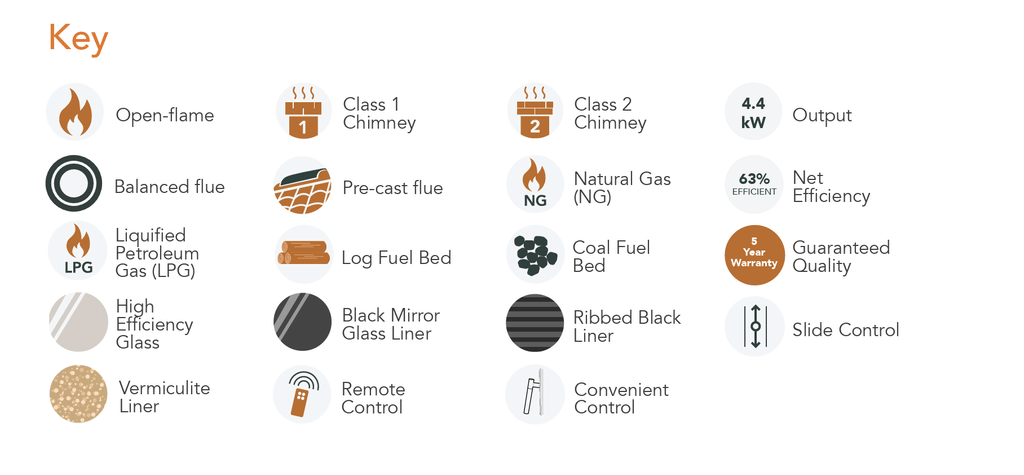
Part One: Understanding All 19 Symbols in the Key
Think of the Key as a guide to the information on each product page. Some symbols describe installation requirements, others explain performance, and the rest identify appearance, controls or warranty cover.
The Key is not a specification for every fire. Figures such as 4.4kW and 63% illustrate how information is displayed; check the individual product page for the model you are considering. Likewise, not every fire offers every feature.
Working across the Key from left to right, here is what each symbol means, and the notes that follow explain what these 19 symbols mean in more detail.
1. Open-flame
This identifies an open-fronted gas fire, rather than a fire with a sealed glass front enclosing the flame picture. It offers the visual appeal of an open fire while burning gas.
Importantly, open-flame does not mean flueless. Conventional flue gas fires need a suitable chimney or flue to carry combustion gases outside.
2. Class 1 Chimney
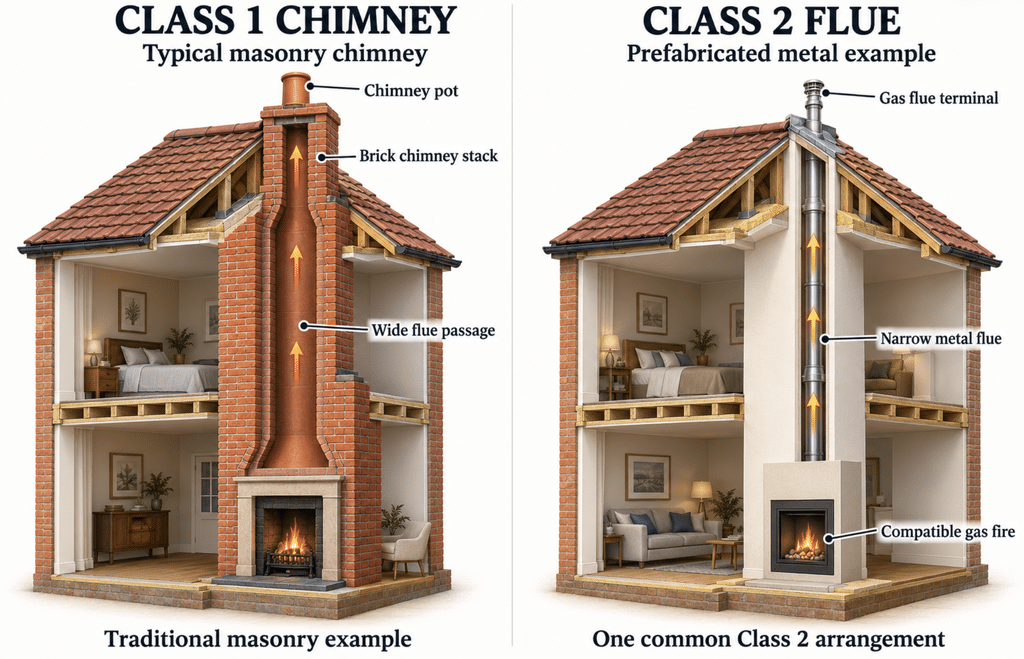
A Class 1 chimney is typically a traditional masonry chimney with a substantial chimney breast and stack. Its relatively generous flue passage can accommodate a wider range of suitable appliances than narrower systems.
The symbol indicates compatibility with this chimney category.
3. Class 2 Chimney
Class 2 commonly refers to a narrower flue system used for suitable gas appliances, including prefabricated metal flues.
The important distinction is compatibility. Class 2 doesn’t mean second-rate, just as Class 1 isn’t the flagship. These descriptions help identify which appliances can work with the available flue.
Do not assume a fire suitable for one arrangement automatically suits another.
4. Output
Output describes the rate at which the appliance supplies useful heat, expressed in kilowatts, or kW. For example, the Paragon One Evolution has a stated heat output of 4.4kW.
Output is different from input: input describes the energy supplied to the appliance in its fuel. The distinction is visible in specifications such as the Paragon P11’s stated 4.4kW output from a 6.1kW input.
When choosing, ask which output suits your room rather than automatically selecting the highest output. Discuss how you intend to use the fire, and ask about its available heat settings as well as its maximum output.
Paragon P11:

5. Balanced Flue
A balanced-flue gas fire has a room-sealed combustion arrangement. It takes combustion air from outside and discharges combustion gases outside through its specified flue system.
This can make it an option for homes without a conventional chimney. However, it still needs an appropriate flue route and terminal position. Balanced flue and flueless are not interchangeable terms. A balanced-flue appliance has a flue; it simply uses a different arrangement from a conventional chimney-connected fire.
6. Pre-Cast Flue
A pre-cast flue is formed from purpose-made concrete flue blocks, often incorporated into a wall. These systems can have a relatively shallow fireplace opening.
That makes appliance dimensions particularly important. A fire may look right for the room but need more installation depth than the opening provides. You need to assess the specific pre-cast flue and fireplace opening.
7. Natural Gas (NG)
NG means natural gas, normally supplied through the mains gas network.
This symbol identifies the fuel for the relevant appliance. It is a compatibility label, not an efficiency grade: check the gas supply before selecting the fire.
8. Net Efficiency
Efficiency describes how effectively the appliance converts fuel energy into useful heat under its stated test conditions.
The word net indicates the basis for the calculation. Our brochure quotes net efficiencies and explains that these are normally higher than gross efficiencies for the same appliance. Comparing a net figure for one fire with a gross figure for another can therefore be misleading.
For a meaningful comparison, check that the figures use the same basis. Also keep efficiency separate from output: they answer different questions about the fire.
As we explore below, a fire’s efficiency percentage is not its home’s SAP score.
9. Liquefied Petroleum Gas (LPG)
LPG provides a gas-fuel option for some homes without a mains natural-gas connection.
An appliance must be suitable for the fuel supplied: natural gas and LPG are not interchangeable without the correct approved appliance configuration. Where both options are offered, confirm the version being purchased with your retailer and installer.
10. Log Fuel Bed
This describes the fire’s log-effect arrangement: specially designed components that create the appearance of burning logs while the appliance burns gas.
For example, the Paragon One Evolution is offered with a mixed-log fuel bed as an alternative to its coal-effect appearance.
It lets you enjoy a wood-fire aesthetic without choosing a wood-burning appliance. The logs are part of the gas fire’s specified fuel-effect assembly.
11. Coal Fuel Bed
A coal fuel bed provides a traditional coal-fire appearance. For example, the Paragon 2000 Low Lintel uses a realistic coal-effect fuel bed. The artificial fuel-effect components form part of the appliance’s design and must be handled and positioned as instructed.
Paragon 2000 Low Lintel:
12. Guaranteed Quality
The Key represents this with a five-year warranty symbol. It is worth understanding the cover behind the badge.
The gas fire warranty provides two years of parts and labour cover, with the option to extend parts cover for a further three years. To extend the warranty, you must register within one month of purchase and comply with the applicable terms, including annual servicing.
In other words, five-year extended cover does not mean five years of unrestricted parts and labour protection. Ask your retailer to explain the terms, exclusions, and registration process when you purchase.
13. High Efficiency Glass
This symbol identifies the glass-fronted approach used in our high-efficiency gas-fire designs. The glass front is part of the appliance’s overall engineering, rather than simply a decorative screen.
The Paragon Focus HE, for example, combines a full-length glass window with a stated net efficiency of up to 82%.
Do not confuse the front glass with the decorative glass liners inside the firebox. Nor should the symbol alone be taken to mean balanced flue: the Focus HE is a conventional-flue model. Always read the flue and efficiency information alongside the glass symbol.
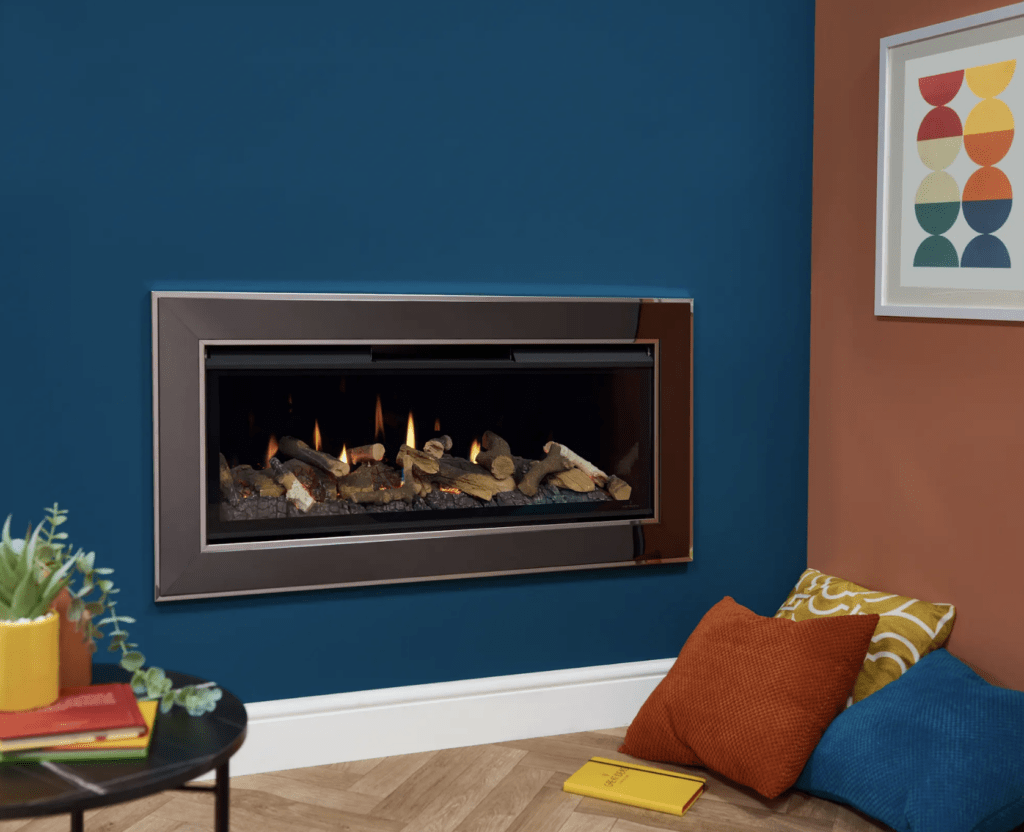
14. Black Mirror Glass Liner
This describes reflective panels inside the firebox, behind and around the flame display.
They create reflections that add visual depth to the flames. For example, the Infinity 890HD model uses black mirror glass liners to enhance its flame picture.
Consider whether you prefer a reflective interior with apparent depth or a less reflective backdrop that emphasises the individual flames. It may help to do this in-store, so you can see various options up close.
Infinity 890HD:
15. Ribbed Black Liner
A ribbed black liner provides a dark, textured interior rather than a mirror-like surface. The Paragon P11 offers black mirror and black ribbed liner choices.
The difference is easiest to see when you view the alternatives alongside the fuel bed. Consider how the liner looks both when the fire is operating and when it is switched off.
16. Slide Control
Slide control allows the fire to be operated using a lever on the appliance, rather than relying solely on a separate handset. Our Paragon P11 is one example offering this control option.
On relevant models, you use the lever through the lighting and heat-selection sequence described in the operating instructions.
Before choosing, try the control in a showroom. Is its position comfortable to reach? Does its operation feel straightforward? A feature that seems small on a brochure page can make a considerable difference to your preference.
17. Vermiculite Liner
Vermiculite is a mineral used to manufacture heat-resistant insulating materials, including stove and fireplace lining panels. It can withstand repeated heating and cooling.
In our gas range, the symbol identifies this type of firebox lining. The Paragon Edge Stove, for example, offers vermiculite or black mirror glass liners.
It helps to distinguish material, appearance and performance. Vermiculite names the lining material; the appliance’s published output and efficiency remain the figures to consult when comparing heating performance.
Paragon Edge Stove:

18. Remote Control
The remote-control symbol identifies operation through a handset. Depending on the model, this lets you switch the fire on or off and adjust its heat setting without using the appliance’s controls. The Infinity 890HD model offers full remote control.
However, don’t assume every remote has the same features. Ask specifically about the functions you need, whether that is basic flame adjustment, temperature control or programming.
19. Convenient Control
This is more specific than its name might suggest.
On the Panache 56SD CF gas stove, Convenient Control allows operation through the stove’s handle. It is a distinct control arrangement, not simply another name for a remote handset or a general claim that the appliance is easy to use.
It is particularly worth seeing demonstrated. How a control feels in use can matter as much as its description on paper.
Part Two: What Does SAP Rating Mean?
Once you understand the individual fire, SAP introduces the bigger picture: the home in which it will be installed.
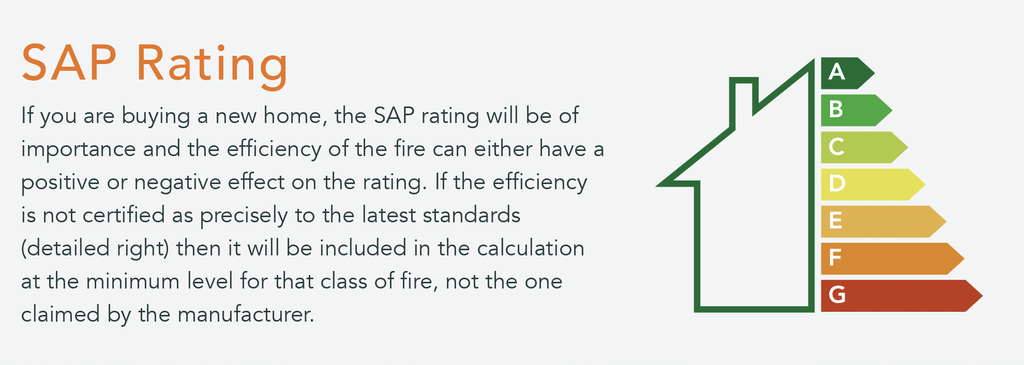
SAP stands for Standard Assessment Procedure. It is the government’s methodology for assessing the energy performance of dwellings, used for purposes including Building Regulations assessments and producing domestic Energy Performance Certificates, or EPCs. Existing homes are commonly assessed using the reduced-data version, RdSAP.
What does the rating actually measure?
The familiar domestic energy-efficiency rating is based on modelled energy costs, rather than being a simple percentage showing how much heat a building retains. It should not be confused with a direct carbon-emissions rating, either.
The assessment considers the building and its systems, using standardised assumptions rather than measuring how one particular household behaves. Construction, insulation and heating all contribute to the result. This allows homes to be compared on a more consistent basis.
That distinction is important when interpreting an EPC. The rating provides useful evidence about the property, but it doesn’t guarantee your energy costs will fall within a particular range. Your actual use of the home can differ from the assumptions behind the assessment.
Understanding the A–G classification
The A–G graphic in our brochure illustrates the familiar domestic energy-efficiency bands. A is the highest band and G the lowest, with the numerical score determining the letter.
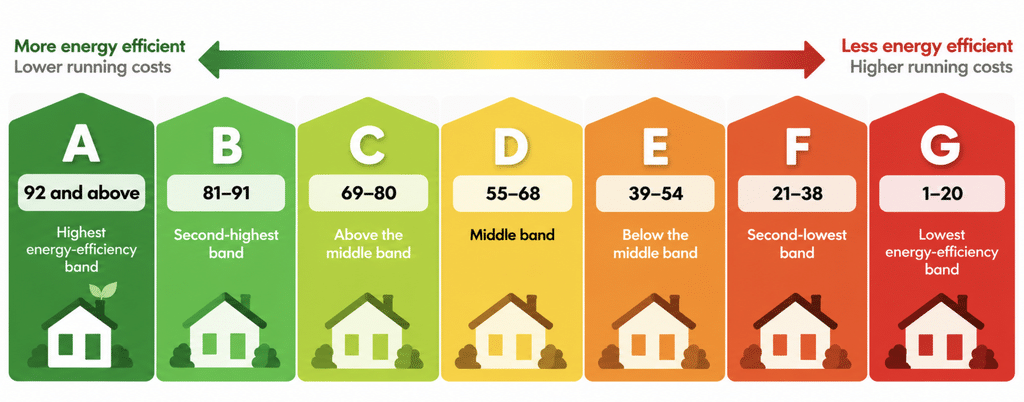
These are the published domestic EPC band boundaries.
The boundaries are useful, but they should not distract from the score itself. For example, a home scoring 68 is in band D, while one scoring 69 is in band C. The letter changes at that boundary, but the numerical difference is only one point.
Most importantly, these are scores, not efficiency percentages. A home scoring 85 is not 85% efficient in the same sense as a gas fire with an 85% net-efficiency specification. The two numbers describe different things.
Why certified efficiency figures are important
Our brochure highlights a practical issue: where an appliance’s efficiency is not supported by appropriate certification, its claimed performance may not be the figure used in the SAP calculation.
The official SAP guidance provides the technical detail. For room heaters, suitably certified manufacturer-declared efficiencies should be used where available; otherwise, the relevant default values are taken from SAP’s tables.
The lesson for homeowners is to keep the exact model information and supporting documentation available. A general marketing description is not the same thing as the evidence an assessor needs.
Our brochure identifies the testing standards used for the relevant fire types, including BS 7977-1:2009+A1:2013 and BS EN 613:2021. Your retailer can help identify the documentation for the specific appliance.
Will a new gas fire move my home into a better band?
That cannot be determined from the fire’s brochure page alone. A sensible approach is to ask an accredited energy assessor to consider the proposed change within the property’s overall assessment. For a new-build project, involve the project’s assessor before finalising the heating specification. SAP is used within Building Regulations assessments, but an appliance’s efficiency badge does not establish compliance for the building.
Similarly, do not select a fire solely because its efficiency percentage resembles the score needed for a particular EPC band. An 85% efficient appliance does not award the home 85 points, and an attractive flame picture certainly does not tell you how the building will perform.
The brochure helps you identify the product. The assessment establishes its place in the wider home.
Bringing the Information Together
A useful way to approach our gas brochure is to begin with what your home can accommodate, then consider how you want the fire to look and operate.
First, establish the appropriate fuel and flue arrangement. Next, discuss heat output and compare efficiency figures on a consistent basis. Then explore the choices that shape the everyday experience: the fuel bed, liners and controls.
Finally, understand the warranty and keep the product documentation. Where SAP or an EPC assessment is relevant, make that information available to the assessor.
A showroom visit is an opportunity to turn those small symbols into practical questions. Ask to see the different liners, try the controls and discuss the intended installation. The final suitability and installation of the appliance should be confirmed by an appropriately qualified Gas Safe registered engineer.
Explore the Charlton & Jenrick gas collection with your local retailer, and choose a fire with a clear understanding of its appearance, performance and suitability for your home.