When trouble flares in the Middle East, it can feel distant until it reaches UK homes through higher petrol and diesel prices, energy market volatility, and another round of anxiety about bills and the cost of living. The latest IEA reporting says the March 2026 conflict has already disrupted oil markets enough for member countries to release emergency stocks.
The Strait of Hormuz remains one of the world’s most critical energy chokepoints, with roughly 20 million barrels a day of oil and oil products moving through it in 2025, and major LNG volumes exposed to it. For UK households, the issue is not that every therm of gas or litre of fuel comes directly from the Gulf. It is that Britain still buys into global energy markets, and Ofgem says wholesale energy remains the largest component of a customer’s bill.
The 1970’s Oil Crisis
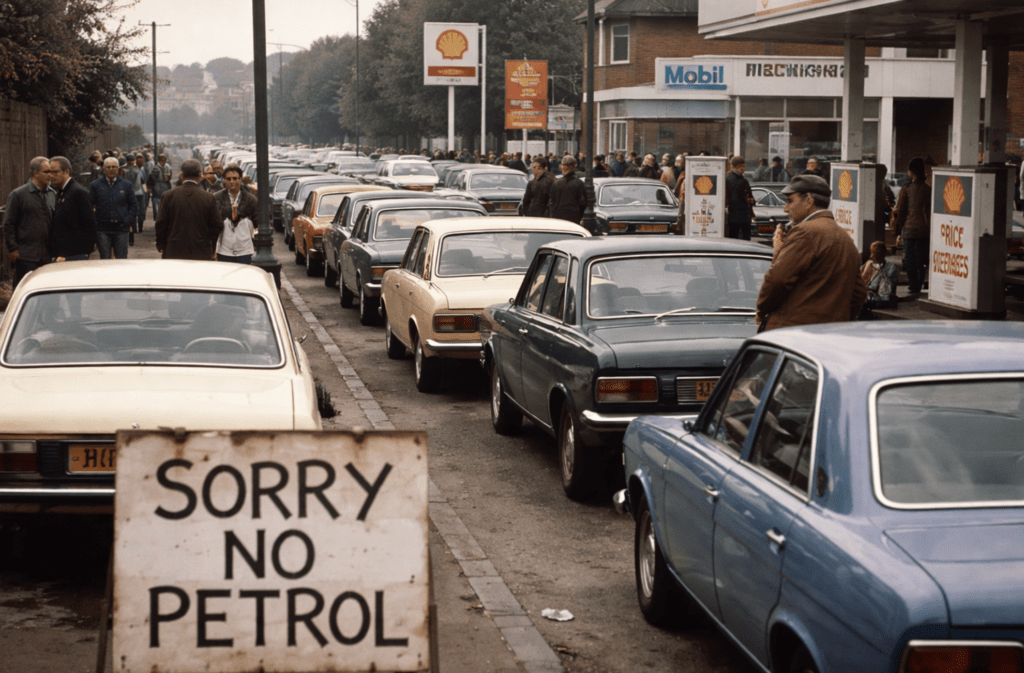
That is why this moment feels familiar. Not identical to the 1970s, but familiar enough to be worth paying attention to. The 1973–74 oil crisis exposed how vulnerable advanced economies were to events far beyond their borders; it was serious enough to prompt the creation of the IEA (International Energy Agency). In the UK, that global shock collided with domestic industrial unrest and fuel constraints. Emergency powers were taken under the Fuel and Electricity (Control) Act 1973, and by early 1974, the country was operating under the three-day week for many businesses. For households, the era became known for dimmer evenings, curtailed work, queues, uncertainty, and the real sense that normal life could be severely disrupted by energy scarcity.
The Good News
The good news is that the UK in 2026 is not the UK in 1974. Our electricity system is more diverse, and DESNZ’s (Department for Energy and Net Zero) latest UK Energy in Brief says renewables now account for 50.4% of generation. NESO’s (National Energy System Operator) Winter Outlook 2025/26 said electricity margins were expected to remain adequate and within the Reliability Standard. But that does not mean households are insulated from shocks. Heating in the UK is still heavily tied to gas: the House of Commons Library reports that 73% of households use mains gas as their only central heating source. And the current Ofgem cap for a typical direct-debit dual-fuel household from 1 April to 30 June 2026 is £1,641 a year, with average unit rates of 24.67p/kWh for electricity and 5.74p/kWh for gas. In other words, the system is stronger than it was in the 1970s, but household budgets are still highly sensitive to energy prices.
So what should being “energy aware” mean in 2026? Above all, it should mean resisting panic and focusing on controllable things. The lesson of the 1970s is not to rush out and hoard. It is to reduce exposure. The homes that cope best with volatile markets are usually not the homes with the biggest boilers or the highest heat output. They are the homes that need fewer kilowatt-hours in the first place, use their controls properly, and have more than one sensible way to keep key living spaces warm. The government’s new Warm Homes Plan is built on exactly that idea: lower long-term bills by improving insulation, heating systems and home performance, while GOV.UK’s home-energy service points households towards upgrades, estimated savings and next steps.
Increasing Your Household’s Efficiency
The first and cheapest place to start is almost always heat demand. Every pound saved before the heat is generated is a pound you do not have to chase later with a more expensive appliance or tariff. That means draught-proofing obvious gaps, keeping curtains closed on cold evenings, insulating where possible, checking whether a hot-water cylinder jacket is missing or too thin, and making sure radiators are not blocked by sofas or drying laundry. Adjusting heating and hot-water controls are among the quickest ways to use less energy while staying warm.
The next step is to get more from the heat you already pay for. Many households still overspend because their heating systems are working harder than they need to. Using controls to find your lowest comfortable setting rather than simply turning everything up is an idea many people are simply not aware of; we suggest starting around 21 °C and stepping down gradually to find the lowest temperature you feel comfortable. We suggest not dropping to any lower than 16 °C. Energy awareness is not about enduring a cold house. It is about heating smarter.
Zone Heating
This is where room-by-room heating becomes especially valuable. In the 1970s, many households ended up informally zoning their homes, keeping one room warm and letting the rest of the house run cooler. In 2026, we can do that more deliberately and more comfortably. If you spend most winter evenings in one main living space, it rarely makes sense to heat every room to the same level for the same number of hours. A secondary heat source in the room you actually use can give you flexibility: central heating for baseline comfort and frost protection, with focused heat where the family is sitting, reading, working or relaxing. That approach can be about resilience as much as economy. It gives you options when prices move, without forcing you to choose between whole-house heating and going cold.
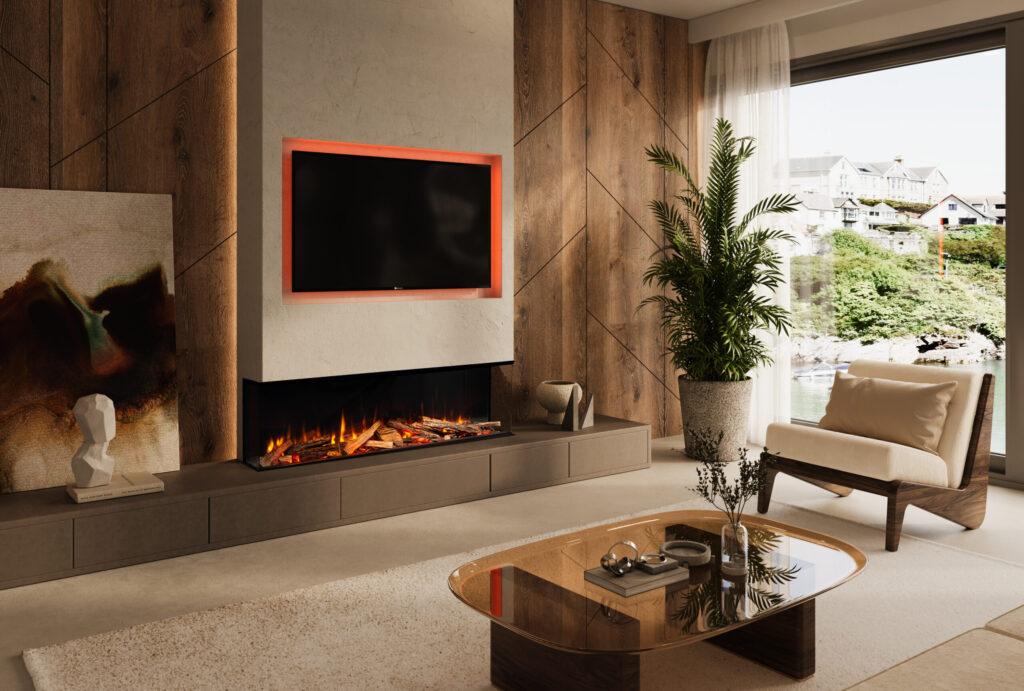
For some homes, a modern electric fire is part of that answer. Electric fires can suit highly efficient homes where a very high heat output is not necessary. That does not make electric heating the cheapest whole-house solution, but it can make it a very practical and controllable top-up heat source in the rooms you use most. For households that want visual comfort, simple installation and precise control, that matters.
Below is an electric fire from our range – the iRange i1500e Deep
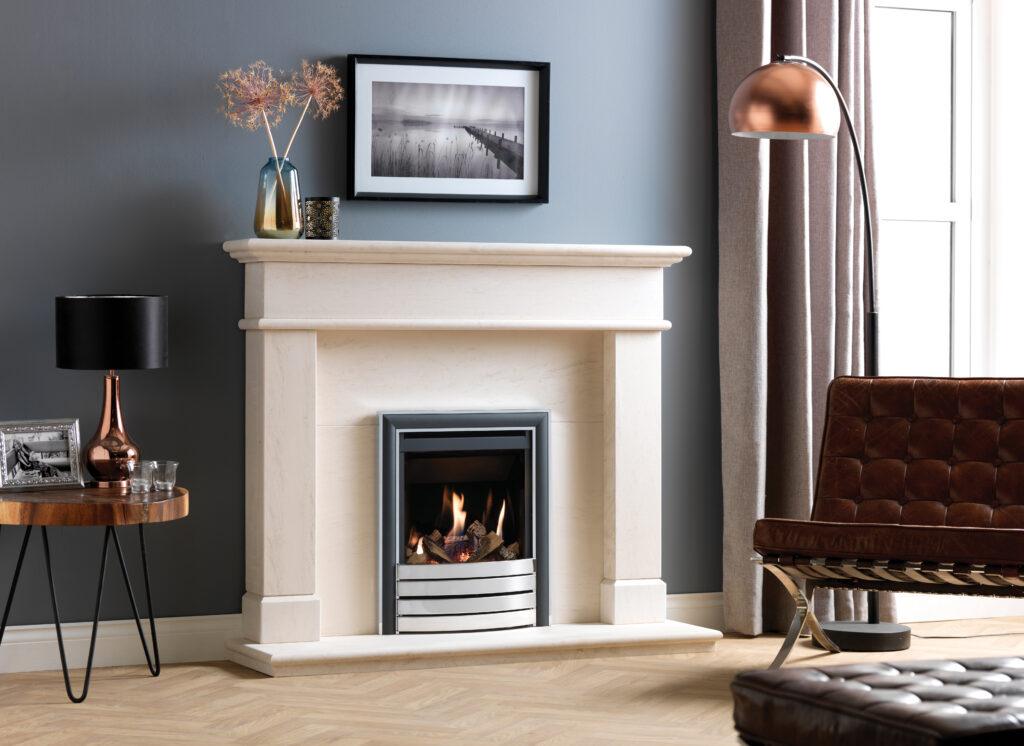
For other homes, gas room heating has more of a place. Our glass-fronted gas fires start at around 77% efficiency, with some models exceeding 90%. Again, the value here is controllability. When used as part of a layered heating strategy, an efficient gas fire can quickly warm a living room without raising the entire house to the same temperature. And for households comparing today’s appliances with old open fires, the jump in useful heat and reduction in waste is significant.
Below is a gas fire from our range. The Paragon Core BF Balanced Flue.
What about wood?
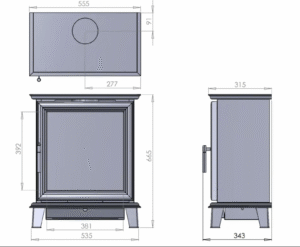
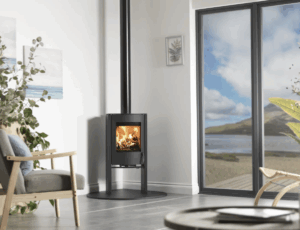
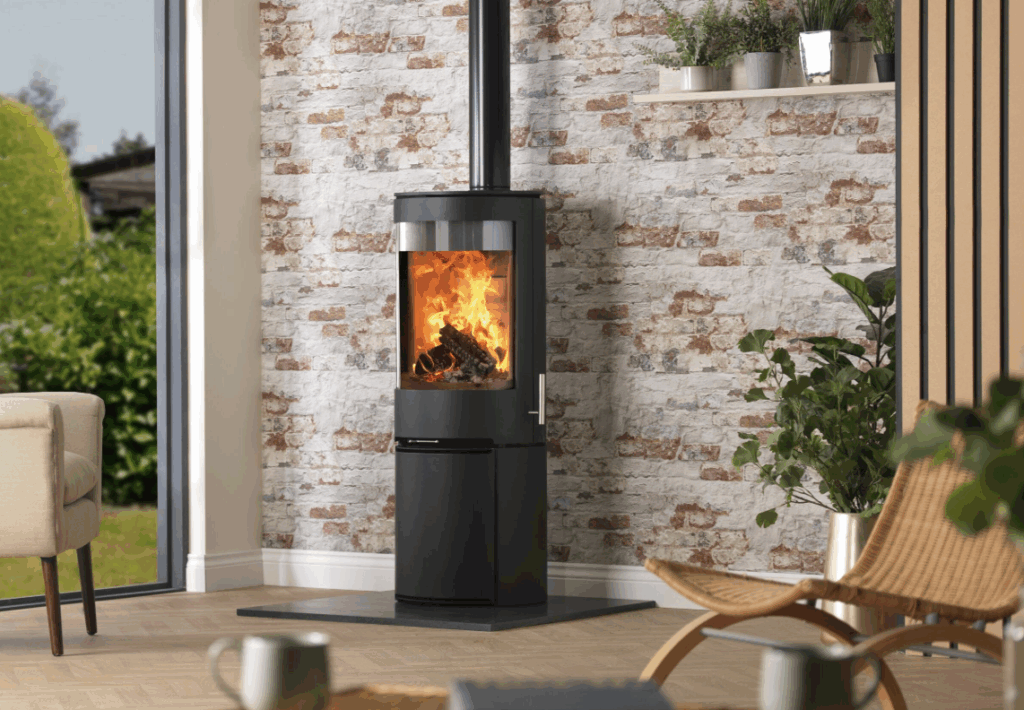
Wood-burning stoves deserve a separate mention, because they speak directly to one of the biggest emotional themes in any energy crisis: control. A modern Ecodesign stove is very different from the old, inefficient solid-fuel appliances many people remember from decades ago. Ecodesign regulations set minimum seasonal-efficiency and maximum-emission requirements for solid-fuel appliances. They provide more useful heat from less fuel, lower running costs and compliance with modern rules. For households that want a complementary heat source, a modern Ecodesign-ready stove can be part of the plan. The great advantage of wood is that it’s not subject to the market fluctuations of gas and electricity. Once you have your wood stored and ready to burn, you can relax as it’s bought and paid for in advance.
Below is a wood-burning stove from our range. The PVR Cylinder Stove.
Preparation
The other lesson from the 1970s is that preparation matters most before restrictions arrive, not during them. The government’s Prepare campaign says that, in the unlikely event of a national energy shortage, emergency power cuts could be scheduled by load block for around three hours at a time. It also advises keeping a battery or wind-up torch at home, not relying on candles, storing bottled water and non-perishable food, keeping a radio, and knowing that many gas boilers, heat pumps, hobs and broadband services will not work during a power cut. A small amount of planning can make a short disruption far less stressful.
If anyone in the home is older, disabled, pregnant, recovering from illness, has young children, or depends on electrically powered medical equipment, registering for extra support should be a priority now. Ofgem says suppliers and network operators both run Priority Services Registers, which can provide priority support in an emergency, advance notice of planned outages where possible, help with communications and other practical assistance. Energy awareness is not only about efficiency. It is also about vulnerability, health and knowing who may need help first if conditions tighten.
In the 1970’s, the UK learned the hard way that energy security is not an abstract policy topic. It reaches into kitchens, sitting rooms, school runs, pay packets and public confidence. Today we are better prepared as a system, with more diverse electricity generation, better data and more efficient products. But households still benefit from the same basic discipline: use less heat where you can, waste less where you cannot, and build flexibility into how you stay warm. In 2026, being energy aware does not mean living in fear of restrictions. It means making sensible choices now so that, if markets stay volatile or supplies tighten, your home remains safe, warm and affordable to run.